



A lower rate is not automatically a better deal. Break-even and total interest tell you if refinancing pays off.
Updated November 2026
The question refinancing answers
Refinancing swaps your current loan for a new one, usually to get a lower rate. It costs money up front, so the real question is how long it takes for the savings to cover the costs. That is the break-even point. Try your figures in the refinance calculator.
Worked example
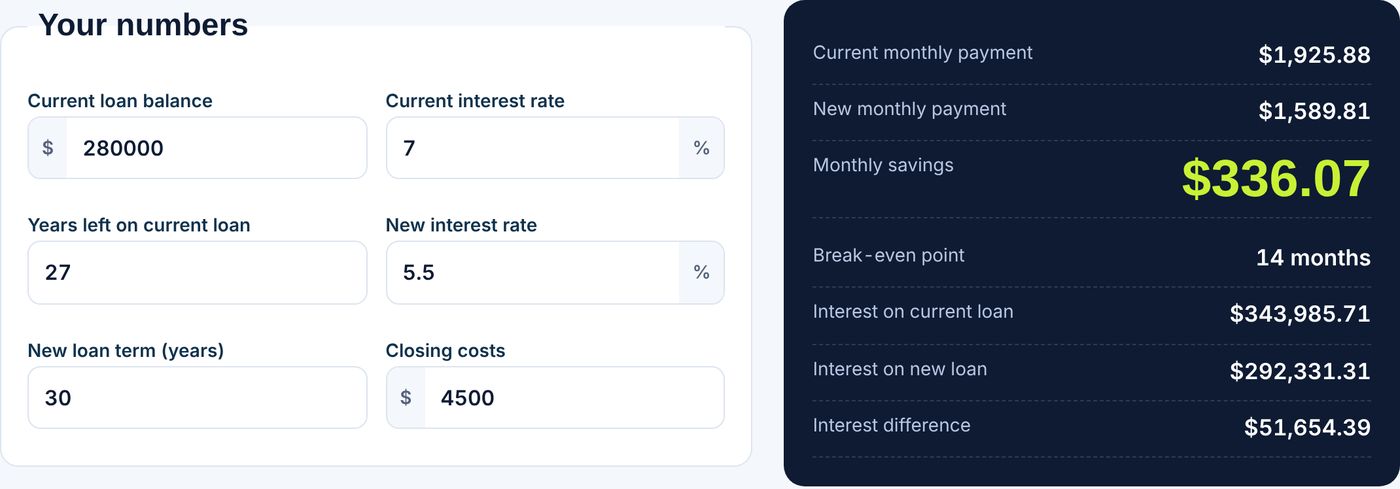
You owe $280,000 at 7% with 27 years left. The payment is $1,925.88. A new 30-year loan at 5.5% would cost $1,589.81 a month, a saving of $336.07. If closing costs are $4,500, break-even is $4,500 / $336.07 = 14 months… rounded up, 14 months, or about 1.2 years. If you will keep the loan longer than that, the monthly saving pays back the costs.
The catch: resetting the term
The new loan runs 30 years, three longer than the old one. Total interest on the current loan from here is $343,985.71. On the new loan it is $292,331.31. The difference is $51,654.39, and part of the benefit comes from the lower rate, part from stretching payments. To avoid extending the term, compare against the same remaining years: a 27-year option would raise the new payment.
Excel formulas
Current payment: =PMT(7%/12,27*12,-280000). New payment: =PMT(5.5%/12,360,-280000). Savings: subtract. Break-even months: =ROUNDUP(4500/savings,0). Total interest on a loan: =PMT(rate/12,months,-balance)*months-balance. Microsoft explains the PMT function. For vehicle loans use our auto loan refinance calculator and the guide on when to refinance an auto loan.
Costs to include
- Origination, appraisal, title and recording fees. The CFPB explains closing costs and the Closing Disclosure.
- Prepayment penalty on the old loan, if any.
- Any points you pay to lower the rate.
A quick decision checklist
- Get the new rate and fees in writing as a loan estimate.
- Calculate payment, break-even months and total interest.
- Decide how long you will realistically keep the loan.
- Compare against making extra payments on the current loan.
If break-even is longer than your expected time in the home, the answer is usually no. If it is much shorter and the term is not extended, it is usually worth a closer look.
When it does not make sense
Skip or delay a refinance if you plan to move before break-even, if the rate drop is small, or if the longer term raises total interest more than you value the monthly saving. Also compare an extra-payment plan with the mortgage payoff calculator. Illustrations only, not financial advice.
Frequently asked questions
How do I calculate the break-even on a refinance?
Divide total closing costs by the monthly payment saving. $4,500 / monthly saving gives the months needed.
Is refinancing worth it?
It can be if you keep the loan beyond the break-even point and the new term does not add more interest than you save.
Does resetting to 30 years cost more?
Often yes in total interest, even with a lower rate. Compare total interest on both loans.
What costs should I include?
Lender fees, appraisal, title, recording, points and any prepayment penalty on the old loan.
Related: Cash-out refinance calculator
Related: VA Loan Refinance Calculator