
Contractor Bid Calculator
Add up the job’s materials, labor and subs. Set your overhead, contingency and the profit margin you want. You get a bid price, a breakdown you can trust, a margin check and a message to send the client.
Your rates (change to match your company)
How the bid is built
Most under-priced bids skip one of these layers. Each one is added in order, so you can see exactly what pays for what.
1. Direct cost
Materials plus sales tax, labor hours × your labor cost plus burden, subcontractors, equipment and other job costs. This is what the job itself costs you.
2. Overhead and contingency
Overhead covers the office, trucks, insurance and your salary. Contingency is a cushion for surprises behind the walls. Both are a % of direct cost.
3. Profit, then permits
By margin: price = cost ÷ (1 − margin). By markup: price = cost × (1 + markup). Permits are added last at cost, with no profit on them.
Markup vs margin for contractors
They are not the same number. A 25% markup only earns a 20% margin. If you want a 25% margin, you need a 33.3% markup. Use these tables to convert.
If you mark up by…
| Markup | Your margin | $10,000 cost bids at |
|---|
To earn a margin of…
| Margin | Markup needed | $10,000 cost bids at |
|---|
Track every job after you win it
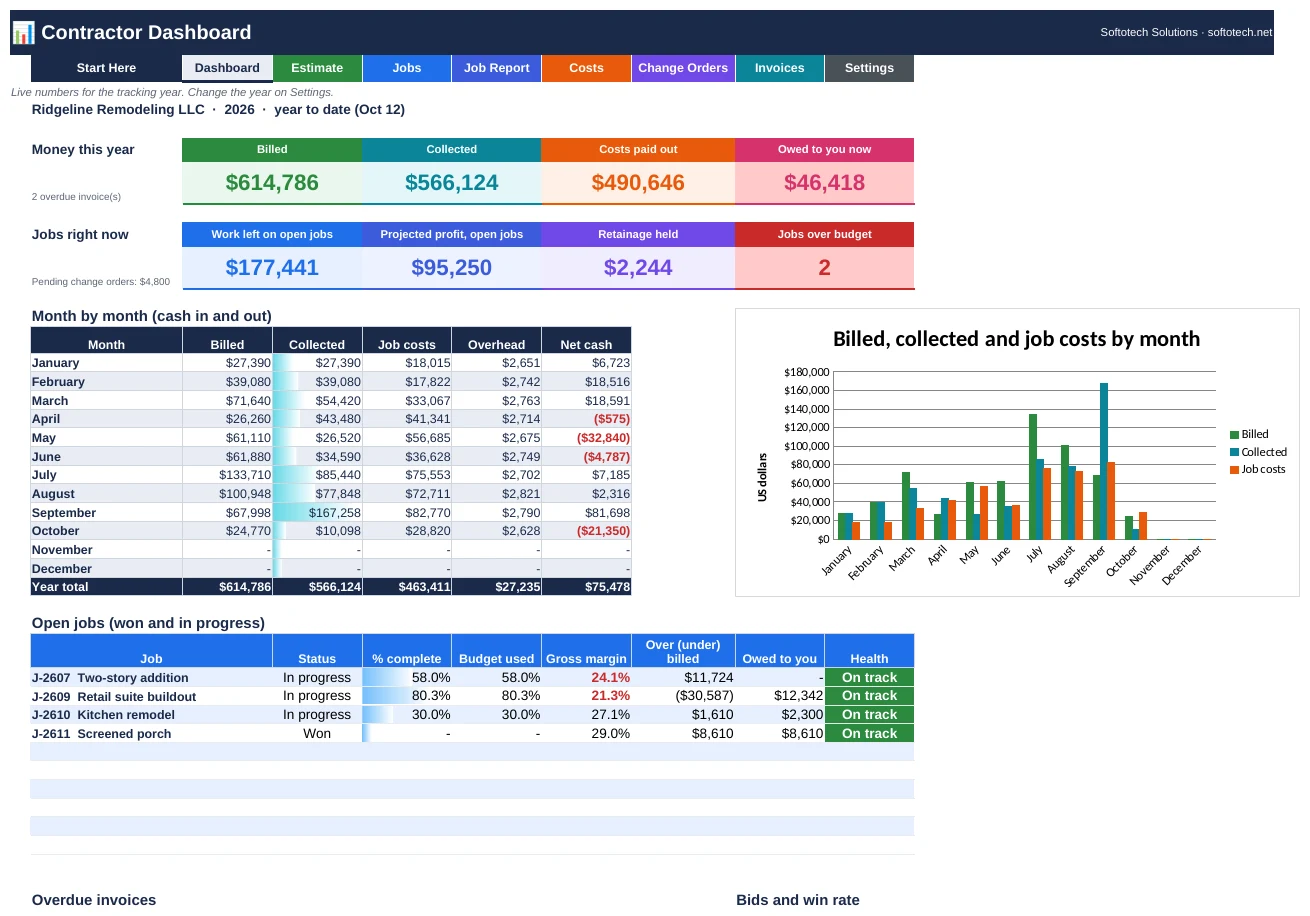
The Contractor Job Costing & Estimate spreadsheet has a line-item version of this bid builder, plus jobs, costs, change orders and invoices in one file. Excel and Google Sheets.
- Budget vs actual on every job, with over-budget jobs flagged red
- Change orders that update the contract and the budget
- Progress billing with retainage, over and under billing and overdue alerts
- A job report with cost by cost code, and a dashboard with your win rate
$34 one-time, instant download
Questions
How much should a contractor mark up a job?
Many remodelers aim for a 10% to 20% profit margin after overhead, which works out to roughly a 35% to 50% markup on direct cost once overhead and contingency are included. Your number depends on your overhead, your market and the job’s risk. Price by margin so the profit you see is the profit you keep.
What is the difference between markup and margin?
Markup is profit as a % of cost. Margin is profit as a % of the price. On a job that costs $10,000 and sells for $12,500, the markup is 25% and the margin is 20%.
What counts as overhead?
Costs you pay whether or not a job is running: insurance, trucks, office, software, marketing, your own salary. Add up a year of overhead and divide by a year of direct job costs to get your overhead %.
How much contingency should I add?
3% to 10% of direct cost is common. Use more on old homes, remodels with unknowns behind the walls, and fixed-price jobs. Use less on new work with a clear scope.
Is my information saved or sent anywhere?
No. Everything is calculated in your browser and nothing is stored or sent.
More free calculators
Price a job, check a deal or test a loan in seconds. No sign-up.