



Pick a percentage with numbers, not guesses. Here is how match, paycheck amount and the IRS limit fit together.
Updated November 2026
Three numbers decide your contribution
How much to put into a 401(k) comes down to your salary, your employer’s match and the IRS limit. Use the 401k contribution calculator to turn a percentage into dollars per paycheck, match and annual total.
Step 1: Get the full match
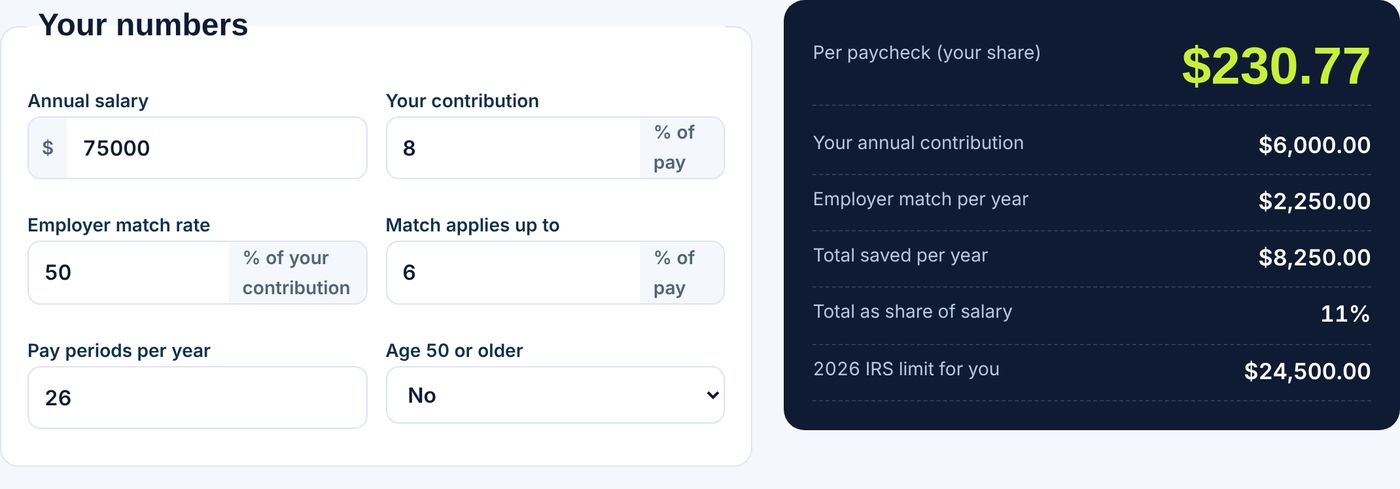
An employer match is part of your pay. Say you earn $75,000 and your employer matches 50 cents per dollar on the first 6 percent you contribute. The match covers contributions up to 6 percent of pay, which is $4,500, so the match is at most $2,250 a year. If you contribute only 3 percent ($2,250), you receive $1,125 and leave $1,125 unclaimed. Check your plan’s exact formula, since matches vary by employer and some have vesting schedules.
Step 2: Choose a percentage
At 8 percent of $75,000 you contribute $6,000.00 a year. That is $230.77 per paycheck with 26 pay periods. Because it is above the 6 percent the employer matches, the match is the full $2,250.00. Total saved is $8,250.00, which is 11 percent of salary. At 6 percent you would contribute $4,500.00 and still receive $2,250.00, so the extra 2 percent costs $1,500.00 for no extra match.
Step 3: Check the IRS limit
The IRS sets a yearly cap on employee deferrals and a higher cap for people 50 and older. The current figures are published on the IRS page on 401(k) contribution limits. For 2026 the employee limit is $24,500, with an $8,000 catch-up for those 50 and older, per that page when we checked. Check it again each year because limits change. Our calculator caps your contribution at the limit and shows when you reach it.
Excel formulas
With salary in B1, contribution percent in B2, match rate in B3, match cap percent in B4 and pay periods in B5:
=MIN(B1*B2,24500) your annual contribution (C1).
=MIN(C1,B1*B4)*B3 employer match.
=C1/B5 your share per paycheck.
With the sample values these return $6,000.00, $2,250.00 and $230.77. Microsoft’s page on the MIN function explains the cap logic.
Traditional vs Roth
Traditional contributions reduce taxable pay now and are taxed on withdrawal. Roth contributions are taxed now and may be tax-free later if rules are met. Both count toward the same limit. The right mix depends on your tax situation, so consider talking to a tax professional.
What your savings could become
Once you know the yearly total, project it forward with the 401k savings calculator or read how to estimate your 401k balance at retirement. The growth rate is an assumption, so run a conservative and an optimistic case.
Common mistakes
- Contributing below the match threshold.
- Forgetting that match formulas differ, such as dollar-for-dollar up to 3 percent.
- Ignoring vesting. Unvested match can be lost if you leave.
- Not raising the percentage after raises. Increase by 1 point each year.
Illustrations only, not tax or investment advice.
Frequently asked questions
How much should I contribute to my 401(k)?
At least enough to get the full employer match. After that, raise it as your budget allows, up to the IRS limit.
How is an employer match calculated?
It is a share of your contribution up to a cap. 50 percent of the first 6 percent on $75,000 is at most $2,250.
What is the 2026 401(k) limit?
$24,500 for employees, plus $8,000 catch-up at 50 or older, according to the IRS page. Check for updates yearly.
How do I find the amount per paycheck?
Divide your annual contribution by your number of pay periods. $6,000 / 26 is $230.77.