



Refinancing a car loan can save real money, but a lower payment alone does not prove it. What matters is the break-even point and the total cost. This guide shows how to check both with one worked example.
Updated November 2026
What refinancing does
When you refinance a car loan, a new lender pays off the old one and you make payments on the new loan. The goal is usually a lower rate, a lower payment, or both. The CFPB notes that when you refinance you must pay off the original loan in full and may owe a fee if your current agreement has a prepayment penalty. Your contract and state law decide whether early payoff is allowed without penalty.
The three numbers to compare
- Monthly saving: current payment minus new payment.
- Break-even point: upfront fees divided by the monthly saving.
- Total saved after fees: what you would pay on the old loan minus what you would pay on the new one, including fees.
Worked example
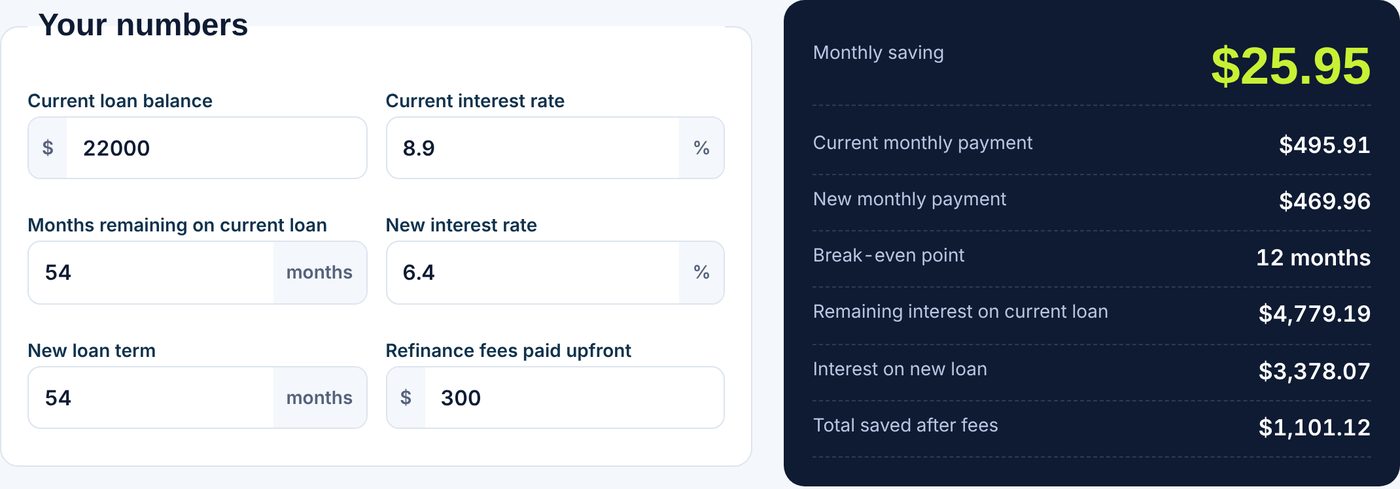
Illustration only, not a quote. You owe $22,000 at 8.9 percent with 54 months left. A lender offers 6.4 percent for 54 months with $300 in fees paid upfront.
| Current loan | New loan | |
|---|---|---|
| Rate | 8.9% | 6.4% |
| Monthly payment | $495.91 | $469.96 |
| Interest over 54 months | $4,779.19 | $3,378.07 |
The monthly saving is $25.95. Fees of $300 divided by $25.95 gives about 11.6, so you break even in 12 months. Over the full 54 months you pay $26,779.19 on the current loan against $25,678.07 on the new loan including fees, a net saving of $1,101.12.
The longer-term trap
Stretching the term lowers the payment but not always the cost. Suppose the same $22,000 at 6.4 percent runs 72 months instead of 54. The payment drops to $368.77, a saving of $127.14 a month against the current loan. But you would pay $26,851.58 in total including fees, compared with $26,779.19 for the 54 months left on the current loan, so you pay $72.39 more overall. Always compare total cost, not just the monthly figure.
How to calculate it in Excel
Current payment: =PMT(0.089/12,54,-22000). New payment: =PMT(0.064/12,54,-22000). Break-even months: =ROUNDUP(300/(B1-B2),0). Net saving: =B1*54-(B2*54+300). Or use the auto loan refinance calculator to see all of it at once.
When refinancing tends to make sense
- Your credit has improved since you took the loan, or market rates have fallen.
- You can get a meaningfully lower rate with low fees.
- You plan to keep the car beyond the break-even point.
- You can keep the term close to what is left.
When to be cautious
- The loan is nearly paid off, so there is little interest left to save.
- You owe more than the car is worth, which can make approval harder or the rate higher.
- The lender adds products or fees that offset the saving.
Costs people overlook
Look for a lien recording or title fee, a new-loan origination fee, and any prepayment penalty on the current loan. Add all of them to the upfront fees you enter in the break-even formula. Also check whether the new lender requires specific insurance coverage, since a higher premium can eat into the saving.
Checklist
- Get your current payoff amount and check for a prepayment penalty.
- Collect several offers and compare the APR, which includes fees. The APR calculator can help.
- Calculate the break-even and total saving for each.
- Check the CFPB’s auto loan tools, which advise comparing interest rates and terms and note that terms are negotiable.
- If you want to pay the loan off faster instead, try the loan payoff calculator.
Frequently asked questions
How do I know if refinancing my car loan is worth it?
Compare the monthly payment and total cost of both loans, including fees. Divide the fees by the monthly saving to find the break-even point.
Can I refinance an auto loan with no fees?
Some lenders charge no origination fee, but check for title and lien fees and for any prepayment penalty on your current loan.
Does refinancing hurt my credit?
Applying usually involves a credit inquiry and a new account, which can have a small short-term effect. Ask each lender whether it checks your credit with a soft or hard inquiry before you apply.
Should I lengthen the term when I refinance?
It lowers the payment but usually raises total interest. Keep the term close to the time remaining if your goal is to save money.