


A weighted GPA gives extra points to harder classes, such as honors and Advanced Placement courses, so that a B in a difficult class can count as much as an A in a standard one. It also usually weights each course by its credits, so a four-credit class counts more than a one-credit class. Many high schools report both a weighted and an unweighted GPA, and colleges often look at both. This guide explains the formula, shows a full five-course example with every step, gives the Excel formula, and shows how to work out the grade you need next term to reach a target. The grade scale and the extra points differ from school to school, so always check your own school policy.
Updated November 2026
In this guide
- Weighted and unweighted GPA
- The formula
- Common grade point scale
- Example: five courses
- Step 1: find the grade point for each course
- Step 2: multiply by the credits
- Step 3: add up and divide
- Step 4: compare with the unweighted GPA
- Excel formula for weighted GPA
- Add a column for the course type
- What grade do I need next term?
- When courses have different credits
- What colleges look at
- Common mistakes
- Practice problems
- Quick recap
Weighted and unweighted GPA
An unweighted GPA uses the standard four-point scale, where A is 4.0, B is 3.0, C is 2.0, D is 1.0 and F is 0. Every course is treated the same, whether it is easy or hard. A weighted GPA adds a bonus for harder courses. A common system adds 0.5 for honors and 1.0 for AP or International Baccalaureate courses, so an A in an AP class counts as 5.0. Because of this, a weighted GPA can be higher than 4.0. Some schools use a different scale, for example a five-point or a six-point scale, so read your school handbook.
The formula
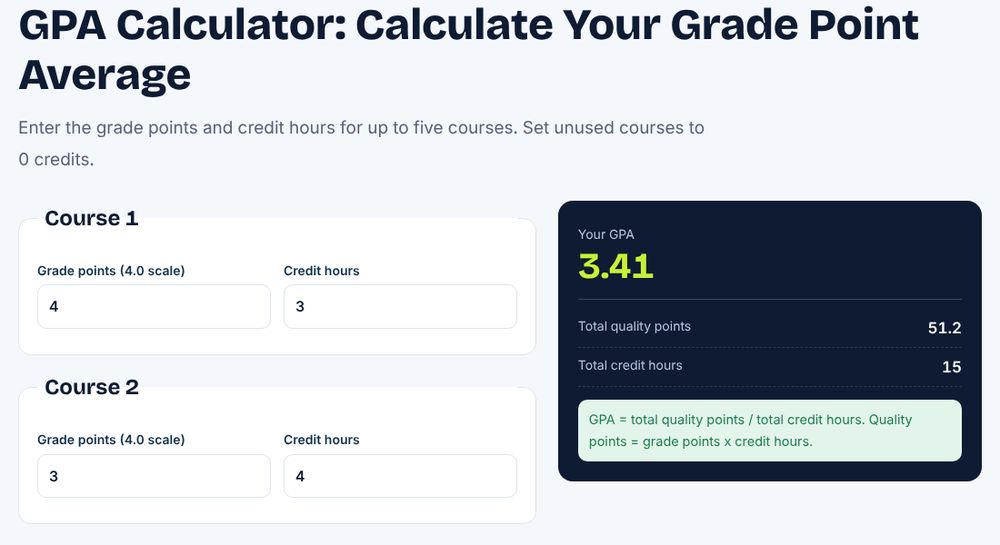
The weighted GPA is the sum of credits times grade points, divided by the total credits. In words: multiply each course grade point, including any bonus, by the credits of that course, add the results, and divide by the sum of all credits. As a formula, GPA equals the sum of credits times points, divided by the sum of credits. If all courses have the same credits, you can simply average the grade points. Our weighted average guide explains the general idea behind this calculation.
Common grade point scale
This is a typical scale, but schools differ, so use your own.
| Letter | Standard points | Honors (+0.5) | AP (+1.0) |
|---|---|---|---|
| A | 4.0 | 4.5 | 5.0 |
| B | 3.0 | 3.5 | 4.0 |
| C | 2.0 | 2.5 | 3.0 |
| D | 1.0 | 1.5 | 2.0 |
| F | 0.0 | 0.0 | 0.0 |
Many schools do not add a bonus to a failing grade, which is why F stays at 0. Some schools also use plus and minus grades, such as A minus at 3.7 and B plus at 3.3. Check how your school treats them.
Example: five courses
A student takes five courses. English has 3 credits, and the grade is an A in a standard class. Biology has 4 credits, the grade is a B and it is an honors class. Calculus has 4 credits, the grade is an A and it is an AP class. History has 3 credits, and the grade is a B in a standard class. PE has 1 credit, and the grade is an A in a standard class. The total credits are 3 plus 4 plus 4 plus 3 plus 1, which is 15. We will find the weighted and the unweighted GPA.
Step 1: find the grade point for each course
Use the table above. English is an A in a standard class, so 4.0. Biology is a B in an honors class, so 3.0 plus 0.5, which is 3.5. Calculus is an A in an AP class, so 4.0 plus 1.0, which is 5.0. History is a B in a standard class, so 3.0. PE is an A in a standard class, so 4.0. Write the points next to each course so that you can check them later.
Step 2: multiply by the credits
Multiply each grade point by its credits. English is 4.0 times 3, which is 12.0. Biology is 3.5 times 4, which is 14.0. Calculus is 5.0 times 4, which is 20.0. History is 3.0 times 3, which is 9.0. PE is 4.0 times 1, which is 4.0. These products are called quality points. A quality point total shows how much each course adds to the overall result.
Step 3: add up and divide
Add the quality points: 12.0 plus 14.0 plus 20.0 plus 9.0 plus 4.0 equals 59.0. Divide by the total credits of 15. The weighted GPA is 59.0 divided by 15, which is 3.9333, so 3.93 when rounded to two decimals. A GPA over 3.9 on a four-point scale looks very strong, but this one is on a weighted scale, so it is not directly comparable with an unweighted 3.9. Always say which one you mean when you report it.
Step 4: compare with the unweighted GPA
For the unweighted GPA, use the standard points: A is 4.0 and B is 3.0, with no bonus. The quality points are English 12.0, Biology 3.0 times 4 which is 12.0, Calculus 4.0 times 4 which is 16.0, History 9.0 and PE 4.0. The total is 12.0 plus 12.0 plus 16.0 plus 9.0 plus 4.0, which is 53.0. Dividing by 15 gives 3.5333, or 3.53. So the honors and AP bonuses add about 0.40 to the GPA, from 3.53 to 3.93.
Excel formula for weighted GPA
List the credits in B2:B6 and the grade points, including bonuses, in C2:C6. Then use =SUMPRODUCT(B2:B6,C2:C6)/SUM(B2:B6). SUMPRODUCT multiplies each pair and adds the results, so it gives 59 divided by 15, which is 3.9333. Format the cell with two decimals. To get the points from the letter, add a small lookup table with the letters and the points, and use =XLOOKUP(D2,Scale[Letter],Scale[Points])+E2, where E2 is the bonus. See our XLOOKUP guide for the details.
Add a column for the course type
To make the sheet easy to use, add a column called Type with a drop-down of Standard, Honors and AP. Add a small table that gives the bonus for each type: 0, 0.5 and 1.0. Then the grade point is the standard points plus the bonus looked up from the type. Change the bonus values if your school uses a different rule, and every result updates. This is much safer than typing the points by hand, since one typing mistake can change the GPA. Our drop-down list guide shows how to build the list.
What grade do I need next term?
Suppose you want a cumulative weighted GPA of 3.8 after 30 credits. You need 3.8 times 30, which is 114 quality points in total. You already have 59 from the first 15 credits, so you need 114 minus 59, which is 55 quality points from the next 15 credits. That is 55 divided by 15, or 3.67, on average. In other words, you need a mix of A grades in weighted classes and B grades in standard ones, such as mostly A and B plus. Use the same method for any target. For a quick check, try our GPA calculator.
When courses have different credits
Not every school uses credits in the same way. Some schools give every course the same weight, and then the GPA is the plain average of the grade points. Others use credits, hours or units. Colleges often use semester hours, with a lab course that may be 4 hours. If your transcript shows credits, use them. If the courses have equal weight, you can use the average calculator, but the answer is the same as the weighted formula with all credits equal. For the final grade in a single course, see our final grade guide.
What colleges look at
Many colleges recalculate your GPA with their own rules, using only core academic subjects and an unweighted or a weighted scale of their own. So a high weighted GPA at your school may turn into a different number at a college. The course difficulty still matters, because it shows that you challenged yourself. Do not choose a harder class only for the bonus, since a lower grade in an AP class may be worse than a higher grade in a standard class. Talk to your counselor about a balanced schedule.
Common mistakes
The most common mistake is to average the grade points without using the credits, when the school uses credits. Another is to add the bonus twice. A third is to give a bonus to a failing grade, when the school does not. A fourth is to mix a weighted and an unweighted result. A fifth is to round each course before the final division, which changes the result slightly. A sixth is to use the wrong scale for plus and minus grades. Calculate with full numbers, and round only the final GPA.
Practice problems
Try these. Problem 1: an A in a 4-credit AP class and a B in a 3-credit standard class give quality points of 20 and 9, which is 29 divided by 7, or 4.14. Problem 2: three standard courses of 3 credits each, with grades A, B and C, give 4.0, 3.0 and 2.0, so the GPA is 3.0. Problem 3: a B in an honors course is 3.5, and in a 4-credit course that is 14 quality points. Problem 4: with 59 points from 15 credits, find the GPA after a further 15 credits with 52 points, which is 111 divided by 30, or 3.70. Problem 5: use the Excel formula for your own courses.
Quick recap
Convert each letter grade to points and add the honors or AP bonus. Multiply each result by the course credits to get quality points, add them up and divide by the total credits. For the example, 59 quality points over 15 credits gives a weighted GPA of 3.93, compared with 3.53 unweighted. In Excel use SUMPRODUCT divided by SUM. To plan, work out the quality points you need for a target GPA and divide the missing points by the credits you still have to take. Always follow your own school scale.
Frequently asked questions
What is a weighted GPA?
It is a GPA that adds extra points for honors and AP classes and usually weights courses by credits.
How do I calculate a weighted GPA?
Multiply each grade point by its credits, add the results and divide by the total credits.
What is a good weighted GPA?
Above 4.0 is common for students in many AP classes, but it depends on the school scale.
Is a 4.5 GPA possible?
Yes, on a weighted scale with honors and AP bonuses.
What is the Excel formula for GPA?
Use SUMPRODUCT of credits and points divided by the SUM of credits.