


A proportion is an equation that says two ratios are equal. For example, 3 over 4 equals 6 over 8. Proportions help you scale a recipe, read a map, convert units, compare prices, work out a percentage and solve many word problems in school and in daily life. The standard way to solve a proportion with a missing number is cross multiplication: multiply across the equals sign in a cross pattern and then divide. This guide explains what a proportion is, shows the steps with several worked examples, covers word problems, shows how to check the answer, gives an Excel formula and lists the common mistakes. Every example has numbers that you can verify by hand.
Updated November 2026
In this guide
- What is a proportion?
- The cross multiplication rule
- Steps to solve a proportion
- Example 1: a missing value
- Example 2: the unknown in the denominator
- Example 3: a recipe
- Example 4: a map scale
- Example 5: percentages as proportions
- Example 6: unit prices and shopping
- Direct and inverse proportion
- Solve a proportion in Excel
- How to check your answer
- Common mistakes
- Practice problems
- Quick recap
What is a proportion?
A ratio compares two quantities, such as 3 apples to 4 oranges, written as 3 to 4 or as the fraction 3 over 4. A proportion states that two ratios are equal, such as 3 over 4 equals 6 over 8. The two ratios look different, but they describe the same relationship, because both reduce to the same fraction. If you multiply the top and the bottom of 3 over 4 by 2, you get 6 over 8. In a proportion of the form a over b equals c over d, the numbers a and d are called the extremes and b and c are the means.
The cross multiplication rule
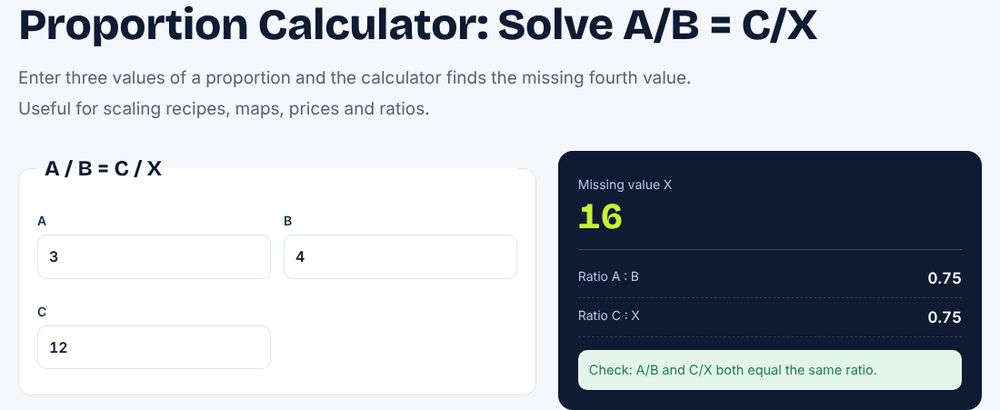
In a true proportion, the products across the equals sign are equal. For a over b equals c over d, it means a times d equals b times c. Test it with 3 over 4 equals 6 over 8. The cross products are 3 times 8, which is 24, and 4 times 6, which is 24. They are equal, so the proportion is true. This property is the basis for solving a proportion with an unknown value, since you can turn the equation into a simple one without fractions.
Steps to solve a proportion
Follow four steps. First, write the proportion with the unknown as x, keeping the same quantities in the same positions on both sides. Second, cross multiply to get an equation. Third, divide both sides by the number that multiplies x. Fourth, check by putting the value of x back into the proportion and comparing the cross products. The most important part is the first step, because a wrong setup gives a wrong answer even when the calculation is perfect.
Example 1: a missing value
Solve 3 over 4 equals x over 20. Cross multiply: 3 times 20 equals 4 times x, so 60 equals 4x. Divide both sides by 4: x equals 15. Check: 3 over 4 is 0.75, and 15 over 20 is also 0.75, so the answer is right. Notice that the denominator went from 4 to 20, which is a factor of 5, and the numerator went from 3 to 15, which is also a factor of 5. A quick way to check is to see whether both sides were multiplied by the same number.
Example 2: the unknown in the denominator
Solve 5 over 8 equals 15 over x. Cross multiply: 5 times x equals 8 times 15, so 5x equals 120. Divide by 5: x equals 24. Check: 5 over 8 is 0.625, and 15 over 24 is 0.625. The method is the same when the unknown is in the denominator. Just be careful to cross multiply in the right order, and to divide by the number that sits with x. If x appears in both a numerator and a denominator, the equation is more complex and needs algebra.
Example 3: a recipe
A recipe for 4 people uses 300 grams of rice. How much is needed for 10 people? Write the proportion with people over rice: 4 over 300 equals 10 over x. Cross multiply: 4x equals 3,000, so x equals 750. You need 750 grams of rice. Check with the unit rate: 300 grams for 4 people is 75 grams per person, and 75 times 10 is 750. Our unit rate calculator finds the rate per unit, which is another way to solve many proportion problems.
Example 4: a map scale
A map scale says that 2 centimeters on the map represent 15 kilometers in real life. Two towns are 7 centimeters apart on the map. How far apart are they? Set up map over real: 2 over 15 equals 7 over x. Cross multiply: 2x equals 105, so x equals 52.5. The towns are 52.5 kilometers apart. Check: 15 divided by 2 is 7.5 kilometers per centimeter, and 7.5 times 7 is 52.5. Always keep the units in the same position on both sides, with map on the top and real distance on the bottom.
Example 5: percentages as proportions
A percentage is a proportion with a denominator of 100. To find 15 percent of 80, write 15 over 100 equals x over 80. Cross multiply: 100x equals 1,200, so x equals 12. To find what percent 18 is of 60, write x over 100 equals 18 over 60. Cross multiply: 60x equals 1,800, so x equals 30, which means 18 is 30 percent of 60. This method is a good way to remember percentage problems without a formula for each case. Our percent error calculator uses a related idea.
Example 6: unit prices and shopping
If 6 bottles of water cost 4.50, how much do 15 bottles cost? Write bottles over cost: 6 over 4.50 equals 15 over x. Cross multiply: 6x equals 67.5, so x equals 11.25. Fifteen bottles cost 11.25. Check: 4.50 divided by 6 is 0.75 per bottle, and 0.75 times 15 is 11.25. Proportions let you compare prices of different pack sizes. Always make sure that the price is per the same unit before you compare.
Direct and inverse proportion
The examples above are direct proportions: when one quantity grows, the other grows by the same factor. In an inverse proportion, when one quantity grows, the other shrinks. For example, if 4 workers finish a job in 6 days, how long will 8 workers take, if they work at the same speed? The total work is 4 times 6, which is 24 worker-days. With 8 workers, the time is 24 divided by 8, which is 3 days. The product stays constant, instead of the ratio. Decide first which type you have, because the setup is different.
Solve a proportion in Excel
Put the known numbers in cells and write the cross multiplication as a formula. For 3 over 4 equals x over 20, put 3 in A1, 4 in B1 and 20 in B2. The unknown is =A1*B2/B1, which gives 3 times 20 divided by 4, or 15. In words, x is the numerator times the opposite denominator divided by the other denominator. For the recipe, with 4 people, 300 grams and 10 people, the formula is =300*10/4, which gives 750. Use cell references so you can change the numbers. See our percent difference guide for more percent formulas.
How to check your answer
There are three simple checks. First, put x back and compare the decimal values of both fractions, as in the examples. Second, check that the cross products are equal. Third, ask whether the answer makes sense: if you have more people, you need more rice, so 750 is more than 300, which is reasonable. If your answer for a larger group is smaller than the original amount, you probably set up the proportion upside down. A quick estimate takes seconds and catches most mistakes.
Common mistakes
The most common mistake is to put the quantities in different positions on the two sides, such as people over rice on one side and rice over people on the other. Another is to cross multiply incorrectly, for example by multiplying the numerators together. A third is to forget the units, so one side is in centimeters and the other in meters. A fourth is to treat an inverse relationship as a direct one. A fifth is to round too early in a long calculation. Write the setup in words first, then put in the numbers.
Practice problems
Try these. Problem 1: solve 2 over 5 equals x over 30. The answer is 12. Problem 2: solve 9 over x equals 3 over 7. The answer is 21. Problem 3: if 5 pens cost 3.50, 12 pens cost 8.40. Problem 4: a photo that is 6 by 4 inches is enlarged so that the width is 15 inches, so the height is 10 inches. Problem 5: if 3 machines make 90 parts in an hour, 7 machines make 210 parts in an hour.
Quick recap
A proportion says that two ratios are equal. To solve for an unknown, write the proportion with the same quantity in the same position on each side, cross multiply, divide by the number with x and check the answer. The method works for recipes, maps, prices and percentages. Use an inverse relationship when more of one thing means less of the other. In Excel, multiply the numerator by the opposite denominator and divide by the other denominator. Setting up the problem carefully is the key to getting it right every time.
Frequently asked questions
What is a proportion?
An equation that states that two ratios are equal.
How do you solve a proportion?
Cross multiply and divide to find the unknown.
What is cross multiplication?
Multiplying the numerator of each fraction by the denominator of the other.
How do you check a proportion?
Check that the cross products are equal.
What is the difference between direct and inverse proportion?
In a direct proportion both quantities grow together, and in an inverse proportion one grows as the other shrinks.