



Your grade point average, or GPA, turns all your course grades into one number. Colleges, scholarship committees and employers use it as a quick summary of academic performance, and you often need it before you apply for something. The good news is that the calculation is simple once you know the three ingredients: the grade you earned in each course, the grade points that grade is worth and the credit hours of each course. This guide walks through unweighted, weighted and cumulative GPA with worked examples you can check by hand, then shows you how to do the same thing in Excel.
Updated November 2026
In this guide
- What GPA means and what you need to calculate it
- The standard four-point grade scale
- The GPA formula, step by step
- Worked example: one semester
- Weighted GPA for honors and AP courses
- How to calculate cumulative GPA
- What GPA do you need to reach a goal?
- Practice problems with answers
- How colleges and employers read your GPA
- Calculate GPA in Excel or Google Sheets
- Common mistakes to avoid
What GPA means and what you need to calculate it
GPA is a weighted average of your grade points. Each letter grade is converted to a number on a scale, and each course counts in proportion to its credit hours. A four-credit science course therefore matters more than a one-credit seminar. Before you start, gather three pieces of information for every course: the letter grade, the credit hours (sometimes called units) and the grading scale that your school uses.
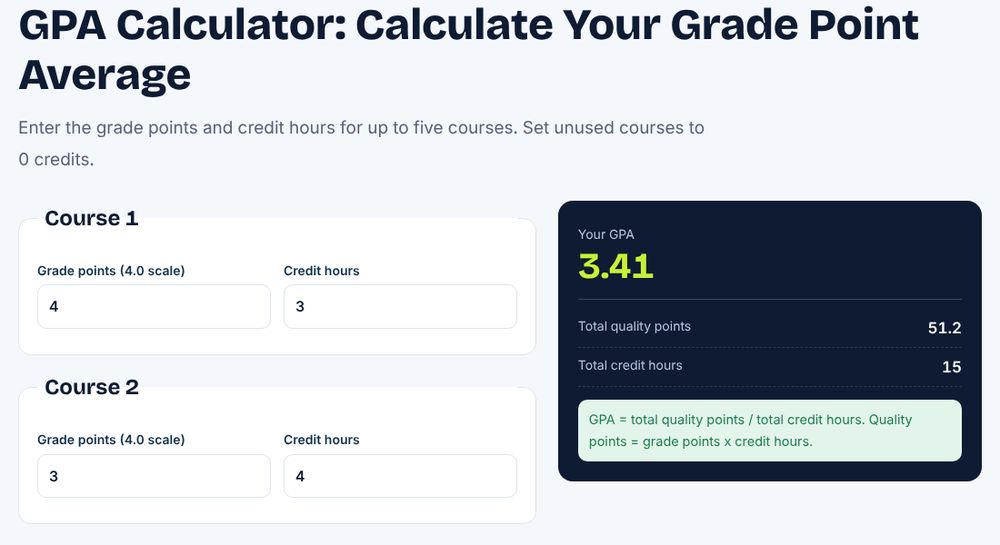
Schools differ in the details. Most United States schools use a four-point scale for unweighted GPA, while some high schools add extra points for honors or Advanced Placement classes. Always check your school’s published scale because a transcript calculated under a different system will not match yours. If you only want a fast answer, our GPA calculator does the arithmetic for up to five courses.
The standard four-point grade scale
The scale below is the one most commonly used for unweighted GPA. Some schools do not award A+ above 4.0 and some do not use plus and minus grades at all, so treat it as a typical example and replace it with your own school’s table when it differs.
| Letter grade | Grade points |
|---|---|
| A | 4.0 |
| A- | 3.7 |
| B+ | 3.3 |
| B | 3.0 |
| B- | 2.7 |
| C+ | 2.3 |
| C | 2.0 |
| C- | 1.7 |
| D+ | 1.3 |
| D | 1.0 |
| F | 0.0 |
The GPA formula, step by step
The formula is: GPA = total quality points divided by total credit hours. Quality points for one course are the grade points multiplied by the credit hours. Follow these four steps.
- Write down every course with its grade and its credit hours.
- Convert each grade to grade points using your scale.
- Multiply grade points by credit hours for each course to get quality points.
- Add all quality points, add all credit hours and divide the first total by the second.
Keep at least three decimal places while you work and round only at the end. Most schools report GPA to two decimal places, so 3.4133 becomes 3.41.
Worked example: one semester
Suppose a student takes five courses in a semester with the grades and credits shown below.
| Course | Grade | Grade points | Credits | Quality points |
|---|---|---|---|---|
| English composition | A | 4.0 | 3 | 12.0 |
| Calculus | B | 3.0 | 4 | 12.0 |
| Chemistry | A- | 3.7 | 3 | 11.1 |
| History | B- | 2.7 | 3 | 8.1 |
| Art workshop | A | 4.0 | 2 | 8.0 |
| Total | 15 | 51.2 |
The semester GPA is 51.2 divided by 15, which equals 3.4133, or 3.41 when rounded. Notice that the calculus grade of B pulls the result down more than the art workshop grade would, because calculus carries four credits against two. You can enter the same numbers into the GPA calculator to confirm the result.
Weighted GPA for honors and AP courses
A weighted GPA gives extra points for harder classes, so a student can earn more than 4.0. A common approach adds 0.5 for honors courses and 1.0 for AP or International Baccalaureate courses, but schools set their own rules, so check the official policy before you use any numbers.
Example with the common method: an A in an AP course counts as 5.0, a B in an honors course counts as 3.5 and an A in a standard course counts as 4.0. If each course has one credit, three courses with those grades give (5.0 + 3.5 + 4.0) divided by 3, which is 12.5 divided by 3, or 4.17. The same three grades without weighting would give (4.0 + 3.0 + 4.0) divided by 3, which is 3.67. Always label which version you are quoting so that readers do not confuse the two.
How to calculate cumulative GPA
Cumulative GPA covers every course you have taken, not just one term. You do not average the semester GPAs, because semesters can have different credit loads. Instead add up all quality points from every term and divide by all credit hours.
Example: Semester 1 had 51.2 quality points and 15 credits. Semester 2 had 44.4 quality points and 12 credits. Cumulative quality points are 51.2 plus 44.4, which is 95.6. Total credits are 15 plus 12, which is 27. Cumulative GPA is 95.6 divided by 27, which equals 3.54. If you averaged the two semester GPAs (3.41 and 3.70) you would get 3.555, a slightly different number, which shows why the credit-weighted method is the correct one.
What GPA do you need to reach a goal?
You can work backwards to see what grades you need. Suppose you have 45 credits at a 3.20 GPA, which is 144 quality points, and you will take 15 more credits. To reach a cumulative 3.40 across 60 credits you need 60 times 3.40, which is 204 quality points in total. You already have 144, so you need 60 more from the next 15 credits. That is an average of 60 divided by 15, which is 4.0 for the term, a perfect semester. For a target of 3.30 you need 198 total, so 54 more points, which is an average of 3.6 over the next 15 credits. This kind of check tells you quickly whether a goal is realistic.
Retaking a course can change the picture too. Some schools replace the old grade with the new one and some average both, so confirm the policy with your registrar before you rely on a retake to repair a GPA.
Practice problems with answers
Try these to test yourself. Problem 1: a student earns A (3 credits), B+ (4 credits), C (2 credits) and A- (3 credits). Quality points are 12.0, 13.2, 4.0 and 11.1, a total of 40.3 over 12 credits, so GPA is 3.36. Problem 2: a student has 60 credits at 3.00, which is 180 quality points, and earns a 4.0 in 12 new credits, adding 48 points. New GPA is 228 divided by 72, which is 3.17. Problem 3: what happens if the same student instead earns a 2.0 in 12 credits? Points added are 24, so GPA is 204 divided by 72, which is 2.83. Comparing problems 2 and 3 shows that one semester can move a 60-credit GPA by about 0.17 in either direction, and that the effect shrinks as your credit total grows.
How colleges and employers read your GPA
Admissions offices often recalculate GPA using only core academic subjects and their own scale, so your school’s number may differ from theirs. Scholarship programs commonly set a minimum such as 3.0 or 3.5 and check it at the end of each term, so it is worth running the goal calculation above before the term closes. Employers usually care most about GPA for first jobs and internships and rarely ask about it later in a career. If your overall GPA is lower than you would like, many applications let you list a major GPA or a recent-semester GPA, and you can compute either one with the same formula by limiting the courses you include.
Keep an official copy of your grading scale next to your calculations. If you are an international student, credential evaluation services convert grades from other systems to a four-point scale, and their conversion rules may differ from the simple table in this guide.
Calculate GPA in Excel or Google Sheets
Put grade points in column B and credits in column C, starting at row 2. The weighted average is then =SUMPRODUCT(B2:B6,C2:C6)/SUM(C2:C6). SUMPRODUCT multiplies each pair of cells and adds the products, which gives total quality points in one step. To convert letter grades automatically, create a small table with letters in column F and points in column G, then use =VLOOKUP(A2,$F$2:$G$12,2,FALSE) in column B. If a grade does not match, read our checklist on why VLOOKUP is not working. The same formulas work in Google Sheets.
Common mistakes to avoid
The first mistake is averaging grade points without weighting them by credits, which only works when every course has the same number of credits. The second is mixing scales, for example using weighted grade points for some courses and unweighted for others. The third is rounding too early: if you round every quality point to one decimal place you can drift by a few hundredths. The fourth is including pass or fail courses. Most schools exclude them from GPA although the credits may count toward graduation, so check your policy. Finally, remember that transfer credits sometimes count toward degree requirements but not toward your institutional GPA.
Frequently asked questions
How do you calculate GPA?
Multiply each course grade point value by its credit hours, add the results, then divide by the total credit hours.
What is the difference between weighted and unweighted GPA?
Unweighted GPA uses a plain 4.0 scale. Weighted GPA adds extra points for honors or advanced courses, so it can exceed 4.0.
How do I calculate cumulative GPA?
Add the quality points from all semesters and divide by all credit hours. Do not average semester GPAs.
Is a 3.5 GPA good?
It is generally considered strong, but what counts as good depends on the school, the major and the opportunity you are applying for.
Can I raise my GPA quickly?
The more credits you have already completed, the less each new grade can move your GPA. Use the goal calculation above to see what grades you need.