



An interest-only loan gives you a low payment for a while, and then the bill changes. Understanding the reset before you sign matters more than the starting payment. Here is how the math works, with a worked example.
Updated November 2026
How the payments work
On a standard loan, each payment covers interest and chips away at the balance. On an interest-only loan, for a set period your scheduled payments cover only interest. The Consumer Financial Protection Bureau puts it this way: the amount you owe does not go down with each payment. When the interest-only period ends, you may pay the full balance at once, refinance if that option exists, or begin repaying principal through monthly payments that are higher than the interest-only amount.
The two formulas
B is the balance, i the monthly rate and N the number of months left after the interest-only period.
Worked example
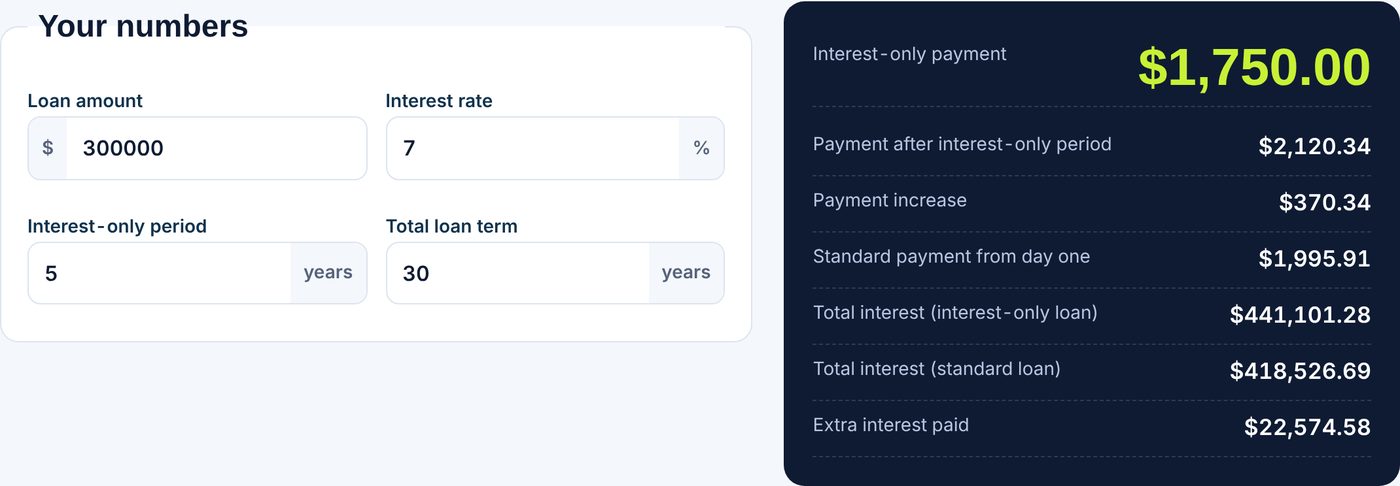
These numbers are an illustration. Take a $300,000 loan at 7 percent with a 30-year term and 5 interest-only years.
- Interest-only payment: $300,000 x 0.07 / 12 = $1,750.00.
- After five years the balance is still $300,000 and 25 years (300 months) remain. The payment becomes $2,120.34, which is $370.34 more.
- A standard 30-year loan at the same rate would cost $1,995.91 a month from day one.
| Interest-only loan | Standard 30-year loan | |
|---|---|---|
| First payment | $1,750.00 | $1,995.91 |
| Payment after year 5 | $2,120.34 | $1,995.91 |
| Total interest | $441,101.28 | $418,526.69 |
The interest-only structure saves $245.91 a month at first, then costs $22,574.58 more in total interest. The reset payment is also $124.43 a month higher than the standard payment, because the same balance is squeezed into fewer years.
How to calculate it in Excel
Interest-only payment: =300000*0.07/12. Payment after the reset: =PMT(0.07/12,25*12,-300000). Standard payment: =PMT(0.07/12,30*12,-300000). Total interest for the interest-only loan: =B1*12*5+B2*25*12-300000, where B1 and B2 hold the two payments.
Skip the sheet with our interest-only loan calculator, which shows the payment increase and extra interest for any amount, rate and period.
Who might consider one
- Borrowers with irregular income who expect it to rise and want a smaller early payment.
- Investors who plan to sell or refinance before the period ends.
Neither case is risk free. The CFPB cautions against assuming you can sell or refinance if payments rise, because property values can fall and finances can change, and suggests considering a different loan if you cannot afford the higher payments on your current income.
Warning signs
- Rate adjustments. If the loan is adjustable, the rate can reset along with the payment.
- Negative amortization. This is a different feature, where a payment is too small to cover the interest. The CFPB explains the unpaid interest is added to the balance, so the debt grows even though you are paying.
- Balloon payments. Some loans require the full balance at the end of the period.
Questions to ask the lender
- When exactly does the interest-only period end, and what will the payment be then?
- Is the rate fixed or adjustable, and what are the caps?
- Is there a prepayment penalty or a balloon payment?
- Can I make extra principal payments during the interest-only period?
Compare before you decide
Run a standard loan next to the interest-only version with the loan payoff calculator to see what extra payments would do, and check the real cost including fees with the APR calculator. If you only need a lower payment, a longer standard term may be a simpler alternative, and the home loan EMI calculator will show the difference.
Frequently asked questions
Do I build equity with an interest-only loan?
Not from payments during the interest-only period, because none of the payment reduces the balance. You can still gain equity if the property value rises, but that is not guaranteed.
What happens when the interest-only period ends?
You may pay off the balance, refinance if you can, or start paying principal and interest, which makes the payment higher. Plan for the higher amount in advance.
Is an interest-only loan cheaper?
The early payment is lower, but total interest is usually higher, because the balance stays the same for longer.
Can I make principal payments on an interest-only loan?
Often yes, but terms differ. Check the loan agreement for any limits or penalties.