


Insulation prices are quoted per square foot, but the number you see depends on the material, the thickness, whether the space is open attic or a closed wall, and what the quoting site counts. That is why published ranges disagree. This guide puts the figures from several named sources side by side so you can see the spread instead of trusting one number.
Updated November 2026
Insulation cost per square foot by type
All figures are typical ranges reported by the named sources on the dates shown, in US dollars. They are not quotes. Get at least three written estimates for your own project.
| Type | Typical range per sq ft | Source and date |
|---|---|---|
| Fiberglass batts or rolls | $0.30 to $1.50 | HomeAdvisor, updated December 2024 |
| Fiberglass (blown-in, material) | $0.50 to $1.10 | Angi, undated page |
| Cellulose, wet-spray | $0.60 to $1.80 | Angi, undated page |
| Cellulose, dense-pack | $2.00 to $2.30 | Angi, undated page |
| Mineral wool | $1.40 to $2.10 | Angi, undated page |
| Blown-in, all materials | $0.17 to $2.66 | Thumbtack, updated July 2026 |
| Blown-in cavity wall fill | $1 to $2 | HomeAdvisor, updated December 2024 |
| Spray foam | $1 to $2 | HomeAdvisor, updated December 2024 |
| Spray foam | $3.00 to $5.00 | Thumbtack, updated July 2026 |
| Spray foam, new construction | $2.75 to $6.50 | Fixr, updated January 2025 |
| Spray foam, existing walls | $3.15 to $7.50 | Fixr, updated January 2025 |
| Attic insulation, all types, installed | $1 to $7 (most $2 to $3.25) | Fixr, updated September 2022 (older) |
Spray foam shows the widest spread: HomeAdvisor lists $1 to $2, Thumbtack lists $3 to $5, and Fixr lists installed ranges starting at $2.75. Part of that gap likely comes from thickness and from whether the source is quoting per square foot or per board foot (one square foot, one inch thick). The sources do not all say which basis they use, so ask each contractor to quote thickness, R-value and total price.
Real contractor prices for blown-in attic insulation
Thumbtack also names two contractors: Capital Insulation in Tacoma, Washington, charges $1.20 to $1.25 per square foot for loose-fill cellulose in an attic, and Green Attics in Fort Worth, Texas, charges $1 per square foot for loose-fill fiberglass. Wall installations in finished structures cost more; Thumbtack cites $1.50 per square foot for loose-fill cellulose. These are single-company examples, not national averages.
Whole-attic and project totals
| Project | Typical range | Source and date |
|---|---|---|
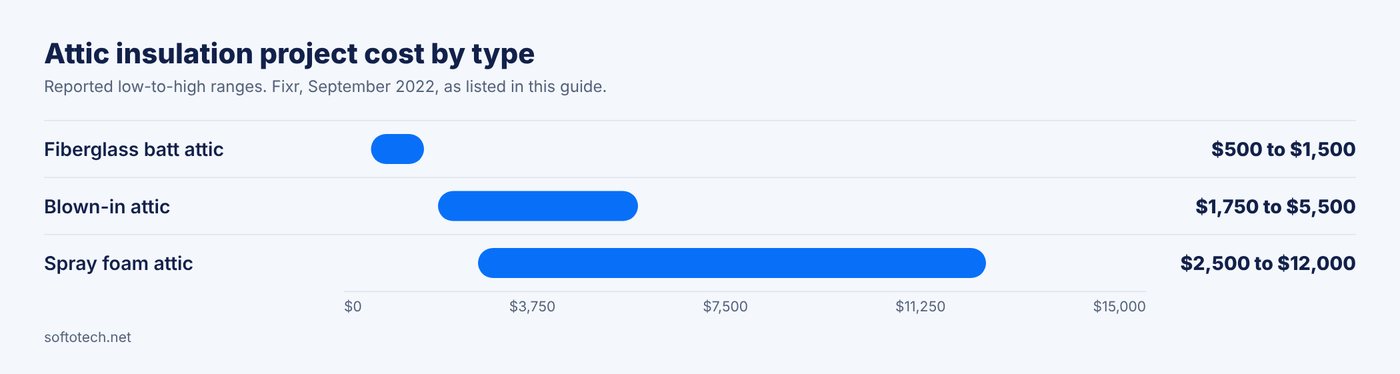
| Blown-in attic | $1,750 to $5,500 | Fixr, September 2022 |
| Fiberglass batt attic | $500 to $1,500 | Fixr, September 2022 |
| Spray foam attic | $2,500 to $12,000 | Fixr, September 2022 |
| Average blown-in project | $1,651 (typical total $975 to $2,200) | HomeAdvisor, December 2024 |
| Average batt project | $1,853 (typical total $1,000 to $2,400) | HomeAdvisor, December 2024 |
| Average spray foam project | $2,886 | HomeAdvisor, December 2024 |
| Whole spray foam project | $10,000 to $30,000, average $20,000 | Fixr, January 2025 |
The Fixr attic page is the oldest source here (2022), so treat its totals as a floor and expect current quotes to differ. The same page puts removal of old insulation at $1 to $3 per square foot, which is worth asking about if yours is wet, moldy or contaminated.
R-value: what you are actually buying
The U.S. Department of Energy explains that insulation is rated by R-value, and the higher the R-value, the greater the insulating effectiveness. R-value depends on the type of insulation, its thickness and its density. For loose-fill products it does not rise in direct proportion to thickness because the material compresses under its own weight, and compressed insulation will not deliver its rated value.
The department’s recommendations follow the 2021 IECC climate zones. For an uninsulated attic it lists R30 to R49 in Zone 1, R49 to R60 in Zone 3, and R60 in Zones 4 through 8. Its types page notes that 2×4 walls hold R-13 or R-15 batts and 2×6 walls hold R-19 or R-21 batts (Energy Saver guide to insulation types). Because the target changes by climate, compare quotes by price per R-value delivered, not just price per square foot. A cheaper product that needs more depth to reach R-49 may cost the same in the end.
What moves the price
- Material: fiberglass and cellulose are lowest; mineral wool and spray foam cost more.
- Open attic or closed cavity: blowing into an open attic is quick; dense-packing finished walls needs drilling and patching.
- Depth and R-value target: more inches, more material.
- Prep work: air sealing, baffles, removal of old material and any moisture repairs.
- Access and local labor rates: Fixr gives labor at $0.25 to $2.50 per square foot for most insulation types and $50 to $100 per hour for spray foam crews.
How to save without cutting corners
- Seal air leaks and attic bypasses first; insulation works poorly where air moves freely.
- Get quotes that list R-value, depth, square footage and brand, so they can be compared.
- Use blown-in fiberglass or cellulose for open attics, and keep spray foam for rim joists, rooflines or tight spots where its air-sealing is worth the premium.
- Ask your utility and state about rebates; programs change and vary by location.
- Do not buy more than the recommended R-value for your zone without a clear reason.
Estimate your own area first
Measure the surface you want to insulate, multiply by a per-square-foot range from the table, and add prep costs. Our insulation calculator helps you work out how much material you need, and the HVAC sizing calculator shows how a better envelope affects heating and cooling load. If you are re-roofing at the same time, see roofing cost.
Frequently asked questions
How much does it cost to insulate an attic per square foot?
Sources disagree by material. Thumbtack (July 2026) names contractors at about $1 to $1.25 per square foot for blown-in fiberglass or cellulose in an attic, and its general blown-in range is $0.17 to $2.66. Spray foam is higher, from $1 to $2 (HomeAdvisor, December 2024) up to $3 to $5 (Thumbtack, July 2026).
Is blown-in or spray foam insulation cheaper?
Blown-in is generally cheaper per square foot in every source above. Spray foam costs more but also acts as an air barrier, which can matter in rooflines and rim joists.
What R-value do I need in my attic?
The U.S. Department of Energy lists R30 to R49 for an uninsulated attic in Zone 1, R49 to R60 in Zone 3 and R60 in Zones 4 through 8, based on the 2021 IECC. Check your climate zone and local code.
Why do insulation quotes vary so much?
Quotes differ in material, depth, R-value, prep work, air sealing and whether old insulation is removed. Compare written quotes that state those details.