



Straight line depreciation is the first method most people learn and the one many small businesses use for their books. It charges the same amount every year. This guide explains the formula, walks through a complete schedule, shows the Excel function and points to the IRS guidance for tax work.
Updated November 2026
What straight line depreciation is
When a business buys equipment, a vehicle or a building improvement, it does not usually treat the full cost as an expense on day one. Depreciation spreads the cost across the years the asset is expected to be useful. Straight line is the simplest approach: it charges the same amount every year.
Annual depreciation = (Cost - Salvage value) / Useful life
- Cost is what you paid to get the asset ready to use.
- Salvage value is the estimated worth at the end of its useful life. It can be zero.
- Useful life is the number of years you expect to use it.
The amount that gets depreciated, cost minus salvage, is called the depreciable base.
Worked example
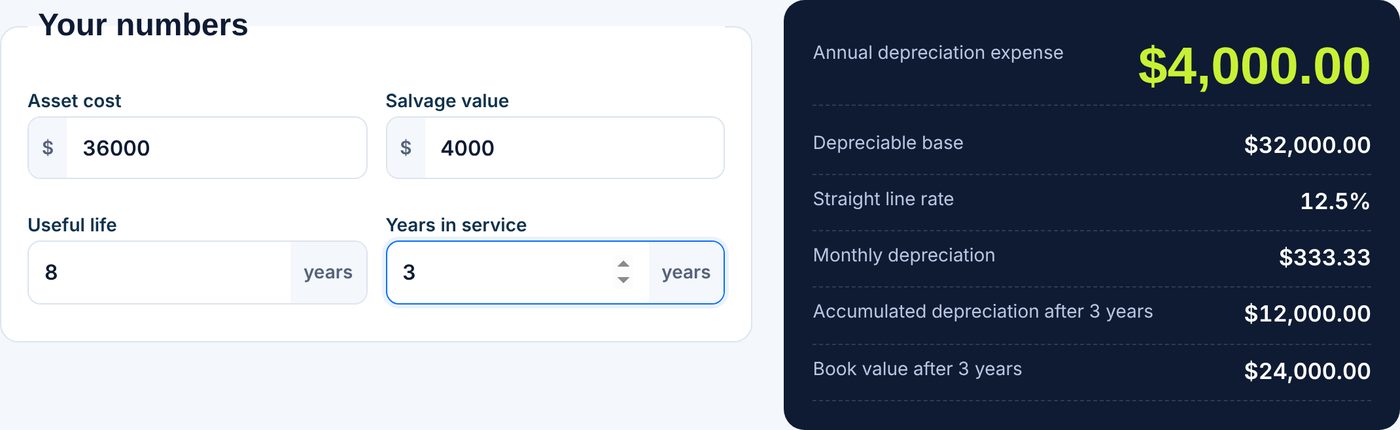
A company buys a delivery van for $36,000. It expects to use it for 8 years and sell it for $4,000. These are illustration numbers.
- Depreciable base = 36,000 – 4,000 = $32,000
- Annual depreciation = 32,000 / 8 = $4,000
- Monthly depreciation = 4,000 / 12 = $333
- Straight line rate = 1 / 8 = 12.5% of the depreciable base per year
Here is the full schedule. Book value is cost minus accumulated depreciation:
| Year | Depreciation expense | Accumulated depreciation | Book value |
|---|---|---|---|
| 0 | – | $0 | $36,000 |
| 1 | $4,000 | $4,000 | $32,000 |
| 2 | $4,000 | $8,000 | $28,000 |
| 3 | $4,000 | $12,000 | $24,000 |
| 4 | $4,000 | $16,000 | $20,000 |
| 5 | $4,000 | $20,000 | $16,000 |
| 6 | $4,000 | $24,000 | $12,000 |
| 7 | $4,000 | $28,000 | $8,000 |
| 8 | $4,000 | $32,000 | $4,000 |
By the end of year 8, book value reaches the $4,000 salvage value and depreciation stops. You can test your own asset in the straight line depreciation calculator.
Partial first year
If the asset goes into service part-way through the year, accounting often records only the months used in the first year. As an illustration, if the van enters service on April 1, it is used for 9 months in the first year, so year 1 expense is 4,000 x 9/12 = $3,000. The remaining $1,000 falls into the final year, so the total over the asset's life is still $32,000. Companies choose a convention, such as full month or half year, and apply it consistently.
Calculating it in Excel
Excel has a built-in function for straight line depreciation. With cost in B1, salvage in B2 and life in B3, use =SLN(B1,B2,B3). Microsoft documents the arguments on its SLN function page. The example returns 4,000.00. You can also write it by hand as =(B1-B2)/B3. For book value after n years, use =B1-SLN(B1,B2,B3)*n.
Book versus tax depreciation
The method above is the one many companies use in their own financial statements. Tax depreciation can follow different rules, recovery periods and conventions. The IRS explains how depreciation works for US tax purposes in Publication 946, How To Depreciate Property (2025 edition). If you will claim depreciation on a return, read it or ask a tax professional. This article is general information, not tax or accounting advice.
Strengths and drawbacks
- Simple and predictable. The expense is the same every period, so budgeting is easy.
- May not match real use. An asset that loses value fast in its early years is not described well by an even charge.
- Depends on estimates. Salvage value and useful life are judgments. If they turn out wrong, you can revise them going forward.
- Land is not depreciated. Only assets that wear out or become obsolete are.
For other methods and more tools, use our depreciation calculator and read the broader guide on how to calculate depreciation. If you are sizing up a purchase, the ROI calculator can help check the return.
Recording the entry
Each period, the accounting entry is a debit to depreciation expense and a credit to accumulated depreciation, which is a contra-asset account that reduces the asset's carrying amount. In the example, each year records $4,000 of expense. The asset stays on the balance sheet at cost, with accumulated depreciation shown below it, and the net figure is the book value. Keep a fixed-asset register listing each asset's cost, in-service date, life and salvage so the schedule can be rebuilt at any time. If you later change the estimated life or salvage value, the usual approach is to spread the remaining book value, less the new salvage value, over the remaining years instead of restating past periods. Check your accounting standard for the exact treatment. Fully depreciated assets that are still in use stay on the register at salvage value until they are sold or retired.
Frequently asked questions
What is the straight line depreciation formula?
Annual depreciation equals cost minus salvage value, divided by the useful life in years.
What if the salvage value is zero?
Then the whole cost is depreciated. Annual expense is simply cost divided by useful life.
Does depreciation reduce cash?
No. It is a non-cash expense that spreads an earlier purchase over time. The cash left the business when the asset was bought.
Is straight line depreciation allowed for taxes?
The IRS covers the straight line method for tax purposes in Publication 946, but tax rules differ from book rules. Check the publication or ask a tax professional.