


A balance sheet is a snapshot of what a business owns, what it owes, and what is left over for the owners on one specific date. It does not show how the business performed over a month or a year; that is the job of the profit and loss statement. If you can read a balance sheet, you can tell in a few minutes whether a company can pay its bills, how much of it is financed by debt, and how much cash is tied up in stock or unpaid invoices.
This guide walks through a small made-up balance sheet line by line, checks the arithmetic, and then shows four quick ratios you can calculate from it. The SEC makes the same basic point for public companies: the balance sheet is one of the core statements, and it is read together with the notes that explain it (SEC Investor Bulletin: How to Read a 10-K).
Updated November 2026
The one equation behind every balance sheet
Every balance sheet rests on Assets = Liabilities + Equity. Assets are what the business has. Liabilities are what it owes to others. Equity is the owners’ claim: money they put in plus profits kept in the business. If the two sides do not match, there is an error somewhere, and finding it is the first thing a bookkeeper does.
A small worked example
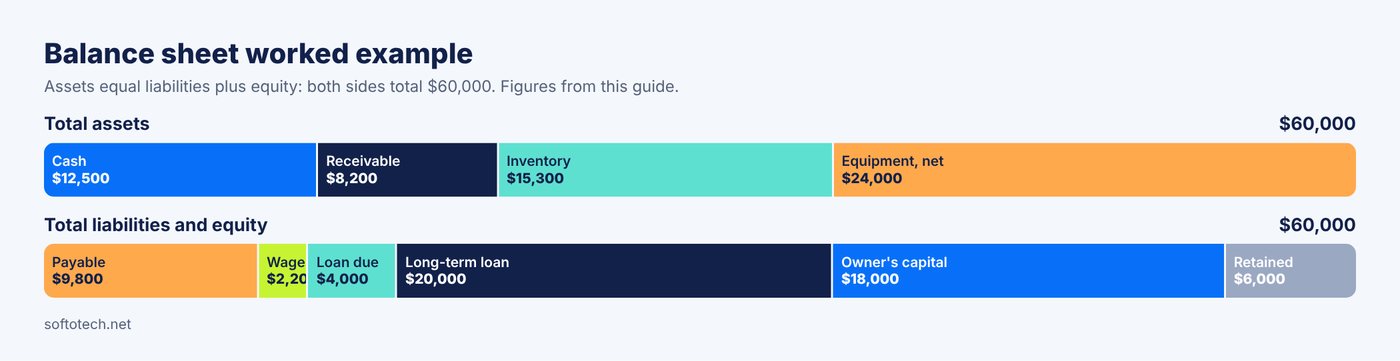
Below is the balance sheet of an imaginary small retailer as of December 31. The figures are illustrations, not real data. Each subtotal has been recomputed to confirm it adds up.
| Line | Amount |
|---|---|
| Current assets | |
| Cash | $12,500 |
| Accounts receivable | $8,200 |
| Inventory | $15,300 |
| Total current assets | $36,000 |
| Equipment, at cost | $30,000 |
| Less accumulated depreciation | ($6,000) |
| Equipment, net | $24,000 |
| Total assets | $60,000 |
| Current liabilities | |
| Accounts payable | $9,800 |
| Accrued wages | $2,200 |
| Loan payments due within 12 months | $4,000 |
| Total current liabilities | $16,000 |
| Long-term loan | $20,000 |
| Total liabilities | $36,000 |
| Owner’s capital | $18,000 |
| Retained earnings | $6,000 |
| Total equity | $24,000 |
| Total liabilities and equity | $60,000 |
The check: $12,500 + $8,200 + $15,300 = $36,000 in current assets; $36,000 + $24,000 = $60,000 in total assets. On the other side, $9,800 + $2,200 + $4,000 = $16,000 in current liabilities; $16,000 + $20,000 = $36,000 in total liabilities; $36,000 + $24,000 = $60,000. Both sides equal $60,000, so the sheet balances.
How to read each section
Assets
Assets are listed from most liquid (easiest to turn into cash) to least liquid. Current assets are expected to become cash within a year: cash itself, accounts receivable (money customers owe you), and inventory. Fixed assets such as equipment, vehicles and buildings are used over many years. Accumulated depreciation is the portion of their cost already expensed, so equipment is shown at $30,000 minus $6,000. Notice that inventory is $15,300 of the $36,000 in current assets. Stock is not cash until it sells, which is why lenders look at it separately.
Liabilities
Current liabilities are due within a year: supplier invoices (accounts payable), wages earned but not yet paid, and the part of a loan due in the next 12 months. Long-term liabilities are everything due later. Splitting the loan into a $4,000 current piece and a $20,000 long-term piece is standard, and it matters because only the $4,000 competes with your cash this year.
Equity
Equity is the residual: assets minus liabilities, here $60,000 – $36,000 = $24,000. It grows when the business keeps profits (retained earnings) and shrinks when owners withdraw money or the business loses money. A sole proprietor may see a single “owner’s equity” line instead.
Four ratios worth calculating
| Measure | Formula | Result for the example |
|---|---|---|
| Working capital | Current assets – current liabilities | $36,000 – $16,000 = $20,000 |
| Current ratio | Current assets / current liabilities | 2.25 |
| Quick ratio | (Cash + receivables) / current liabilities | $20,700 / $16,000 = 1.29 |
| Debt-to-equity | Total liabilities / total equity | $36,000 / $24,000 = 1.5 |
A current ratio above 1 means current assets cover current liabilities. The quick ratio drops inventory, so it answers a harder question: could you pay the short-term bills without selling any stock? A debt-to-equity of 1.5 means the business owes $1.50 for every $1 the owners have invested. There is no universal “good” number; what is normal for a retailer is different from a software firm, so compare against your own past sheets and similar businesses.
Excel formulas for your own sheet
If your balance sheet lives in a spreadsheet, let the totals calculate themselves. With current assets in B4:B6, use =SUM(B4:B6) for the subtotal. For a check cell, =B12-(B20+B25) should return 0 when assets equal liabilities plus equity. The ratios become =B7/B15 for the current ratio and =(B4+B5)/B15 for the quick ratio. A ready-made layout with these checks is in our free balance sheet template for Excel.
Common mistakes
- Reading it alone. A balance sheet is one date. Compare it with last quarter and last year, and read it next to the profit and loss statement and the cash flow statement.
- Treating retained earnings as cash. Profit can be sitting in inventory, equipment or receivables.
- Ignoring the notes. Loan terms, leases and pending obligations are explained outside the numbers.
- Mixing personal and business items. Owner draws and personal expenses distort equity.
This article is general education, not accounting or tax advice. Your accountant can tell you how your business should present specific items.
Frequently asked questions
What is the difference between a balance sheet and an income statement?
A balance sheet shows what a business owns, owes and is worth on one date. An income statement shows revenue and expenses over a period, such as a month or a year, and ends with profit or loss.
Why must a balance sheet balance?
Every transaction is recorded in at least two places, so the books always satisfy assets = liabilities + equity. If they do not, a transaction was entered incorrectly or left out.
What is a good current ratio?
There is no single target. A ratio above 1 means current assets exceed current liabilities, but the right level depends on your industry and how quickly inventory and receivables turn into cash. Compare your own history and similar businesses.
How often should a small business prepare a balance sheet?
Monthly is common for businesses that borrow or hold inventory, and at least once a year for tax and lender purposes. Prepare one whenever you apply for financing.