


You can estimate your future 401(k) balance with a handful of inputs. The result is not a promise, but it shows how contributions, the employer match and time work together. Here is the method, a worked example and the 2026 IRS limit.
Updated November 2026
The inputs that drive the result
A 401(k) balance at retirement comes from five things: your starting balance, how much you and your employer contribute each year, how those contributions grow with raises, the investment return, and how many years you have. The estimate below is a projection, not a forecast. Real returns vary from year to year.
How the employer match works
Match formulas differ by plan. A typical form is a percentage of your contribution up to a cap on your salary. A 50 percent match up to 6 percent of salary means that if you contribute 8 percent, your employer adds 50 percent of the first 6 percent, which is 3 percent of salary. Check your plan documents for the exact formula and any vesting schedule.
Worked example
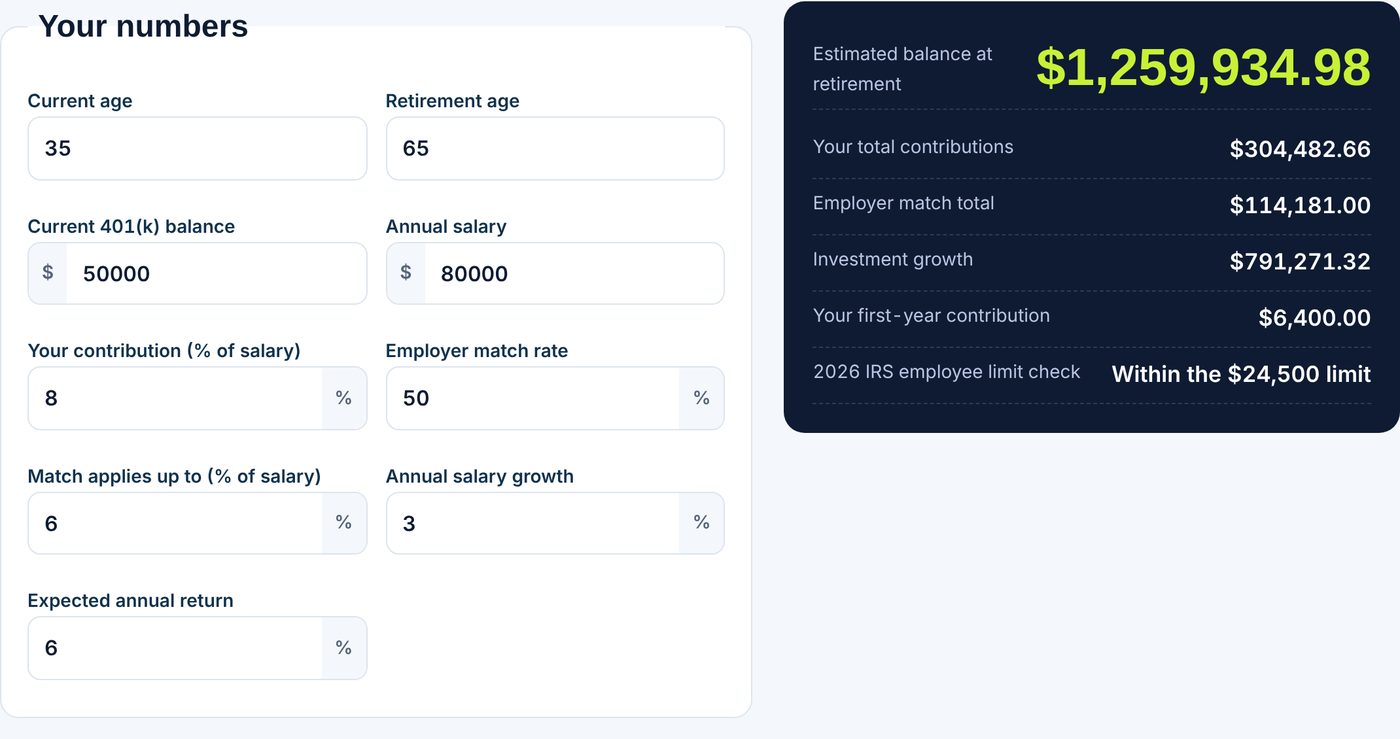
Illustration only. You are 35, retire at 65 (30 years), have $50,000 saved and earn $80,000, with 3 percent annual raises. You contribute 8 percent of salary and your employer matches 50 percent up to 6 percent. Contributions are added at the end of each year, and the return is 6 percent a year (an assumption).
- First-year contribution from you: $80,000 x 8% = $6,400. The employer adds $2,400.
- Estimated balance at 65: $1,259,935.
- Of that, your contributions total $304,483 and the employer match $114,181. The rest, $791,271, is investment growth.
What changes the result
| Scenario | Balance at 65 |
|---|---|
| Base case (6% return, 8% contribution, match) | $1,259,935 |
| No employer match | $994,637 |
| Contribute 9% instead of 8% | $1,348,368 |
| 4% return | $880,369 |
| 8% return | $1,846,962 |
The match alone is worth $265,298 in this example, which is why many people contribute at least enough to receive the full match. The spread between the 4 and 8 percent cases shows how much the return assumption matters.
2026 contribution limits
The IRS announced that the 401(k) employee limit rises to $24,500 for 2026, up from $23,500 in 2025. The catch-up contribution for age 50 and older is $8,000, and the higher catch-up for ages 60 to 63 is $11,250. The IRS 401(k) contribution limits page also lists an overall limit on total additions from employee deferrals, employer matching and other employer contributions, and says it is capped at 100 percent of compensation. These limits are adjusted periodically, so check the IRS for the current year.
Excel formulas
For a fixed annual contribution, the future value is =FV(0.06,30,-8800,-50000), which combines the starting balance and a flat yearly deposit. To model raises, build a column for each year: salary =B2*(1+0.03), contribution =C2*0.08, match =C2*0.5*MIN(0.08,0.06), and balance =D1*(1.06)+E2+F2. Our 401(k) savings calculator does the year-by-year projection for you.
Limits of any estimate
- Returns are not guaranteed and can be negative in some years.
- Fund fees reduce your net return.
- Inflation reduces what the future balance will buy.
- Withdrawals from traditional 401(k) accounts are generally taxed as income.
- Match vesting rules may delay when employer money becomes yours.
Ways to improve the outcome
- Contribute at least enough to get the full match.
- Raise your contribution when you get a raise. Use the pay raise calculator to see how much a raise adds.
- Start early. Time is a large part of the growth. See the effect of compounding with the compound interest calculator.
- Check how contributions affect take-home pay with the paycheck calculator.
Frequently asked questions
What is the 2026 401(k) contribution limit?
The IRS set the employee elective deferral limit at $24,500 for 2026. Catch-up contributions of $8,000 apply at age 50 and older, and $11,250 for ages 60 to 63, according to the IRS.
Does the employer match count toward the $24,500 limit?
No. The elective deferral limit applies to your own contributions. The IRS lists a separate, higher overall limit on combined contributions.
What return should I assume?
Nobody knows future returns. Run a low, middle and high case, as in the table above, and plan around the range.
Is the estimated balance in today’s dollars?
No. It is in future dollars, so adjust for inflation if you want to compare it with today’s costs.