


The weighted average cost of capital shows what a company pays, on average, to fund itself with equity and debt. It is a central input for valuations and investment decisions. This guide walks through the formula, a worked example with verified math, the Excel version and the mistakes to avoid.
Updated November 2026
What WACC measures
A business funds itself with a mix of equity and debt, and each has a cost. Shareholders expect a return for the risk they take. Lenders charge interest. The weighted average cost of capital blends the two, weighted by how much of the total each supplies. It is commonly used as the discount rate when valuing a company or testing whether a project earns enough to justify its funding.
WACC = (E/V) x Re + (D/V) x Rd x (1 - T)
- E is the market value of equity and D is the market value of debt. V is E plus D.
- Re is the cost of equity and Rd is the cost of debt before tax.
- T is the tax rate. Interest is generally deductible, so debt costs less after tax.
Worked example
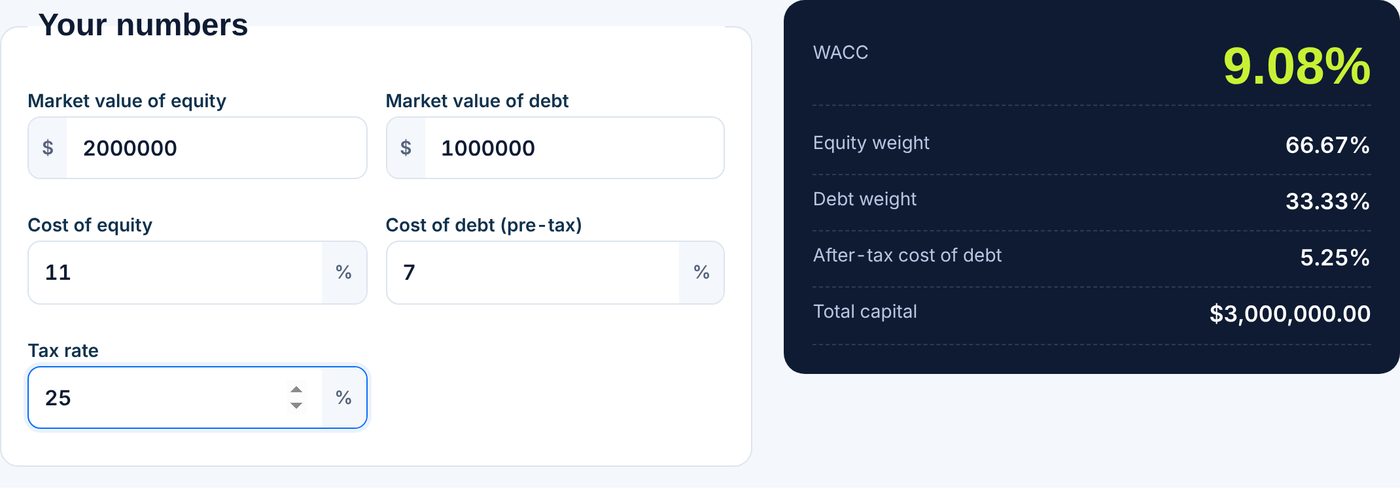
An illustrative company has $2,000,000 of equity and $1,000,000 of debt. Its cost of equity is 11 percent, its pre-tax cost of debt is 7 percent and its tax rate is 25 percent. These are example inputs, not benchmarks.
- Total capital V = $2,000,000 + $1,000,000 = $3,000,000
- Equity weight = 66.67% and debt weight = 33.33%
- After-tax cost of debt = 7% x (1 – 0.25) = 5.25%
- WACC = 0.6667 x 11% + 0.3333 x 5.25% = 7.33% + 1.75% = 9.08%
The company must earn about 9.08 percent on its investments to cover the cost of its funding. To check your own mix, use the WACC calculator.
Calculating WACC in Excel
Put equity in B1, debt in B2, cost of equity in B3, cost of debt in B4 and tax rate in B5, with the percentages stored as decimals such as 0.11. Then:
=B1/(B1+B2)*B3+B2/(B1+B2)*B4*(1-B5)
This returns 9.08% for the example. Keep the weights in their own cells if you want to see how the mix changes the result.
Where to find the inputs
Equity and debt values. For a public company, market value of equity is the share price times shares outstanding. Debt can use the market value of bonds, or book value of loans as a stand-in. For a private business, an estimate based on comparable companies or a valuation is typical.
Cost of debt. Use the current interest rate on the company’s borrowing, or the yield on its bonds. A common reference point for the risk-free part of a rate is the Treasury yield data in the Federal Reserve’s H.15 Selected Interest Rates release, which publishes daily Treasury yields.
Cost of equity. This one cannot be read off a statement. Analysts estimate it, often with a model that adds a market risk premium to a risk-free rate. The estimate is the weakest link in WACC, so test a range of values. The Wikipedia article on weighted average cost of capital outlines the common approaches.
Limits and common mistakes
- Using book values. Market values are preferred because they reflect current investor expectations.
- Forgetting the tax adjustment. Entering the pre-tax cost of debt overstates WACC.
- Percent versus decimal. Mixing 11 and 0.11 in the same formula gives nonsense.
- Using one rate for every project. A project far riskier than the business as a whole may need a higher rate.
- Stable mix assumed. If you plan to raise a lot of debt, the weights will shift.
Once you have a rate, you can use it to discount cash flows with our guide on how to calculate NPV, or to estimate what a company is worth with the business valuation calculator. This is general information, not financial advice.
WACC and valuation
In a discounted cash flow valuation, the company's expected free cash flows are discounted at the WACC to arrive at an enterprise value. A higher WACC lowers the value and a lower WACC raises it, so the choice of inputs matters. Small changes in cost of equity can swing the result by a lot, which is why analysts show a table of values at several rates rather than a single number. When you present a WACC to a lender, investor or partner, write down where each input came from so the assumptions can be reviewed and updated. If you are comparing several companies, use the same method for the inputs each time, such as the same date for market values and the same source for yields, so differences reflect the businesses and not the method.
Frequently asked questions
What is a good WACC?
A lower WACC means cheaper funding, but there is no single good number. It varies by industry, size, risk and interest rates. Compare it with similar companies.
Why do we use the after-tax cost of debt?
Interest payments are generally tax deductible, which lowers the real cost of borrowing. WACC uses the after-tax figure for that reason.
How often should I recalculate WACC?
Update it when interest rates, your mix of debt and equity or your tax rate change in a meaningful way, and whenever you refresh a valuation.
Do I use book value or market value for weights?
Market value is preferred. Use book value only when market values are not available, and say so when you share the result.