


GST, the goods and services tax, is added to most sales in Australia, New Zealand, Singapore, Canada and India. The arithmetic is simple, but one mistake shows up constantly: people remove GST from a total by subtracting the percentage, and the answer comes out wrong. This guide shows both directions of the calculation with checked examples and the Excel formulas to automate them.
Updated November 2026
Know the rate first
GST rates are set by governments and they change, so always confirm with the tax authority. At the time of writing:
- Australia charges 10 percent on most goods and services, according to the Australian Taxation Office.
- New Zealand charges 15 percent, according to Inland Revenue.
- Singapore charges 9 percent, according to IRAS.
- Canada has a 5 percent federal GST, plus HST in some provinces, per the Canada Revenue Agency.
- India moved to mainly 5 and 18 percent slabs, with 40 percent on select items, from 22 September 2025, per the Press Information Bureau. The older 12 and 28 percent slabs were removed.
Adding GST to a net price
If a price is quoted before tax, multiply by the rate to get the GST, then add it. The shortcut is to multiply by one plus the rate.
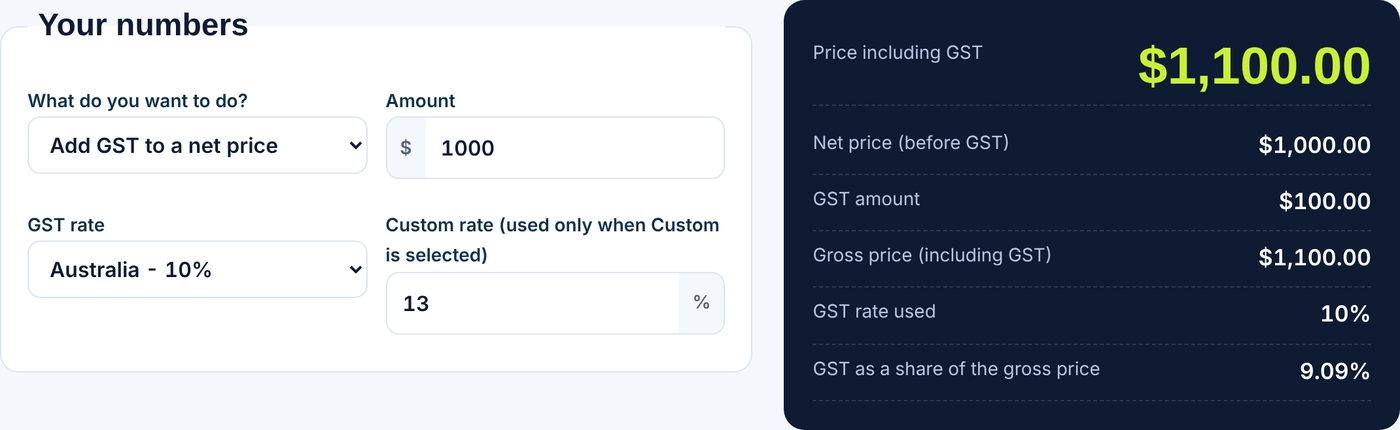
Example (illustration): a consultant quotes $1,000 net in Australia. GST at 10 percent is $100.00, so the invoice total is $1,100.00.
Removing GST from a gross price
If a receipt shows a GST-inclusive total, divide by one plus the rate to find the net price. The GST is what is left over.
Example (illustration): a supplier invoice totals $1,320 including 10 percent GST. Net = 1,320 / 1.10 = $1,200.00, and GST = $120.00. Taking 10 percent off $1,320 would give $1,188, which understates the net price by $12 because the tax was calculated on $1,200, not $1,320.
A quick mental check: at 10 percent, GST is one eleventh of the gross total. One eleventh of $1,320 is $120. At 15 percent, GST is 15/115 of the total, or about 13.04 percent.
A second example at a different rate
A New Zealand shop sells a jacket for $200.00 before GST. At 15 percent, GST is $30.00 and the shelf price is $230.00. Going back the other way, $230.00 divided by 1.15 returns $200.00 exactly, which is a good test that your formula is set up correctly.
Excel and Google Sheets formulas
Put the rate in its own cell, say B1 as 10%, the net price in A3 and use these:
- GST from net:
=A3*$B$1 - Gross from net:
=A3*(1+$B$1) - Net from gross:
=A3/(1+$B$1) - GST from gross:
=A3-A3/(1+$B$1) - Rounded to cents:
=ROUND(A3/(1+$B$1),2)
Keeping the rate in one cell means a rate change is a one-cell edit. For percent basics in spreadsheets, see our guide to the percentage formula in Excel, and if you issue invoices, the invoice template for Excel is a starting point.
Why the gross price hides the tax
On a retail shelf or a customer-facing invoice you often see only the GST-inclusive figure. That is why bookkeepers work backwards so often: the accounting entry needs the net sale and the GST separately, because the tax is owed to the government rather than earned by the business. Splitting every receipt the same way, with one rate cell and one formula, keeps the books consistent and makes mistakes easy to spot.
Skip the manual work
Our GST calculator adds or removes GST at common rates for Australia, India, Canada, New Zealand and Singapore, and shows the net price, GST and gross price together. If you work with US sales tax instead, read how to calculate sales tax.
Common mistakes
- Subtracting the rate from the total. Divide by 1 plus the rate instead.
- Using an old rate. India’s change in September 2025 is a recent example. Check the current rate before you invoice.
- Rounding too early. Round the final GST per invoice or per line as your tax authority requires, not at every step.
- Charging GST on exempt or zero-rated items. Some goods and services are treated differently, and registration thresholds apply.
- Mixing HST and GST in Canada. Some provinces charge a combined rate, so the federal 5 percent alone may not be what applies to your sale.
This article is general information, not tax advice. Ask a registered tax agent or accountant about your own situation.
Frequently asked questions
Do I subtract the GST percentage from the total to remove GST?
No. Divide the GST-inclusive total by 1 plus the rate. For a total of $1,320 at 10 percent, subtracting 10 percent gives $1,188, which is wrong. Dividing by 1.10 gives the correct net price of $1,200.
What fraction of a GST-inclusive price is tax?
It is the rate divided by 100 plus the rate. At 10 percent that is one eleventh, or about 9.09 percent, and at 15 percent it is 15 out of 115, or about 13.04 percent.
Is India’s GST still 12 and 28 percent?
No. The GST Council moved the main structure to 5 and 18 percent, with 40 percent on a few select goods and services, effective 22 September 2025, per the Press Information Bureau. Check the rate for your specific item.
Does GST apply to every sale?
No. Zero-rated, exempt and special-treatment items exist in every GST country, and registration thresholds apply. Confirm with your tax authority before charging or claiming GST.