



Before deciding how much to spend on winning customers, you need to know what one customer is worth. This guide shows the two common customer lifetime value formulas, a worked example with checked numbers, the Excel formulas and how to use the result.
Updated November 2026
What customer lifetime value is
Customer lifetime value, usually shortened to CLV or LTV, is the total amount a typical customer is expected to bring in during the whole time they buy from you. Knowing it tells you how much you can afford to spend to win a customer, and which products or channels bring the most valuable buyers.
There are two common versions. The simple version counts revenue. The margin-based version counts gross profit, which is the better basis for budgeting, since revenue is not what you keep.
The formulas
Annual revenue per customer = Average order value x Purchases per year
Simple CLV = Annual revenue per customer x Customer lifespan (years)
Margin-based CLV = Simple CLV x Gross margin
LTV to CAC ratio = CLV / Customer acquisition cost
Worked example
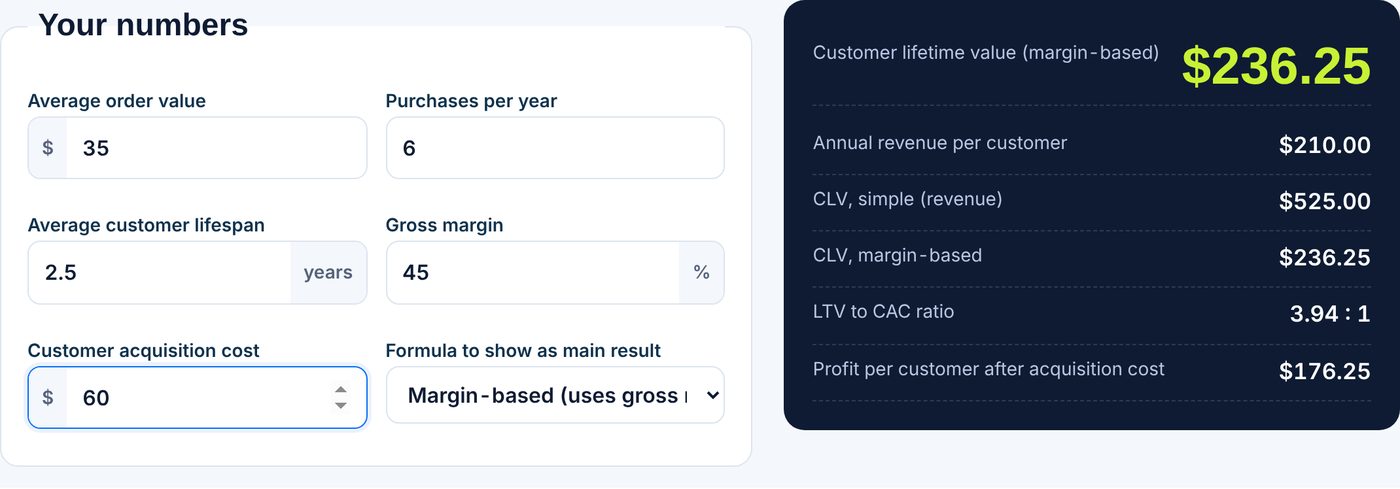
An illustrative online shop sees customers who spend $35 per order, order 6 times a year and stay for 2.5 years on average. Its gross margin is 45 percent and each new customer costs $60 to acquire. These are example inputs, not benchmarks.
- Annual revenue per customer = $35 x 6 = $210.00
- Simple CLV = $210.00 x 2.5 = $525.00
- Margin-based CLV = $525.00 x 0.45 = $236.25
- LTV to CAC = $236.25 / $60 = 3.94 to 1
- Profit per customer after acquisition = $236.25 – $60 = $176.25
The simple formula says a customer is worth $525.00, but only $236.25 of that is gross profit. Spending $60 to win that customer leaves $176.25 before overhead. Try your own inputs in our customer lifetime value calculator.
Finding customer lifespan
Lifespan is the hardest input. If you know the annual churn rate, the share of customers who stop buying each year, a common approximation is lifespan = 1 / churn. A shop losing 40 percent of customers a year has a lifespan near 2.5 years, which is what the example uses. You can also measure it directly from order history: for customers who have clearly stopped, average the time between their first and last order. Include only customers old enough to have shown their pattern, or you will underestimate it. The idea of tracking how long customers stay is also covered in the Wikipedia article on customer retention.
Calculating CLV in Excel
With order value in B1, purchases per year in B2, lifespan in B3, gross margin as a decimal in B4 and acquisition cost in B5:
=B1*B2*B3 for the simple CLV, =B1*B2*B3*B4 for the margin-based CLV, and =B1*B2*B3*B4/B5 for the LTV to CAC ratio.
The example returns 525.00, 236.25 and 3.94. The Wikipedia entry on customer lifetime value describes more advanced versions that discount future cash and model retention by period.
Using the number
- Set an acquisition budget. Many businesses want lifetime value to be a healthy multiple of acquisition cost, and 3 to 1 is a commonly quoted rule of thumb. It is a guide, not a law, and payback time matters too.
- Segment it. One blended average can hide a profitable group and an unprofitable one. Break it out by channel, product or first purchase.
- Raise it. You can increase order value, purchase frequency, lifespan or margin. Small gains in each multiply together.
Limits
These formulas use averages and treat a dollar next year the same as a dollar today. They assume spending stays flat, and they ignore overhead and returns unless your margin already includes them. Check your margin input with our gross profit guide or the gross margin calculator, and consider the break-even picture with the break-even calculator. The result is a planning estimate, not a guarantee.
Common mistakes
The first mistake is using revenue where profit belongs, which overstates what each customer is worth. The second is using a lifespan from your best customers for every customer. The third is leaving out costs that scale with each customer, such as shipping, payment fees or support time. A fourth is mixing up acquisition cost with total marketing spend: only count the spend that actually produced the new customers in the same period. Finally, recalculate when your pricing, product or retention changes, since an old lifetime value can be wrong within a few quarters. When you share a CLV figure with a partner or lender, state the formula used, the margin, the lifespan and the period of data behind it, so the number can be checked and compared fairly.
Frequently asked questions
What is the difference between CLV and LTV?
They are two names for the same idea: the value of a customer over the whole relationship.
Should I use revenue or profit for CLV?
Profit, or gross margin, is better for deciding how much to spend on acquisition. Revenue-based CLV overstates what you keep.
What is a good LTV to CAC ratio?
A ratio of 3 to 1 is a commonly quoted rule of thumb, but the right number depends on your margins, cash needs and how fast you recover acquisition cost.
How do I estimate customer lifespan?
Divide 1 by your annual churn rate, or average the time between first and last purchase for customers who have clearly stopped buying.