


A personal loan payment looks like a single number, but it hides interest, principal and fees. Here is how it is built and how to compare offers.
Updated November 2026
The payment formula
Most personal loans are fixed-rate installment loans. Each month you pay the same amount, and the interest part shrinks as the balance falls. The payment comes from one formula:
L is the loan amount, i is the monthly rate (annual rate / 12) and n is the number of months. Try your numbers in the personal loan calculator.
Worked example
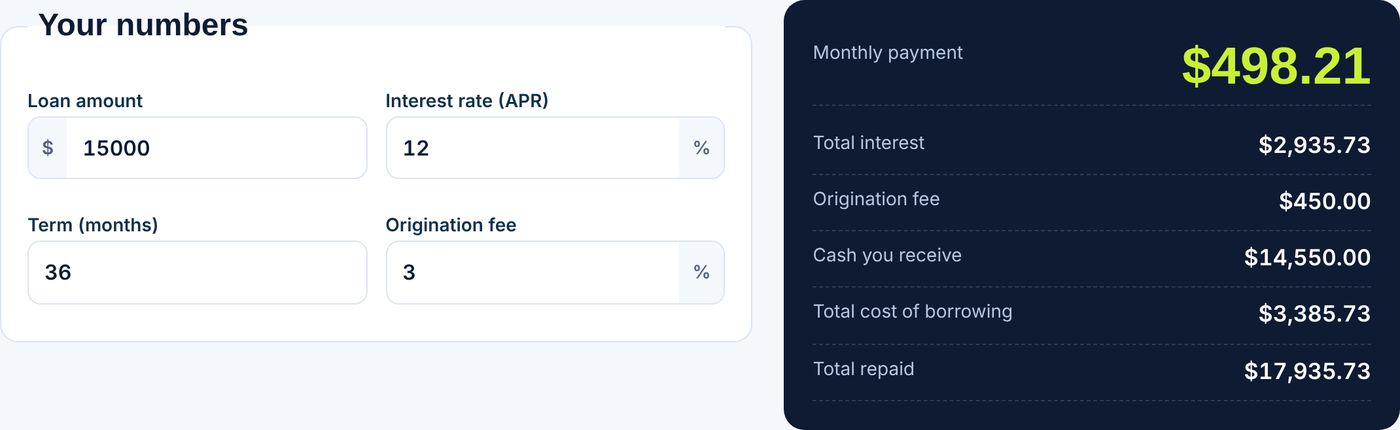
Borrow $15,000 at 12% for 36 months with a 3% origination fee. The monthly rate is 0.01. The payment is $498.21. Over 36 months you repay $17,935.73, so interest is $2,935.73.
The 3% fee is $450. Many lenders deduct it from the loan, so you receive $14,550 but repay the full $15,000 balance. Your true cost of borrowing is $3,385.73, which is interest plus fee. Compare lenders on that figure, not the rate alone.
Term changes the cost a lot
| Term | Monthly payment | Total interest |
|---|---|---|
| 36 months | $498.21 | $2,935.73 |
| 60 months | $333.67 | $5,020.00 |
The longer loan lowers the payment by $164.55 a month but adds $2,084.28 of interest.
Excel formulas
The PMT function does the work: =PMT(12%/12,36,-15000) returns $498.21. Total interest is =PMT(12%/12,36,-15000)*36-15000. For the full month-by-month split, see our loan amortization schedule for Excel.
What to compare between offers
- The APR, which includes fees, rather than the headline rate.
- Origination fee and whether it is taken from the loan.
- Prepayment penalties. Ask if you can pay early without a charge.
- Late fees and whether the rate is fixed.
The CFPB explains fees and loan terms on its site; its guide to closing costs covers mortgage closing, while for personal loans read the lender’s disclosure box carefully.
Common mistakes
- Comparing on rate instead of APR and total cost.
- Borrowing the full approved amount when a smaller loan would do. Interest is charged on every dollar.
- Taking a very long term to get a low payment, then paying far more interest.
- Using a personal loan to cover a recurring shortfall. That tends to repeat.
Run two or three scenarios in the calculator, changing only one input at a time, so you can see which input drives the cost. Rate and term matter most; the amount scales everything linearly.
Paying it off early
Extra payments go to principal and cut interest. Our loan payoff calculator shows how much time and interest an extra amount saves. Before borrowing, check the payment fits your budget with room to spare. Illustrations only, not financial advice.
Frequently asked questions
How do I calculate a personal loan payment?
Use Payment = L x i / (1 – (1 + i)^-n), or =PMT(rate/12,months,-amount) in Excel.
What is the payment on a $15,000 loan at 12% for 3 years?
$498.21 a month, with $2,935.73 total interest.
Does an origination fee change my payment?
Not if the fee is taken from the proceeds, but you receive less cash while repaying the full amount, which raises the true cost.
Is a longer term better?
It lowers the payment but raises total interest. Choose the shortest term you can afford.