


The honest answer to how big your emergency fund should be is: it depends. But you can turn it into a number in a few minutes. Here is how to pick a target, work out the timeline, and build the fund without guesswork.
Updated November 2026
Start with essential expenses
An emergency fund covers the costs you cannot skip if income stops or a big bill lands. List what you must pay every month: housing, utilities, groceries, insurance, transportation, minimum debt payments and any dependent care. Leave out restaurants, streaming and other spending you could pause. For this article, assume essentials add up to $3,500 a month.
How many months?
There is no universal figure. The Consumer Financial Protection Bureau’s guide to building an emergency fund says the target depends on your situation, and suggests you think about the most common unexpected expenses you have had in the past and what they cost. It also notes that even a small amount can provide some financial security, and that an emergency fund can be the first achievable savings goal when you are starting out.
Many planners cite three to six months as a rule of thumb, which is a convention, not a rule from a regulator. Consider a larger target if:
- Your income varies, as with freelance or commission work.
- One paycheck supports the household.
- You have dependents or health costs that are not fully insured.
- Your industry has long hiring cycles.
A smaller target may be enough if you have two stable incomes, strong insurance and other accessible assets.
The formula
Worked example
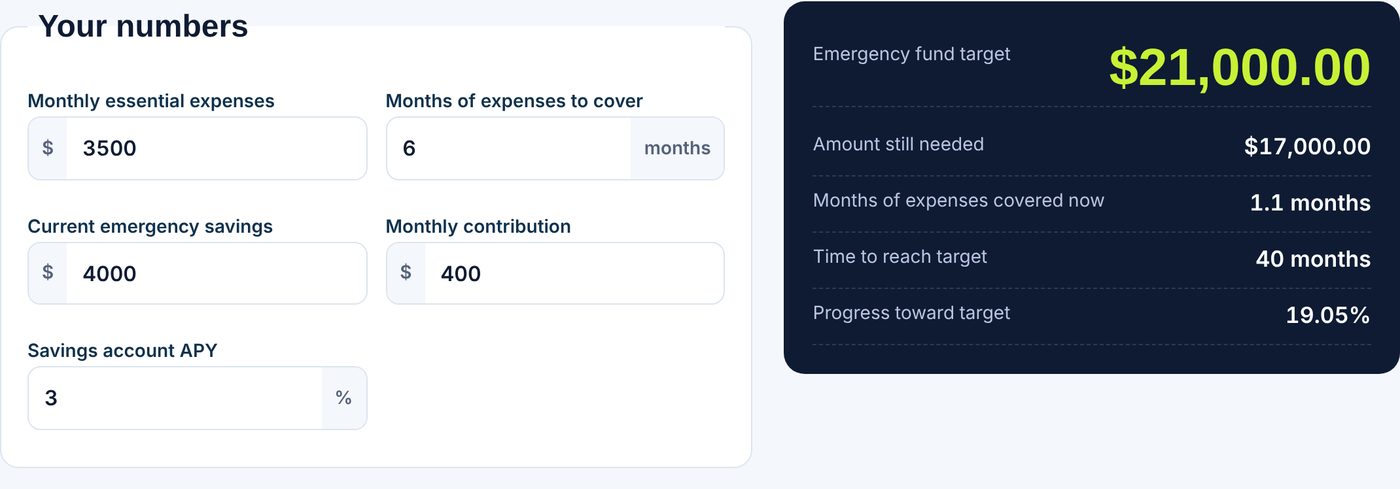
Illustration only. Essentials are $3,500 a month. You already have $4,000 saved, add $400 a month, and the account earns 3 percent APY (an assumption). That savings balance covers 1.1 months of expenses today.
| Goal | Target | Still needed | Time to reach |
|---|---|---|---|
| 3 months | $10,500 | $6,500 | 16 months |
| 6 months | $21,000 | $17,000 | 40 months |
| 9 months | $31,500 | $27,500 | 63 months |
The six-month target of $21,000 takes 40 months, about 3.3 years. Raising the monthly contribution is the fastest lever. The emergency fund calculator lets you try different amounts and see the timeline.
Excel formulas
Target: =3500*6. Months covered: =4000/3500. Months to reach the goal with interest: =NPER(0.03/12,-400,-4000,21000). NPER assumes monthly compounding at the nominal rate and payments at the end of each period, so it can differ by a month from the calculator, which converts the APY exactly. Without interest, use =(21000-4000)/400.
Ways to build it faster
- Automate a transfer on payday so saving does not depend on willpower. The CFPB lists recurring transfers and splitting direct deposit as ways to start.
- Put part or all of a tax refund or other one-time payment into the fund.
- Trim one recurring cost and send the difference to savings. A budget template makes it easy to see where the money goes.
- Track progress monthly with a savings tracker.
Where to keep it
Choose a place that is safe and quick to reach. Deposits at an FDIC-insured bank are covered, per the FDIC, up to $250,000 per depositor, per insured bank, for each account ownership category. Avoid tying emergency money up in anything that can lose value or carries withdrawal penalties.
Use it only for real emergencies
Decide in advance what counts: job loss, urgent medical or car repairs, a broken furnace. When you use the fund, set a plan to refill it. Treat the balance as insurance, not as a spending account.
Frequently asked questions
How many months of expenses should I save?
There is no single answer. Three to six months is a common range people cite, but your income stability, dependents and insurance coverage all matter. The CFPB says the goal depends on your situation.
Should I count all my spending or just essentials?
Essentials, such as housing, utilities, food, insurance, transportation and minimum debt payments.
Where should I keep my emergency fund?
Somewhere safe and easy to reach, such as an insured savings account. Deposits at an FDIC-insured bank are covered up to $250,000 per depositor, per bank, per ownership category.
Should I build a fund or pay off debt first?
Many people start with a small cushion, then pay down high-rate debt while continuing to save. The best order depends on your rates and risks.