



The surprise with a home equity line of credit is usually the payment, not the rate. Payments are low while you can borrow, then step up when the repayment period begins. This guide walks through both phases with one worked example so you can see the size of the jump before you open a line.
Updated November 2026
The two phases of a HELOC
A home equity line of credit works like a credit line secured by your house. The Consumer Financial Protection Bureau describes two phases. In the draw period, which could last 10 years, you can borrow up to your credit limit. After that is the repayment period, when you can no longer borrow and the balance is repaid on a schedule, often over 10 or 20 years. Its guidance adds that payments are often much higher once repayment begins.
How much equity can you borrow?
Lenders limit borrowing by combined loan-to-value (CLTV): your first mortgage plus the new line, divided by the home’s value. Many lenders cap this near 85 percent, but each sets its own number.
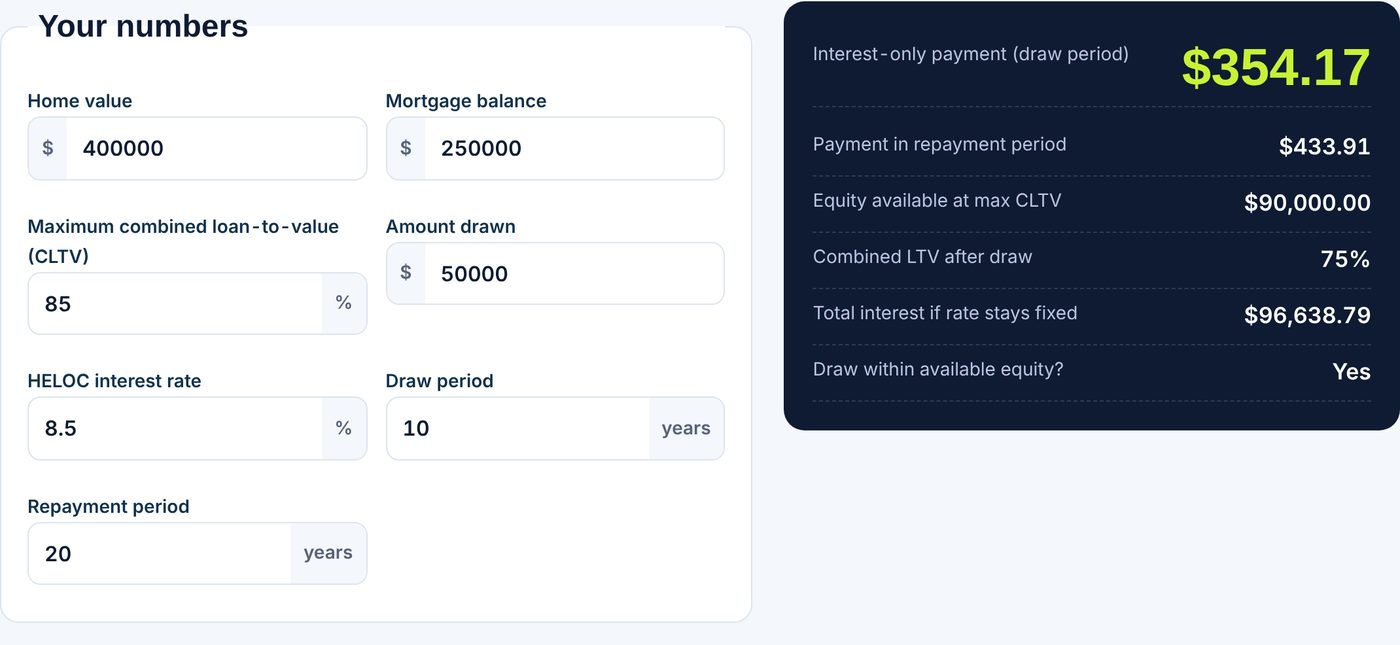
Example (illustration only): a home worth $400,000 with a $250,000 mortgage and an 85 percent limit gives $400,000 x 0.85 – $250,000 = $90,000 of available equity.
Draw period payment
If the plan is interest only, the payment is the drawn balance times the annual rate divided by 12. Draw $50,000 at 8.50 percent and the monthly payment is $50,000 x 0.085 / 12 = $354.17. The balance does not fall, so after 10 years you still owe $50,000.
Repayment period payment
When repayment starts, the standard loan payment formula applies. For a balance B, monthly rate i and N payments:
With $50,000, 8.50 percent and 20 years (240 payments) the payment is $433.91, an increase of $79.74 a month. Across both phases, with the rate held constant and no further borrowing, you would pay $96,638.79 in interest. That figure is a simplified estimate, because real HELOC rates usually change.
| Phase | Length | Monthly payment |
|---|---|---|
| Draw (interest only) | 10 years | $354.17 |
| Repayment | 20 years | $433.91 |
How to calculate it in Excel
Interest-only payment: =50000*0.085/12. Repayment payment: =PMT(0.085/12,20*12,-50000). Available equity: =400000*0.85-250000. Total interest: =B2*12*10+B3*240-50000, where B2 and B3 hold the two payments.
The HELOC calculator on this site runs the same numbers and checks whether your draw fits within the available equity.
Variable rates and other risks
The CFPB notes that HELOCs usually have a variable interest rate, so payments may change from month to month, and that some plans let you convert all or part of the balance to a fixed rate, which is usually higher but more predictable. Because the home secures the line, falling behind could put it at risk.
- Ask whether there are annual fees, draw fees or early closure fees.
- Ask how the rate is set, how often it adjusts and whether there is a cap.
- Ask whether you can make principal payments during the draw period.
- Plan for the higher repayment payment before you draw, not after.
HELOC vs home equity loan
The CFPB explains that a home equity loan pays a single lump sum while a HELOC lets you draw funds several times up to a limit, and repaying a HELOC restores available credit. Home equity loans may be fixed or adjustable, while HELOCs usually have adjustable rates. Either one is a second mortgage on top of your first, so see how it fits with your other debt using the mortgage payoff calculator and the home loan EMI calculator.
Frequently asked questions
What is the draw period on a HELOC?
The first phase of the line, often around 10 years, when you can borrow up to your limit and many plans require only interest on the balance.
Why does my HELOC payment go up?
When the draw period ends, principal repayment starts. If you have been paying interest only, the payment rises because the balance must now be repaid over the remaining term. A rate increase can raise it further.
How much can I borrow with a HELOC?
Lenders usually take a percentage of your home value, such as 85 percent, and subtract your mortgage balance. Your credit and income also matter, and each lender sets its own limits.
Is a HELOC rate fixed or variable?
Usually variable, so payments can change. Some lenders let you lock part of the balance at a fixed rate.