


A US cup holds 16 tablespoons. If you lost the measuring cup or you only need a small amount of an ingredient, that number lets you measure anything with a tablespoon. Below you will find a complete chart, the odd fractions that trip people up and a few tips for measuring sticky and dry ingredients properly.
Updated November 2026
In this guide
- The short answer
- Tablespoons in a cup: full chart
- How to work it out yourself
- Tips for measuring with a tablespoon
- Tablespoons in other countries
- Related conversions
The short answer
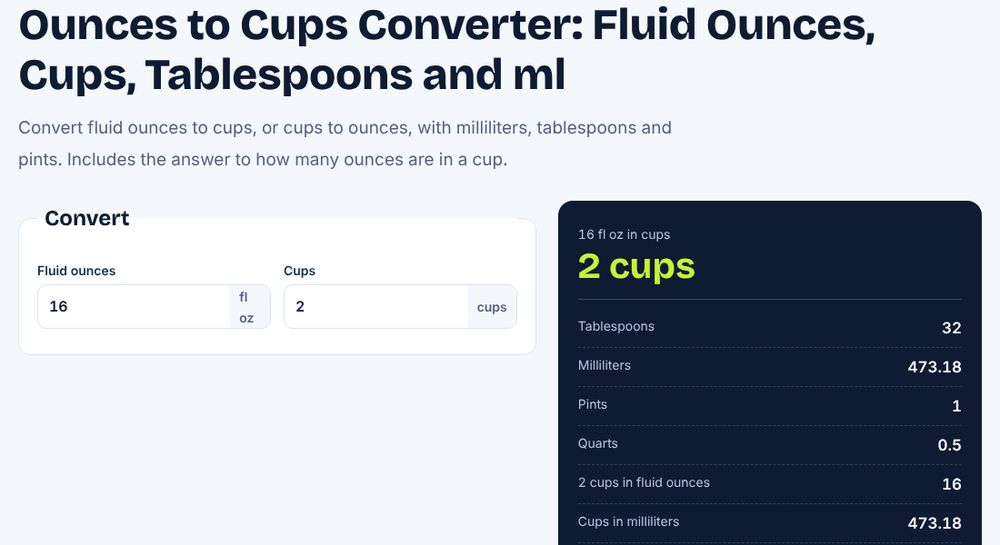
1 cup = 16 tablespoons = 48 teaspoons = 8 fluid ounces. Each tablespoon is 3 teaspoons or half a fluid ounce, which is about 14.79 ml.
Tablespoons in a cup: full chart
| Cup amount | Tablespoons | Teaspoons | Fluid ounces |
|---|---|---|---|
| 1/16 cup | 1 tbsp | 3 tsp | 0.5 fl oz |
| 1/8 cup | 2 tbsp | 6 tsp | 1 fl oz |
| 1/4 cup | 4 tbsp | 12 tsp | 2 fl oz |
| 1/3 cup | 5 tbsp + 1 tsp | 16 tsp | 2.67 fl oz |
| 3/8 cup | 6 tbsp | 18 tsp | 3 fl oz |
| 1/2 cup | 8 tbsp | 24 tsp | 4 fl oz |
| 2/3 cup | 10 tbsp + 2 tsp | 32 tsp | 5.33 fl oz |
| 3/4 cup | 12 tbsp | 36 tsp | 6 fl oz |
| 1 cup | 16 tbsp | 48 tsp | 8 fl oz |
The awkward amounts are 1/3 and 2/3 cup. A third of a cup is 5 tablespoons plus 1 teaspoon because 16 divided by 3 is 5.33, and a third of a tablespoon is 1 teaspoon. Two thirds is exactly double that.
How to work it out yourself
Multiply the number of cups by 16 to get tablespoons. For 0.75 cup that is 0.75 x 16 = 12 tablespoons. To go the other way, divide tablespoons by 16: 6 tablespoons is 6 / 16 = 0.375 cup, or 3/8 cup. For teaspoons multiply cups by 48.
If your recipe needs 2 1/2 cups of sugar and you only have a tablespoon, that is 2.5 x 16 = 40 tablespoons. It is slow, but accurate if you level each spoon. A scale is faster. Use our grams to cups converter to find the weight.
Tips for measuring with a tablespoon
For dry ingredients such as flour, cocoa and baking powder, scoop a heaping spoon and level it with the back of a knife. For liquids, fill the spoon to the brim over a bowl so you do not spill into the recipe. For sticky ingredients like honey, peanut butter and molasses, spray the spoon with a little oil first so the ingredient slides out and the measurement is accurate.
A flatware tablespoon from the drawer is not the same as a measuring tablespoon. Table spoons vary in size and can hold noticeably more or less than 15 ml, so use a real measuring spoon when accuracy matters.
Tablespoons in other countries
The US tablespoon is about 14.79 ml. A metric tablespoon used in Australia is 20 ml, while the UK and most other metric countries use 15 ml. In Australia a recipe that says 4 tablespoons holds 80 ml, which is more than the 59 ml of a US quarter cup. If a recipe comes from another country, check the unit before you convert.
Related conversions
For ounces, see how many ounces are in a cup. For liquid volume in milliliters, use the ml to oz converter. For larger amounts, see quarts in a gallon.
Everyday kitchen conversions
A US stick of butter is 8 tablespoons, which is half a cup or 4 ounces by weight. A standard recipe that calls for 1/4 cup of oil needs 4 tablespoons. A tablespoon of baking powder is 3 teaspoons, so you can split a recipe that needs 1 1/2 teaspoons by using half a tablespoon. When you halve a recipe that uses 1/4 cup, you need 2 tablespoons. When you double a recipe that uses 3 tablespoons, you need 6 tablespoons, which is 3/8 cup. Writing a short list of these on the inside of a cabinet door saves a lot of time and mistakes.
Remember that tablespoon measures assume a level spoon. A heaping tablespoon of flour can hold close to twice the flour of a level one, which makes cakes dry and cookies tough. If a recipe does not say “heaping”, level it.
Worked examples with tablespoons
A US cup holds 16 tablespoons, so the conversions are simple multiplication and division. If a recipe needs three quarters of a cup of oil, multiply 0.75 by 16 to get 12 tablespoons. A third of a cup is 5 tablespoons plus 1 teaspoon, because 16 divided by 3 is 5.33 and one third of a tablespoon is 1 teaspoon. A quarter cup is 4 tablespoons, a half cup is 8 tablespoons and an eighth of a cup is 2 tablespoons.
Suppose you want to make 20 pancakes and the base recipe for 10 pancakes calls for half a cup of melted butter. Doubling gives 1 cup, which is 16 tablespoons. If you only have a tablespoon measure, count out 16 level scoops, or better, cut a stick of butter: one US stick is 8 tablespoons, so you need two sticks.
Teaspoons, tablespoons and fluid ounces together
The kitchen units line up in a few fixed steps. Three teaspoons make one tablespoon. Two tablespoons make one fluid ounce. Sixteen tablespoons make one cup. That means a cup contains 48 teaspoons and 8 fluid ounces. In metric terms a US tablespoon is about 14.8 milliliters, so a cup is about 237 milliliters. Some countries use a 15 milliliter or even 20 milliliter tablespoon, which is why imported recipes can come out slightly different from what you expect.
| Amount | Tablespoons | Teaspoons | Fluid ounces |
|---|---|---|---|
| 1/16 cup | 1 | 3 | 0.5 |
| 1/8 cup | 2 | 6 | 1 |
| 1/4 cup | 4 | 12 | 2 |
| 1/2 cup | 8 | 24 | 4 |
| 3/4 cup | 12 | 36 | 6 |
| 1 cup | 16 | 48 | 8 |
When to measure by weight instead
Tablespoons are fine for liquids, spices and small amounts of fats. For flour, cocoa and powdered sugar they are less accurate, because a heaped tablespoon can differ from a level one by 30 percent or more. For baking, where ratios matter, weigh ingredients whenever the recipe gives grams. For quick cooking such as sauces and dressings, a small error rarely matters, so level tablespoons are fine.
Mistakes to avoid
Do not use a dinner spoon from your cutlery drawer, because those vary widely in size. Level the spoon with the back of a knife instead of heaping it. Do not confuse the tablespoon abbreviation: a capital T usually means tablespoon and a lowercase t means teaspoon, and mixing them up with salt or baking soda can ruin a dish. Finally, when you scale a recipe up or down, convert everything to the same unit first, then multiply, then convert back, so rounding errors do not pile up.
For related conversions see our guide to ounces in a cup and the ml to oz converter.
Quick reference you can memorize
If you only remember three facts, make them these: 3 teaspoons equal 1 tablespoon, 4 tablespoons equal a quarter cup and 16 tablespoons equal a full cup. From those you can rebuild every other conversion in your head. For example, 6 tablespoons is a quarter cup plus 2 tablespoons, because 4 plus 2 is 6. Ten tablespoons is a half cup plus 2 tablespoons. Fourteen tablespoons is a cup minus 2 tablespoons, which is handy when a recipe says almost a full cup.
Butter packaging makes this even easier in the United States. Each tablespoon line on the wrapper equals one tablespoon, and the wrapper is marked at 8 lines for a full stick. A half cup of butter is therefore one stick, and one cup is two sticks. If you ever need to convert a stick into ounces, it is 4 ounces by weight, or 113 grams.
Measuring sticky ingredients
Honey, peanut butter and molasses cling to the spoon, so you lose some every time. Spray the spoon with a little oil or dip it in hot water first and the ingredient will slide off. For a very small amount such as 1 tablespoon of yeast, use a measuring spoon rather than eyeballing, since too much or too little changes how the dough rises. For salt, level the spoon, because a heaping tablespoon can hold nearly twice as much as a level one and your dish will taste far too salty.
Frequently asked questions
How many tablespoons are in half a cup?
There are 8 tablespoons in half a cup.
How many tablespoons are in 1/4 cup?
There are 4 tablespoons in a quarter cup.
How many tablespoons are in 3/4 cup?
There are 12 tablespoons in three quarters of a cup.
How many teaspoons are in a tablespoon?
There are 3 teaspoons in one tablespoon.
How many tablespoons are in 1/3 cup?
A third of a cup is 5 tablespoons plus 1 teaspoon.