


The usual answer is somewhere between 2,000 and 2,500 steps per mile, but your own number depends on how long your stride is. A tall person who walks briskly may need fewer than 2,000 steps, while a shorter person strolling may need more than 2,500. This guide shows you the formula, a chart for common stride lengths and an easy way to measure your own.
Updated November 2026
In this guide
- The quick answer
- The formula
- Steps per mile chart by stride length
- How height affects your steps
- How to measure your own steps per mile
- What about 10,000 steps?
- Walking vs running
The quick answer
A mile is 5,280 feet. If your average step covers 2.5 feet, you need 5,280 / 2.5 = 2,112 steps to walk a mile. That is why 2,000 to 2,500 steps is the common range for adult walking. Running steps are longer, so a runner usually needs far fewer steps per mile than a walker.
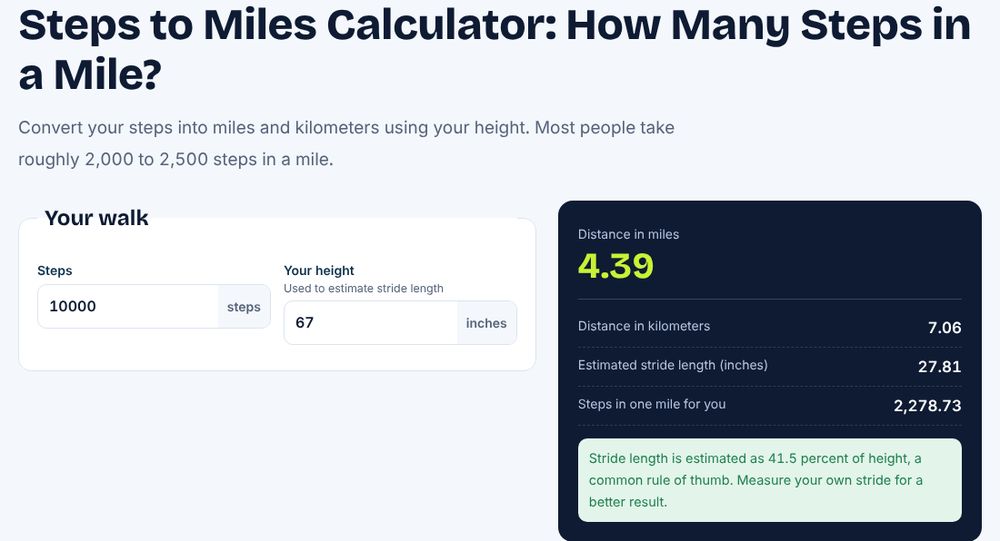
If you want a fast answer, use our steps to miles calculator, which converts any step count into miles and kilometers.
The formula
Steps per mile = 5,280 divided by your stride length in feet. A stride length here means the distance covered by one step, not a pair of steps.
Example: stride length 2.2 feet gives 5,280 / 2.2 = 2,400 steps per mile. Stride length 2.8 feet gives 5,280 / 2.8 = 1,886 steps per mile. The reverse formula gives miles from steps: miles = steps x stride length / 5,280.
Steps per mile chart by stride length
| Stride length | Steps per mile | Steps per kilometer (approx.) |
|---|---|---|
| 2.0 ft (24 in) | 2,640 | 1,640 |
| 2.2 ft (26.4 in) | 2,400 | 1,490 |
| 2.5 ft (30 in) | 2,112 | 1,312 |
| 2.8 ft (33.6 in) | 1,886 | 1,172 |
| 3.0 ft (36 in) | 1,760 | 1,094 |
Kilometer values are rounded. One mile is 1.609 kilometers, so a kilometer needs about 62 percent of the steps of a mile.
How height affects your steps
A common rule of thumb says a walking stride is about 0.413 times your height. A person who is 5 feet 6 inches (66 inches) would have a stride near 27.3 inches, which is 2.27 feet, or roughly 2,320 steps per mile. A person who is 6 feet (72 inches) would have a stride near 29.7 inches, about 2.48 feet, or roughly 2,130 steps per mile. This is only an estimate, because pace, age, footwear and terrain all change your real stride.
How to measure your own steps per mile
The most accurate way is to count. Walk a known distance at your normal pace, such as a quarter-mile lap on a track or a measured 100 feet marked on a flat path. Count your steps for the whole distance, then scale up. If you take 530 steps for a quarter mile, you take 530 x 4 = 2,120 steps per mile. Repeat twice and average the results.
You can also use a phone or fitness tracker, but those devices estimate stride length from your height and can be off by several percent. Calibrating the stride length in the app with a measured walk improves accuracy.
What about 10,000 steps?
Ten thousand steps is a popular daily target. At 2,112 steps per mile it is about 4.7 miles. At 2,400 steps per mile it is about 4.2 miles, and at 1,886 steps per mile it is about 5.3 miles. Your own distance depends on your stride, so treat 10,000 steps as roughly four to five miles for most adults.
If you want to set a distance goal instead of a step goal, convert it first. A 3-mile walk at 2,112 steps per mile takes about 6,336 steps.
Walking vs running
Running lengthens the stride, so a runner may cover a mile in 1,400 to 1,800 steps depending on speed and height. Cadence is different from stride: cadence is steps per minute. A walker at a brisk pace commonly takes around 100 to 120 steps per minute, which at 2,112 steps per mile gives a mile in about 18 to 21 minutes. Do not rely on these as exact, because individual differences are large.
Why your tracker may disagree with a calculator
Fitness bands, watches and phone apps count steps with motion sensors and estimate distance from a stride length that is either typed in or guessed from your height. If the stride length is wrong by 10 percent, the distance is wrong by 10 percent. A walk of 6,000 steps at a true stride of 2.5 feet is 6,000 x 2.5 / 5,280 = 2.84 miles. If your device assumes 2.2 feet, it reports 6,000 x 2.2 / 5,280 = 2.5 miles. Setting the correct stride length, or calibrating with a measured walk, removes most of the gap.
Hills, stairs and carrying weight shorten your stride, so the same 6,000 steps cover less ground on a hilly route. Treat tracker distance as an estimate and compare it with a map-based distance when you need accuracy, for example for charity walks or training logs.
How to set a realistic step goal
Pick a distance goal first, then convert. If you want to walk 3 miles a day and your stride gives 2,112 steps per mile, your goal is 6,336 steps. Add the steps you already take in normal daily life, which many people estimate with a few days of tracking before they set targets. Increase gradually, for example by 500 to 1,000 steps a week, so that you give joints and habits time to adapt.
Worked examples: turning steps into distance
Use steps per mile to convert in both directions. If your stride gives about 2,200 steps per mile, then 8,800 steps is 4 miles, because 8,800 divided by 2,200 equals 4. To reach exactly 5 miles you need 11,000 steps. A 10,000-step day at that stride is about 4.55 miles, found by dividing 10,000 by 2,200. If your stride is shorter and you take 2,500 steps per mile, the same 10,000 steps cover 4 miles, so the “same” goal is a different distance for different people.
For a route you plan to walk, work backwards. A 3.2-mile loop at 2,200 steps per mile is 7,040 steps. A 10-kilometer walk is 6.21 miles, which is about 13,660 steps at that stride. Keep a note of your personal figure once you measure it, because it makes every later estimate more accurate.
Treadmills, hills and uneven ground
Your step count per mile changes with terrain. Walking uphill shortens your stride, so you take more steps for the same distance, while a gentle downhill lengthens it. On a treadmill the belt speed sets your cadence, so steps per mile can differ from outdoor walking even at the same pace. Soft surfaces such as sand also shorten stride. If you want an accurate number, measure on the kind of surface you usually use, and repeat the test two or three times to average out the variation.
Using steps to plan a training week
If you are building up to a regular walking habit, set weekly totals instead of chasing a perfect day. For example, aim for 56,000 steps over seven days, which is an average of 8,000 per day and about 25 miles at 2,200 steps per mile. You can then split the total across busy and quiet days. Increase the weekly total gradually, adding perhaps 5 to 10 percent at a time, so your legs and feet adapt.
To convert steps and distance quickly, you can also use our unit rate calculator, entering steps as the quantity and miles as the unit.
Common questions about stride and pace
Stride length is roughly the distance between two footprints of the same foot divided by two. Taller people usually have longer strides, but pace, fitness and footwear also matter. If your device asks for stride length, enter your measured value instead of the default to improve its distance estimates. When you jog, your stride gets longer and you take fewer steps per mile than when you walk, so keep separate figures for each activity.
Quick recap
Most adults take roughly 2,000 to 2,500 steps per mile, depending on height and speed. Measure your own number over a known distance, such as a quarter-mile track, then use it to convert any step goal into miles. Recheck the figure when you change shoes, speed or terrain, and treat tracker values as estimates rather than exact measurements. With a personal number in hand, planning walks, runs and weekly targets becomes simple arithmetic instead of guesswork.
Frequently asked questions
How many steps are in a mile for an average person?
About 2,000 to 2,500 steps, with 2,112 steps for a 2.5 foot stride.
How many steps are in a kilometer?
Roughly 1,250 to 1,550 steps, depending on stride length.
How many miles is 10,000 steps?
About 4 to 5 miles, or 4.7 miles at a 2.5 foot stride.
Do shorter people take more steps per mile?
Usually yes, because they have a shorter stride and need more steps to cover 5,280 feet.