


There are 8 fluid ounces in one US cup. That single fact answers most kitchen questions, but it stops being true the moment a recipe lists an ingredient by weight. This guide explains why, gives you a chart you can bookmark, and shows how to convert both fluid and dry ingredients without ruining a recipe.
Updated November 2026
In this guide
- The quick answer
- Cups to fluid ounces chart
- Fluid ounces vs ounces by weight
- How to measure a cup accurately
- US cups, metric cups and UK cups
- Related conversions you will need
The quick answer
One US cup equals 8 fluid ounces (fl oz). A fluid ounce measures volume, the space a liquid takes up. So a cup of milk, water, juice or oil fills 8 fluid ounces of space.
Half a cup is 4 fl oz, a quarter cup is 2 fl oz and two cups make 16 fl oz, which is one US pint. Our ounces to cups converter does these conversions instantly if you have an odd amount.
Cups to fluid ounces chart
Use this chart for liquids and for anything measured in a liquid measuring cup.
| US cups | Fluid ounces | Tablespoons | Milliliters (approx.) |
|---|---|---|---|
| 1/4 cup | 2 fl oz | 4 tbsp | 59 ml |
| 1/3 cup | 2.67 fl oz | 5 tbsp + 1 tsp | 79 ml |
| 1/2 cup | 4 fl oz | 8 tbsp | 118 ml |
| 2/3 cup | 5.33 fl oz | 10 tbsp + 2 tsp | 158 ml |
| 3/4 cup | 6 fl oz | 12 tbsp | 177 ml |
| 1 cup | 8 fl oz | 16 tbsp | 237 ml |
| 1 1/2 cups | 12 fl oz | 24 tbsp | 355 ml |
| 2 cups | 16 fl oz | 32 tbsp | 473 ml |
The milliliter column is rounded. One US fluid ounce is 29.5735 ml, so a cup is 236.59 ml. For more detail see the ml to oz converter.
Fluid ounces vs ounces by weight
This is where most mistakes happen. A fluid ounce measures volume. An ounce on a kitchen scale measures weight. For water the two numbers are close: a cup of water weighs about 8.3 ounces. For almost every other ingredient they differ.
A cup of all-purpose flour weighs about 4.2 ounces because flour is light and airy. A cup of granulated sugar weighs about 7 ounces, and a cup of butter weighs 8 ounces. All of them fill the same 8 fluid ounces of space in a measuring cup, but none of them weigh 8 ounces except butter. Typical values vary by brand and by how you scoop.
| Ingredient (1 cup) | Typical weight in grams | Typical weight in ounces |
|---|---|---|
| All-purpose flour | 120 to 125 g | 4.2 to 4.4 oz |
| Granulated sugar | 200 g | 7.1 oz |
| Butter | 227 g | 8 oz |
| Water | 237 g | 8.4 oz |
| Honey | 340 g | 12 oz |
If a recipe says “8 ounces of flour” it means weight, so you need about 1 3/4 cups, not one cup. Use the grams to cups converter with the grams per cup of your ingredient to check.
How to measure a cup accurately
Use a liquid measuring cup (clear, with a spout and marked lines) for liquids and place it on a flat counter. Bend down to read the line at eye level. Use nested dry measuring cups for flour, sugar and similar ingredients. Spoon the flour into the cup and level the top with a knife rather than scooping straight from the bag, which packs in extra flour and can add 20 percent or more.
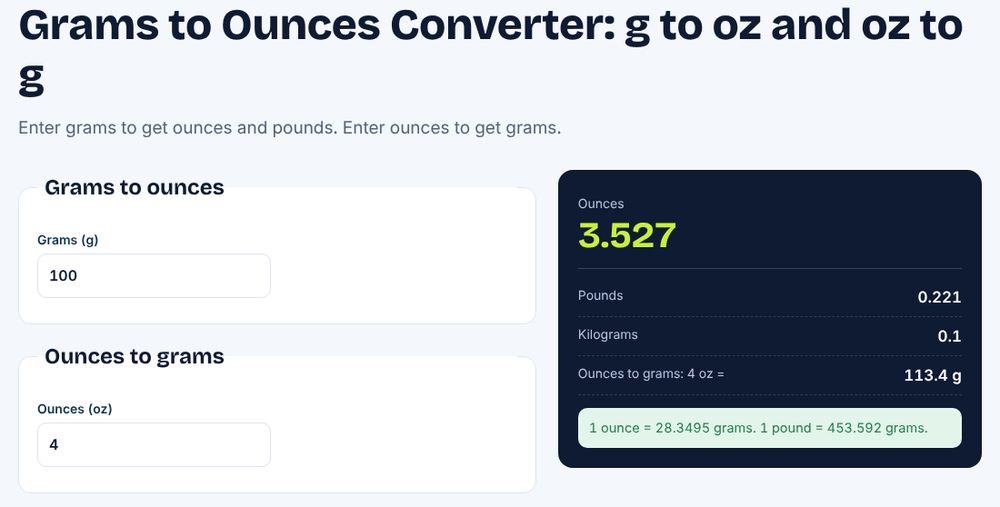
For baking where accuracy matters, a digital scale is better than any cup. Weigh in grams and convert with grams to ounces if your recipe uses ounces.
US cups, metric cups and UK cups
Not every country uses the same cup. The US customary cup is about 237 ml. A metric cup used in Australia, New Zealand and some other places is 250 ml. Nutrition labels in the US use a 240 ml cup. A traditional imperial cup of 10 imperial fluid ounces is roughly 284 ml. The differences are small for a cup of milk but add up in a recipe that calls for four or five cups of flour, so check where the recipe was written.
Related conversions you will need
There are 2 cups in a pint, 4 cups in a quart and 16 cups in a gallon. See our guide to quarts in a gallon for the full ladder. There are 16 tablespoons in a cup and 3 teaspoons in a tablespoon, so one cup holds 48 teaspoons.
Quick mental math
To change cups into fluid ounces, multiply by 8. To change fluid ounces into cups, divide by 8. So 20 fluid ounces is 2.5 cups and 3 cups is 24 fluid ounces. A pint container of milk holds 2 cups, and a standard 12 fl oz can of soda holds 1 1/2 cups. Keeping these anchor numbers in mind makes it easy to scale a recipe up or down without a calculator.
Worked examples: scaling recipes by the cup
Knowing that one US cup equals 8 fluid ounces lets you scale any recipe without a measuring cup. Suppose a soup recipe needs 3 cups of broth and you only have a jug marked in fluid ounces. Multiply 3 by 8 and you need 24 fluid ounces. If you want to halve a recipe that calls for 1.5 cups of milk, the answer is 0.75 cup, which is 6 fluid ounces. To double a recipe that needs 2.5 cups of stock, you need 5 cups, which is 40 fluid ounces.
Going the other way, divide by 8. A 32-ounce carton of broth holds 4 cups, and a 12-ounce can of evaporated milk holds 1.5 cups. A 16-ounce bottle of water is exactly 2 cups, which is why many people count bottles toward a daily water target. If your target is 64 ounces, that equals 8 cups, or four of those bottles.
Cups to ounces for common ingredients
The fluid ounce measures volume, so the 8-ounce cup rule holds for any liquid. Dry ingredients are different because the same cup holds different weights. As a rough guide, a cup of water weighs about 8.3 ounces, a cup of all-purpose flour weighs around 4.25 ounces (120 grams), and a cup of granulated sugar weighs about 7 ounces (200 grams). Weights vary with how the ingredient is packed and sifted, so recipes written in grams are more reliable than recipes written in cups. If your recipe lists weights, a kitchen scale will give a more consistent result than any cup.
Common mistakes when converting cups and ounces
The most frequent mistake is treating fluid ounces and weight ounces as the same thing. A cup of honey holds 8 fluid ounces but weighs about 12 ounces, because honey is denser than water. A second mistake is using a coffee cup, which usually holds 6 to 12 ounces rather than a standard cup. Many coffee-maker “cups” are only 5 to 6 ounces, so a 12-cup machine makes closer to 60 to 72 ounces than 96. A third mistake is reading a liquid measuring cup from above instead of at eye level, which can shift the amount by a few percent. Finally, remember that a few recipes written in the United Kingdom or Australia use different cup sizes, so check where the recipe comes from.
You can double-check any of these numbers in seconds with our ml to oz converter, and for weight conversions use the grams to ounces converter.
Cups to ounces for drinks and daily water goals
Health guidance on hydration is often given in cups or ounces, so the conversion comes up constantly. Eight cups is 64 fluid ounces, ten cups is 80 and twelve cups is 96. A standard 16.9-ounce disposable water bottle is a little over 2 cups, and a 32-ounce reusable bottle holds exactly 4 cups. If you want to drink 80 ounces a day, a 32-ounce bottle refilled two and a half times does the job. Individual needs vary with body size, climate and activity, so treat any figure as a starting point and ask a clinician if you have a medical condition.
The same math helps with baby formula, coffee ratios and cocktail recipes. A pour-over coffee that calls for 12 ounces of water uses 1.5 cups, and a punch recipe for a party of 20 that allows 6 ounces each needs 120 ounces, or 15 cups, which is just under a gallon. Remember that one gallon is 16 cups, so a gallon jug covers that punch with a little left over.
Frequently asked questions
How many ounces are in a cup of water?
A cup of water is 8 fluid ounces by volume and weighs about 8.3 ounces.
How many ounces are in a cup of flour?
A cup of all-purpose flour weighs about 4.2 to 4.4 ounces, although it still fills 8 fluid ounces of space.
How many dry ounces are in a cup?
There is no single number. It depends on the ingredient, so convert using grams per cup for the specific item.
How many cups is 16 ounces?
16 fluid ounces is 2 cups. 16 ounces of flour by weight is about 3.7 cups.