


There are 168 hours in a week. That number is useful for planning staffing, billing clients, setting study goals or working out how much of your week a job really takes. This guide gives you the arithmetic, a chart for days, months and years and a few practical ways to use it.
Updated November 2026
In this guide
- The quick answer
- Hours in a day, week, month and year
- How a 40-hour work week fits
- How to convert hours and minutes to decimals
- Using 168 hours for time budgeting
- Hours for billing and overtime
The quick answer
A week has 7 days and each day has 24 hours, so 7 x 24 = 168 hours. In minutes that is 168 x 60 = 10,080 minutes, and in seconds it is 604,800.
Hours in a day, week, month and year
| Period | Hours | Minutes |
|---|---|---|
| 1 day | 24 | 1,440 |
| 1 week | 168 | 10,080 |
| 4 weeks | 672 | 40,320 |
| 1 average month (365 days / 12) | 730 | 43,800 |
| 1 year (365 days) | 8,760 | 525,600 |
| 1 leap year (366 days) | 8,784 | 527,040 |
A month is not a fixed number of weeks. An average month is 8,760 hours divided by 12, which is 730 hours or about 30.4 days. For payroll that uses exact calendar months you need to count the days of that month.
How a 40-hour work week fits
A full-time week of 40 hours is 40 / 168 = 23.8 percent of all the hours in a week. With 8 hours of sleep each night (56 hours a week), 40 hours of work and about 5 hours of commuting, you still have about 67 hours for everything else. A yearly total of 40 hours x 52 weeks is 2,080 working hours, which is a common basis for converting an hourly wage into a yearly salary. See our annual income calculator and salary to hourly calculator.
How to convert hours and minutes to decimals
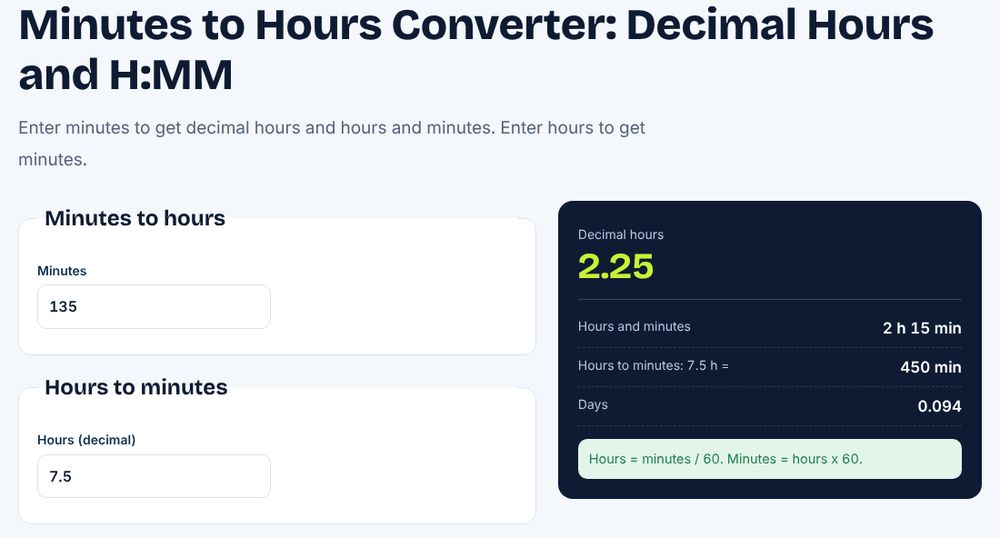
Payroll and billing usually use decimal hours. To convert minutes to a decimal, divide by 60. So 15 minutes is 0.25 hours, 30 minutes is 0.5 hours and 45 minutes is 0.75 hours. A shift of 7 hours 45 minutes is 7.75 hours. Over a week of five such shifts you get 38.75 hours. Use the minutes to hours converter if you want to check a number quickly.
In Excel, if A2 holds minutes, =A2/60 gives decimal hours. If you track time as a clock value such as 7:45, multiply by 24 to get decimal hours: =A2*24. Format the result cell as a number, not as time.
Using 168 hours for time budgeting
Time budgeting starts with the full 168 hours. List fixed items first: sleep, work, commuting, classes. Subtract them and see what is left for flexible activities such as exercise, family, study and rest. Many people find that seeing the remaining hours as a number is more honest than saying they are “too busy”. A study plan for a course that asks for 10 hours a week is 10 / 168, about 6 percent of your week.
Hours for billing and overtime
If you bill by the hour, track hours weekly. A freelancer who bills 25 hours a week at $40 an hour earns $1,000 a week before costs. For employees paid by the hour, hours above 40 in a week are typically overtime under US federal rules, and many employers pay time and a half. Use our time and a half calculator and overtime calculator to see the pay. A timesheet makes weekly totals easier: try our timesheet template.
Weekly planning examples
A part-time employee who works 20 hours a week uses 20 / 168 = 11.9 percent of the week at work. A student who attends 15 hours of classes, studies 25 hours and sleeps 56 hours has used 96 hours, leaving 72 hours for meals, travel, work, exercise and rest. Writing the budget as a table makes trade-offs visible: if you add a 12-hour weekend job, the free time drops to 60 hours.
| Activity | Hours per week | Share of 168 hours |
|---|---|---|
| Sleep (8 h a night) | 56 | 33.3% |
| Full-time work | 40 | 23.8% |
| Commute (1 h a day, 5 days) | 5 | 3.0% |
| Everything else | 67 | 39.9% |
The shares add up to 100 percent: 56 + 40 + 5 + 67 = 168. Use the same layout for a team: add up everyone’s assigned hours and compare the total with the 40 hours each person can realistically contribute.
Hours per week for payroll in a month
A 40-hour week is not exactly 160 hours a month. Multiply weekly hours by 52 and divide by 12: 40 x 52 / 12 = 173.3 hours a month. For a monthly salary converted to hourly, divide by 173.3 for a 40-hour week. For a 35-hour week the figure is 35 x 52 / 12 = 151.7 hours. This is the same logic used in our salary to hourly guide.
Worked examples: where do the 168 hours go?
A week has 7 days of 24 hours, which is 168 hours. Take a person who sleeps 8 hours a night, so 56 hours go to sleep. A full-time job of 40 hours, plus 5 hours of commuting, adds 45. That leaves 168 minus 56 minus 45, which is 67 hours for meals, chores, exercise, family and free time. If meals and chores take 3 hours a day, which is 21 hours, then 46 hours remain for everything else. Seeing the number laid out makes it easier to decide where an extra project can fit.
Hours in a week for part-time and shift work
Many jobs are quoted in hours per week. A 20-hour part-time job is almost 12 percent of the week, since 20 divided by 168 is 0.119. A 12-hour shift worked 3 days a week totals 36 hours. A person working four 10-hour days reaches 40 hours with one fewer day. For overtime in the United States, hours over 40 in a workweek are generally paid at a higher rate for non-exempt employees, but rules vary by state and employer, so check your own agreement.
Converting weekly hours into monthly and yearly totals
A year has 52 weeks plus one day, so 40 hours a week is about 2,080 hours a year. Dividing 52 by 12 gives 4.33 weeks per month, so 40 weekly hours is about 173.3 hours a month. A freelancer who bills 25 hours a week therefore bills about 108 hours in an average month and 1,300 hours in a year. If the hourly rate is 30 dollars, that is 3,250 dollars a month before expenses and taxes, and 39,000 dollars a year. Use these conversions to estimate income, workloads and project timelines.
For quick checks, try our minutes to hours converter and the annual income calculator.
Planning a week with time blocks
A practical way to use the 168 hours is to block them. Start by marking fixed blocks: sleep, work, school and commitments. Next, add recurring needs such as meals, hygiene and travel. What remains is flexible time. If flexible time is only 20 hours, a new 5-hour weekly commitment takes a quarter of it, which is worth knowing before you say yes. Review the plan each Sunday and adjust. Many people find that tracking one real week reveals a few hours that were hiding in scrolling, waiting or unplanned errands.
Hours in a week across different countries
The number of hours in a week is always 168, but standard working weeks differ. Many countries use 40 hours, some use 35 or 37.5 and others allow up to 48 with overtime rules. If you work with international clients, confirm the weekly hour count in the contract and how holidays are counted, so your invoices and expectations match.
You can also try the days until December 1st calculator to plan deadlines.
Recap and quick formulas
Remember three formulas. Hours in a week equal 24 times 7, which is 168. Hours in a year equal 24 times 365, which is 8,760 in a common year. Working hours per year equal weekly hours times 52. With those, you can convert almost any weekly schedule into daily, monthly or yearly totals, which is useful for planning, billing and personal goals. Write the result down once and reuse it, so you do not have to calculate it again each time.
Frequently asked questions
How many hours are in a week?
168 hours, which is 7 days of 24 hours.
How many work hours are in a week?
A standard full-time week is 40 hours, which is about 24 percent of the week.
How many hours are in a year?
8,760 hours in a 365-day year and 8,784 hours in a leap year.
How many hours are in a month?
An average month has about 730 hours, but the exact number depends on the number of days in that month.