



A normal year has 8,760 hours. A leap year, which has an extra day, has 8,784 hours. The numbers come from multiplying the days in the year by 24 hours in a day. People ask this question for many reasons: to convert an hourly wage into a yearly salary, to plan a project, to estimate machine or server time, to work out the cost of electricity for a device that runs all day, or just out of curiosity. This page gives the hours, minutes and seconds in a year, explains leap years, shows the standard number of work hours in a year, gives examples of pay conversion and shows the Excel formulas to calculate them for any year.
Updated November 2026
In this guide
- Hours in a year: the quick answer
- Hours, minutes and seconds in a year
- Which years are leap years?
- Hours in a month
- Standard work hours in a year
- Example: work hours after holidays and leave
- Convert an hourly wage to a yearly salary
- Hours for devices and electricity
- Hours spent on daily activities
- Excel formulas for hours in a year
- Convert hours to days and weeks
- Hours in a year for servers and equipment
- Hours for rentals, subscriptions and loans
- Common mistakes
- Practice problems
- Quick summary
Hours in a year: the quick answer
A normal year has 365 days. Each day has 24 hours, so the year has 365 times 24, which is 8,760 hours. A leap year has 366 days, so it has 366 times 24, which is 8,784 hours. The extra day adds exactly 24 hours. The average calendar year in the Gregorian system is about 365.2425 days, which is about 8,765.82 hours. For most calculations, 8,760 is the number to use.
Hours, minutes and seconds in a year
The table shows the common units for a normal and a leap year.
| Unit | Normal year (365 days) | Leap year (366 days) |
|---|---|---|
| Days | 365 | 366 |
| Weeks | 52.14 | 52.29 |
| Hours | 8,760 | 8,784 |
| Minutes | 525,600 | 527,040 |
| Seconds | 31,536,000 | 31,622,400 |
Minutes come from multiplying the hours by 60, and seconds from multiplying the minutes by 60. For example, 8,760 times 60 is 525,600, and 525,600 times 60 is 31,536,000.
Which years are leap years?
A leap year happens every 4 years, to keep the calendar in line with the time it takes the Earth to go around the Sun. The rule has two exceptions: a year divisible by 100 is not a leap year unless it is also divisible by 400. So 2028 and 2032 are leap years, 2100 is not, and 2000 was. When you plan across years, check whether February 29 is included. The extra 24 hours can matter for payroll, rentals and contracts that count days.
Hours in a month
On average, a year of 8,760 hours divided by 12 months gives 730 hours per month. Real months differ: a 30-day month has 720 hours, a 31-day month has 744 hours and February has 672 hours, or 696 in a leap year. The 730 figure is a useful average for budgeting, such as the monthly cost of a service that runs all the time. Our hours in a week guide gives the weekly number, which is 168.
Standard work hours in a year
Most people do not work every hour of the year. The standard full-time year is 40 hours a week for 52 weeks, which is 2,080 hours. This number is commonly used in payroll in the United States. The actual figure depends on the calendar. A year with 261 weekdays, such as 2026, has 261 times 8, which is 2,088 hours, before holidays. A leap year such as 2028 has 260 weekdays, which gives 2,080 hours. Subtract public holidays and vacation to get the hours really worked.
Example: work hours after holidays and leave
Suppose a person has 261 weekdays in the year, 10 public holidays and 15 days of paid leave. The working days are 261 minus 10 minus 15, which is 236. At 8 hours a day, that is 236 times 8, which is 1,888 hours. This is a more realistic number than 2,080 for a person who takes all their leave. Use it for capacity planning, project estimates and the real cost of an employee. Our weeks in a year guide helps to check the weeks.
Convert an hourly wage to a yearly salary
Multiply the hourly rate by the number of paid hours. With the standard 2,080 hours, a wage of 20 per hour gives 20 times 2,080, which is 41,600 per year. To convert a salary to an hourly rate, divide by 2,080. A salary of 52,000 gives 52,000 divided by 2,080, which is 25 per hour. If the job pays for fewer hours, such as 30 a week, use 30 times 52, which is 1,560 hours. Our annual income calculator does these conversions for you.
Hours for devices and electricity
If a device runs all day, every day, it uses power for 8,760 hours a year. A device of 100 watts uses 0.1 kilowatts, so in a year it uses 0.1 times 8,760, which is 876 kilowatt-hours. At a price of 0.15 per kilowatt-hour, the yearly cost is 131.40. A device that runs 8 hours a day uses 8 times 365 hours, which is 2,920 hours, and costs a third as much. This is a simple way to estimate running costs and to compare a device that stays on with one that you switch off.
Hours spent on daily activities
The year can be broken into the activities of a typical day. Sleeping for 8 hours a day takes 2,920 hours a year, which is one third of the year. Working 8 hours a day on 236 days takes 1,888 hours. Commuting for one hour a day on those days adds 236 hours. Spending one hour a day on a hobby is 365 hours, which is more than 15 full days. Looking at the year in hours makes it easier to see where the time goes and to decide what to change.
Excel formulas for hours in a year
For any year in cell A1, the number of days is =DATE(A1,12,31)-DATE(A1,1,1)+1, and the hours are that number times 24. A single formula is =(DATE(A1,12,31)-DATE(A1,1,1)+1)*24. For 2026 it returns 8,760, and for 2028 it returns 8,784. To find the work hours, use =NETWORKDAYS(DATE(A1,1,1),DATE(A1,12,31))*8, which gives 2,088 for 2026 and 2,080 for 2028. Add a holiday list as the third argument of NETWORKDAYS to subtract holidays. Our DATEDIF guide shows other date counts.
Convert hours to days and weeks
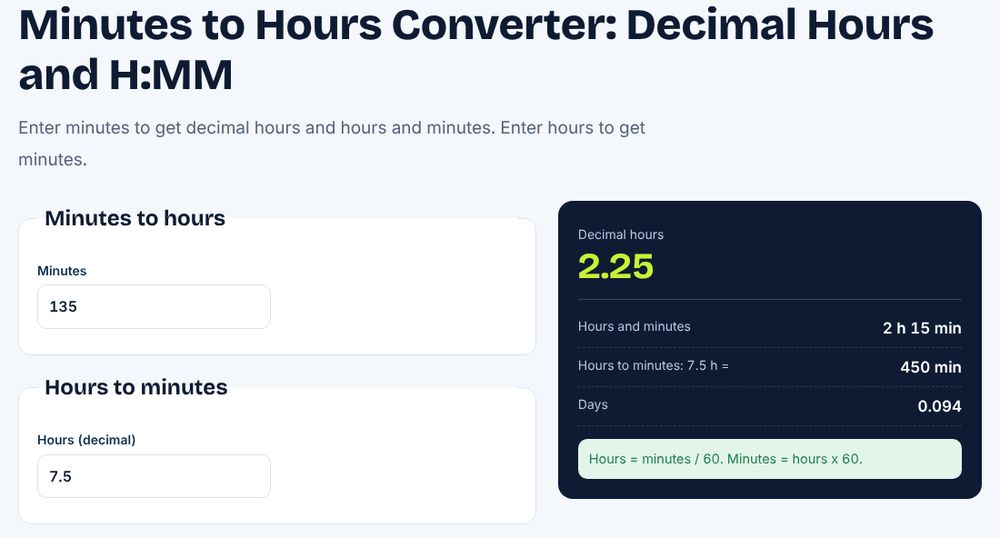
Divide the hours by 24 to get days, and by 168 to get weeks. In a normal year, 8,760 divided by 24 is 365 days, and 8,760 divided by 168 is 52.14 weeks. For a single task, 100 hours is 4.17 days of 24 hours, but only 12.5 working days of 8 hours, so be clear which kind of day you mean. Our minutes to hours converter helps when your data is in minutes.
Hours in a year for servers and equipment
People who run websites, servers or machines often talk about uptime as a percentage of the hours in a year. If a service must be available 99.9 percent of the time, the allowed downtime in a normal year is 0.1 percent of 8,760 hours, which is 8.76 hours. At 99 percent, the allowed downtime is 87.6 hours, and at 99.99 percent it is only 0.876 hours, or about 53 minutes. These numbers help to compare service levels and to decide how much redundancy is worth paying for. Use 8,784 hours for a leap year if the contract counts the extra day.
Hours for rentals, subscriptions and loans
Prices are sometimes quoted per hour and sometimes per year, so a quick conversion helps. A rental of 2 per hour, used all year, would cost 2 times 8,760, which is 17,520. A subscription of 120 per year costs about 0.0137 per hour, because 120 divided by 8,760 is 0.0137. Comparing the cost per hour of use is also helpful for equipment: a tool that costs 400 and is used 100 hours a year costs 4 per hour in the first year, and less each year that you keep using it.
Common mistakes
The most common mistake is to use 365 days in a leap year, which gives 8,760 instead of 8,784. Another is to confuse the total hours in a year with the hours worked, which is only about a quarter of the total. A third is to forget that the standard 2,080 does not subtract holidays. A fourth is to use 52 weeks as exactly one year, when the year has 52 weeks and 1 or 2 extra days. A fifth is to mix 24-hour days and 8-hour work days in a project plan.
Practice problems
Try these. Problem 1: how many hours are in 3 normal years? 3 times 8,760, which is 26,280. Problem 2: how many hours are in a leap year? 8,784. Problem 3: a wage of 18 per hour for 2,080 hours is 37,440 per year. Problem 4: a machine that runs 16 hours a day for 300 days runs 4,800 hours. Problem 5: how many minutes are in a leap year? 527,040.
Quick summary
A normal year has 8,760 hours, 525,600 minutes and 31,536,000 seconds. A leap year has 8,784 hours. The average month has 730 hours. The standard work year has 2,080 hours, and the real number depends on weekdays, holidays and leave. Multiply an hourly wage by 2,080 for a yearly figure and divide a salary by 2,080 for the hourly rate. Use the Excel formulas to calculate the hours for any year, and keep track of whether you mean total hours or working hours.
Frequently asked questions
How many hours are in a year?
A normal year has 8,760 hours, and a leap year has 8,784 hours.
How many minutes are in a year?
There are 525,600 minutes in a normal year.
How many work hours are in a year?
The standard figure is 2,080 hours, which is 40 hours for 52 weeks.
How many hours are in a month?
On average 730 hours.
How do I calculate hours in a year in Excel?
Use =(DATE(year,12,31)-DATE(year,1,1)+1)*24.
Related guides and free tools
- How Many Seconds Are in a Day? Full Breakdown, Formulas and Excel Method
- How Many Minutes in a Day? 1,440 Minutes, Plus Seconds, Weeks and Excel Formulas
- How many hours in a week
- How many weeks in a year
- Annual income calculator
- Minutes to hours converter
- All free calculators
- All free calculators and templates