



A certificate of deposit looks simple: you lock in money and get a rate. But the rate on the ad is often not the rate you earn, and the way interest compounds changes the result. This guide explains how CD interest is calculated and shows the math with a worked example you can repeat in Excel.
Updated November 2026
The basic idea
A certificate of deposit holds your money for a fixed term in exchange for a stated interest rate. According to the SEC’s Investor.gov overview of CDs, the disclosure should tell you the maturity date, whether the rate is fixed or variable, how often interest is paid and any penalty for early withdrawal. Those four items decide how much you earn and how flexible the money is.
Stated rate vs APY
Banks often quote two numbers. The stated rate (or APR) ignores compounding. The APY includes it. Compounding means interest earned in one period is added to the balance and earns interest in later periods, so more frequent compounding gives a slightly higher APY for the same stated rate.
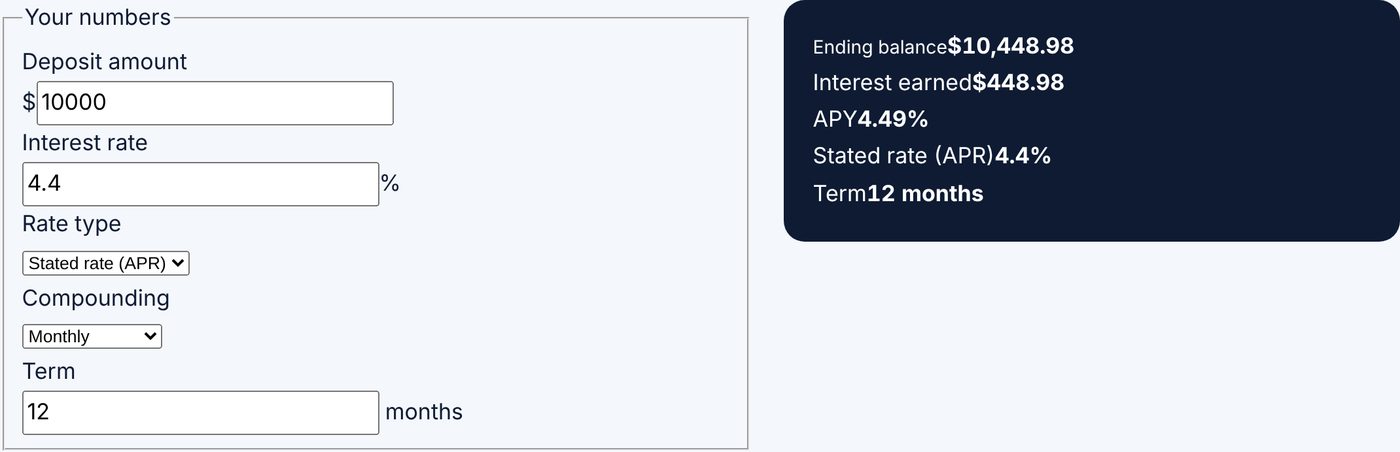
Here m is the number of compounding periods per year. For a stated rate of 4.40 percent compounded monthly, APY = (1 + 0.044 / 12)^12 – 1 = 4.49 percent.
Worked example
These figures are an illustration, not a quote from any bank. Take a $10,000 deposit at a 4.40 percent stated rate.
| Compounding | Balance after 1 year | Balance after 5 years |
|---|---|---|
| Annually | $10,440.00 | $12,402.31 |
| Monthly | $10,448.98 | $12,455.75 |
| Daily | $10,449.80 | $12,460.60 |
The gap between annual and daily compounding is only $9.80 in the first year on $10,000. The stated rate and the term matter far more than the compounding schedule. Still, when two banks offer the same stated rate, the one that compounds more often pays a little more.
How to calculate CD interest in Excel
Use =EFFECT(0.044,12) to convert a stated rate into APY. To project the ending balance with monthly compounding for 5 years, use =FV(0.044/12,12*5,0,-10000), which returns $12,455.75. If you already know the APY, use =10000*(1+APY)^years. Interest earned is the ending balance minus the deposit.
If you do not want to build a sheet, our CD calculator does the same math and lets you switch between APR and APY inputs.
What else affects what you keep
- Early withdrawal penalties. They can wipe out part or all of the interest. They vary by bank and term.
- Renewal terms. Many CDs renew automatically at the rate offered on the maturity date, which may be lower. Put the maturity date in your calendar.
- Taxes. Interest is generally taxable income. Compare your after-tax yield, not only the APY.
- Inflation. A fixed rate loses buying power if prices rise faster than the rate.
Deposit insurance
CDs at FDIC-insured banks are protected up to the standard limit. The FDIC explains that it covers $250,000 per depositor, per FDIC-insured bank, for each account ownership category. If you hold more than that, spread it across banks or ownership categories. Credit unions have separate NCUA coverage.
Comparing a CD with other options
A CD fits money you will not need until a set date, such as a down payment in two years. You give up flexibility for a rate that is locked in. A regular savings account lets you withdraw anytime but the rate can change. To see how a rate compounds over many years, try the compound interest calculator, or check the simple interest calculator to see what compounding adds.
A quick checklist before you buy
- Confirm whether the quoted figure is APR or APY.
- Check the term and maturity date.
- Read the early withdrawal penalty.
- Check whether the bank is FDIC-insured or the credit union NCUA-insured.
- Find out what happens at maturity.
Frequently asked questions
How is CD interest calculated?
Banks apply the stated rate to your balance at each compounding interval, usually daily or monthly. The result over a year is the APY. Use the formula balance = deposit x (1 + APY) ^ years.
Is APY or APR better for comparing CDs?
APY, because it includes compounding. Two CDs with the same stated rate can have different APYs if one compounds more often.
Is CD interest taxable?
Generally yes, as interest income. Banks usually report it on Form 1099-INT. A tax professional can advise on your situation.
What happens if I withdraw from a CD early?
Most banks charge a penalty. Amounts and rules differ, so read the account disclosure before you open the CD.