



A contractor can win every bid and still lose money. The usual cause is a price built on direct costs alone, with no room left for overhead or for the profit the owner needs. This guide explains gross profit, net profit, margin and markup, and shows how to price a job from the margin you want.
Updated November 2026
The four numbers that matter
Gross profit is the contract price minus the direct costs of the job: materials, labor and subcontractors. Net profit is gross profit minus overhead. Margin is profit divided by price. Markup is profit divided by cost. The two percentages answer different questions, and they are never equal unless profit is zero.
Gross profit = price - (materials + labor + subs)
Net profit = gross profit - overhead
Margin = profit / price
Markup = profit / cost
What counts as a direct cost
Materials, field labor and subcontractors tied to the job go in direct costs. Labor should include payroll taxes, workers’ compensation and benefits, not just the hourly wage. Our guide to the labor burden rate shows how to add these. Equipment rental for the job and permits usually belong here too.
What counts as overhead
Overhead is the cost of running the company that is not tied to one job: office rent, insurance, vehicles, tools, software, advertising, admin pay and the owner’s salary. Add up a year of these costs and divide by annual revenue to get an overhead percent. The contractor overhead calculator does this step for you. The U.S. Small Business Administration also has guidance on managing business finances, including cash flow and bookkeeping.
Worked example
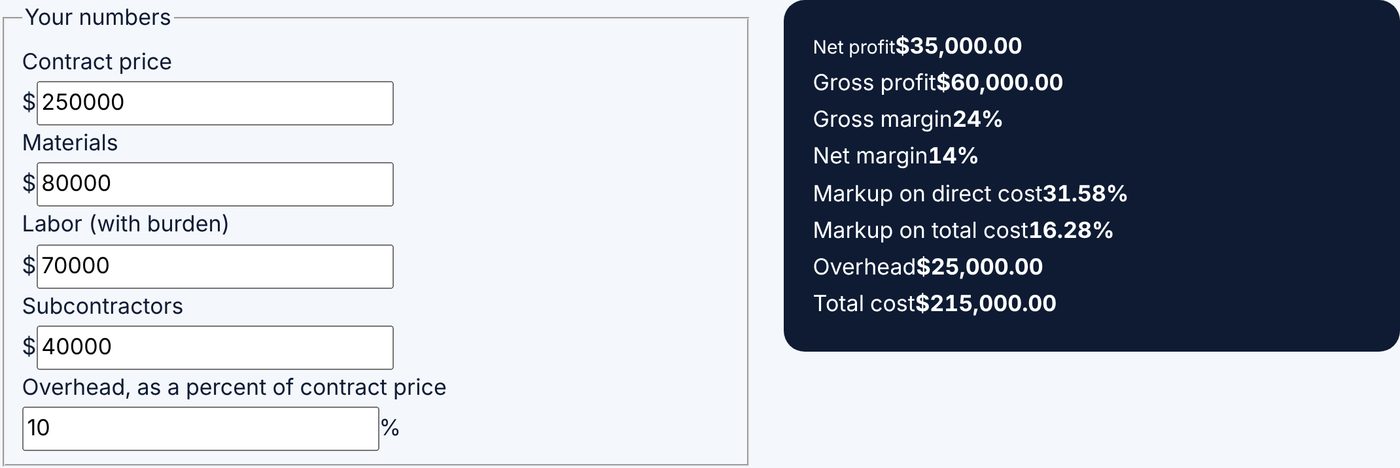
The figures are an illustration, not a benchmark for any trade. A job is priced at $250,000. Materials are $80,000, labor is $70,000 and subcontractors are $40,000. Overhead is set at 10 percent of price.
- Direct costs: $190,000
- Gross profit: $60,000, a gross margin of 24 percent
- Overhead: $25,000
- Net profit: $35,000, a net margin of 14 percent
- Markup on direct cost: 31.58 percent
- Markup on total cost of $215,000: 16.28 percent
The same $60,000 gross profit looks like a 24 percent margin or a 31.58 percent markup. Neither is wrong. They are measured against different bases.
Pricing a job from a target margin
Many bids are built by adding a markup to cost, but if you want a specific margin, divide cost by one minus the margin. With total cost of $215,000 and a target net margin of 15 percent, the price is $215,000 / 0.85 = $252,941.18. That is a markup of 17.65 percent on total cost, not 15 percent. Adding 15 percent to cost would give $247,250.00, a net margin of only 13.04 percent. See contractor markup vs margin and the markup needed for a 30 percent margin for more on this.
Do it in Excel
Put price in B1, materials in B2, labor in B3, subs in B4 and overhead percent in B5 as a decimal, such as 0.1.
Gross profit: =B1-SUM(B2:B4)
Net profit: =B1-SUM(B2:B4)-B1*B5
Gross margin: =(B1-SUM(B2:B4))/B1
Price from a target margin, with total cost in B7 and margin in B8: =B7/(1-B8)
Common mistakes
- Treating markup as margin and underpricing the job.
- Leaving burden costs out of labor.
- Using a guessed overhead rate instead of one built from last year’s books.
- Ignoring change orders, rework and warranty work, which reduce profit after the bid is won.
- Comparing margins across trades without noting that costs and risks differ.
Check your own jobs
Use the construction profit margin calculator to run any job, and the general margin calculator for quick conversions. After a job closes, enter the actual costs and compare them with the estimate. That gap is the most useful number for the next bid. This article is general information, not financial or tax advice.
Setting a realistic target
There is no single correct margin. A target depends on the trade, the size of the job, how much risk you carry, how long the job runs and how much of the work you subcontract. Rather than copying a number from someone else, calculate your overhead rate from your own books, decide what you need the owner’s profit to be, and work backwards to the margin that covers both. Then track the actual result on each job.
Jobs that run long, that have unclear scope or that depend on an owner’s selections deserve a larger cushion than a quick repeat job. Many contractors also separate gross margin targets by job type, for example smaller repair jobs with a higher margin and larger new builds with a lower one, because the overhead and risk are different. Reviewing completed jobs every quarter shows which types of work actually earn your target and which ones need a higher price or should be declined.
Frequently asked questions
What is the difference between gross profit and net profit in construction?
Gross profit is the contract price minus direct job costs. Net profit also subtracts overhead.
Is margin the same as markup?
No. Margin divides profit by the selling price. Markup divides profit by cost. A given profit always gives a higher markup than margin.
How do I price a job to hit a target margin?
Divide your total cost by one minus the target margin. For a 15 percent margin, divide by 0.85.
How do I find my overhead rate?
Add a year of costs that are not tied to a single job and divide by annual revenue.