


A balance transfer card offers a low or 0 percent introductory rate on debt you move from another card. That can save real money, but only when the interest you avoid is larger than the fee and you pay the balance down before the rate resets. Here is how to test an offer with numbers before you apply.
Updated November 2026
What you pay and what you save
Three things decide the outcome: the transfer fee, the length of the promotional period and the rate that applies afterward. The Consumer Financial Protection Bureau says the introductory rate usually lasts a limited time, afterward the rate on the new card may rise, and you will likely pay a transfer fee, typically a percentage of the amount moved. See the CFPB guidance on consolidating credit card debt and on balance transfer fees.
Worked example: a transfer that pays off
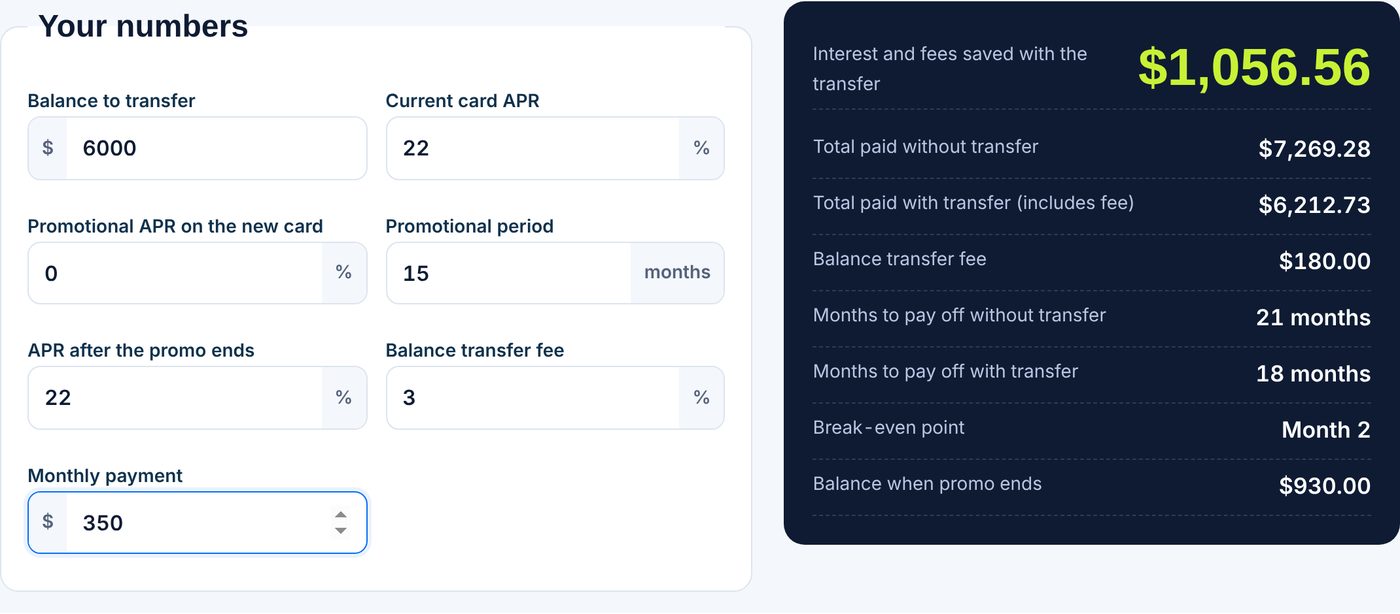
These figures are an illustration, not an offer. You owe $6,000 on a card charging 22 percent APR and plan to pay $350 a month. A new card offers 0 percent for 15 months with a 3 percent fee and 22 percent afterward.
- Fee: 3 percent of $6,000 is $180.00, so the starting balance on the new card is $6,180.
- Without the transfer: 21 months to pay off, $7,269.28 total, of which $1,269.28 is interest.
- With the transfer: after 15 payments of $350 the balance is $930.00. It is cleared in 18 months, and total paid is $6,212.73 including the fee.
- Net saving: $7,269.28 minus $6,212.73, or $1,056.56.
Break-even comes in month 2. By then the old card would have charged more than $180 in interest, so the fee is already earned back. Here the transfer wins because the payment is large enough to clear most of the debt inside the promo window.
Worked example: a transfer that loses
Take the same $6,000 and $350 payment, but a 5 percent fee and only a 2-month promotional period. The fee is $300.00. Interest avoided in two months is about $215, less than the fee, and afterward you pay 22 percent on a bigger balance. Payoff takes 22 months instead of 21 and total paid is $7,389.18 against $7,269.28, so the transfer costs about $119.90 more.
When it is usually worth it
- The promo period is long enough that you can pay off most or all of the balance during it.
- The fee is small compared with the interest you would otherwise pay in that time.
- You will stop adding new debt. A transfer does not fix the spending that created the balance.
- You will make every payment on time. The CFPB says a payment more than 60 days late can let the issuer raise the rate on all balances.
When to be careful
- New purchases on the transfer card may not get a grace period, according to the CFPB.
- If the post-promo APR is higher than your current one, a leftover balance gets more expensive.
- Approval and your credit limit are not guaranteed. A limit lower than your debt means only part moves.
- Applying can affect your credit score, and effects vary from person to person.
Check the fine print on the offer
Before you compare numbers, find three items in the card agreement: how the fee is calculated (some issuers use a percentage with a minimum dollar amount), when the promo clock starts (often from account opening, not from the transfer date), and what rate applies after. Also note whether paying only the minimum is allowed during the promo. A low required minimum can tempt you to pay less than the amount in your plan, which is how a balance survives the promo period.
Excel formulas to test your own offer
Put balance in B1, current APR in B2, fee percentage in B3 and payment in B4.
- Transfer fee:
=B1*B3 - Months to pay off at the current APR:
=NPER(B2/12,-B4,B1) - Total paid without transfer:
=NPER(B2/12,-B4,B1)*B4(approximate, because the last payment is smaller) - Balance after the promo months:
=FV(promoAPR/12,promoMonths,B4,-(B1+B1*B3))
The balance after the promo months is positive when you still owe money, and it becomes the starting balance for a second NPER at the post-promo rate. Our debt snowball spreadsheet helps if you are juggling several cards. To compare against a single-card payoff schedule, try the credit card payoff calculator, and to compare quoted rates see the APR calculator.
Run your own numbers
The balance transfer calculator runs both scenarios month by month and shows the fee, total cost, interest saved, break-even month and the balance left when the promo ends. This article is general information, not financial advice. Read the card’s terms and check your credit before applying.
Frequently asked questions
Does a balance transfer hurt my credit score?
It can. Applying triggers a credit inquiry, a new account lowers your average account age, and a large balance on the new card affects your utilization. Effects vary by person, so check with your issuer and credit reports.
Can I still be charged a fee on a 0 percent offer?
Yes. The CFPB says a credit card company is permitted to charge a balance transfer fee on a zero percent rate offer.
What happens if I buy things on the new card?
The CFPB notes new purchases on the same card may not get a grace period, so you may pay interest on them until the whole balance, including the transferred amount, is paid. Read the terms before using the card.
What if I pay late?
The CFPB says that if you are more than 60 days late on a payment, the issuer can raise the interest rate on all balances, including the transferred balance.