


Updated October 2026 · 6 minute read
Plenty of contractors win jobs, stay busy all year and still end up with less money than they expected. The cause is often one small mix-up: adding a markup percentage when the number they actually needed was a margin. This guide explains the difference in plain terms, gives you a conversion chart and shows how to price a bid that really covers overhead and profit.
- Markup is a percentage of your cost. Margin is a percentage of the selling price.
- A 20% markup gives only a 16.7% margin. To keep a 20% margin you need a 25% markup.
- Small contractors typically carry 15% to 25% overhead, and residential net profit averages about 6% to 9%.
- Price a bid with cost ÷ (1 − target margin), not cost × (1 + margin).
Markup vs margin in plain English
Both numbers describe the gap between what a job costs you and what you charge for it. They just measure that gap against different things.
- Markup = (price − cost) ÷ cost. It answers “how much did I add on top of my cost?”
- Margin = (price − cost) ÷ price. It answers “how much of every dollar the client pays do I keep?”
Take a job that costs you $100 and sells for $120. The $20 difference is a 20% markup (20 ÷ 100) but only a 16.7% margin (20 ÷ 120). Your overhead and profit targets are almost always set as a share of revenue, which means they are margins. If you add them as a markup, you come up short every time.
Markup = margin ÷ (1 − margin)
Price = job cost ÷ (1 − target margin)
Markup to margin conversion chart
| Markup on cost | Gross margin | Price on a $10,000 job cost |
|---|---|---|
| 10% | 9.1% | $11,000 |
| 15% | 13.0% | $11,500 |
| 20% | 16.7% | $12,000 |
| 25% | 20.0% | $12,500 |
| 30% | 23.1% | $13,000 |
| 35% | 25.9% | $13,500 |
| 40% | 28.6% | $14,000 |
| 50% | 33.3% | $15,000 |
| 66.7% | 40.0% | $16,667 |
Read it from the margin column. If your overhead plus profit target is about 26% of revenue, find 25.9% and you can see the markup has to be about 35%, not 26%.
Starting from the margin you want instead? Use our margin to markup chart to find the markup for every margin from 10% to 50%, for example a 42.9% markup for a 30% margin.
Typical overhead and profit in 2026
Buildern’s 2026 review of contractor finances gives these typical ranges:
| Business type | Overhead (share of revenue) | Net profit |
|---|---|---|
| Small contractors | 15%–25% | — |
| Large firms | 10%–14% | — |
| Specialty trades (for example HVAC) | 20%–25% | 10%–14% |
| Residential construction | — | 6%–9% |
| Commercial construction | — | 5%–8% |
| All contractors, average | — | 5%–11% |
Source: Buildern, “Typical Contractor Overhead and Profit: What to Expect in 2026” (April 2026).
Put those together and a small residential contractor with 18% overhead who wants 8% net profit needs a 26% gross margin on every job. That works out to a 35% markup on job cost. Many contractors who “add 20%” are running below break-even without realising it, which is exactly the warning Buildern gives: a 20% markup with 18% overhead loses money.
How to work out your overhead percentage
Your overhead is every cost that keeps the business running but does not belong to one specific job. Pull last year’s numbers from your books and add up:
- Office or shop rent, utilities and phone
- Vehicles, fuel and maintenance not charged to jobs
- General liability, workers’ comp not in your labour rate, and vehicle insurance
- Software, accounting, legal, licences and bonds
- Advertising, website and lead costs
- Office staff and the owner’s time spent estimating, selling and managing
- Small tools and equipment that wear out
Divide that total by last year’s revenue. If overhead was $96,000 on $600,000 of revenue, your overhead is 16%. Recalculate it every year, and again whenever you add a truck, an employee or a new office.
How to price a bid step by step
- Add up the direct job cost. Materials (with waste), labour hours × loaded labour rate, subcontractors, equipment rental, permits and dumpsters.
- Use your real overhead percentage from the section above.
- Pick a profit target. Use the ranges above as a sanity check, and remember profit is what pays for slow months, new equipment and growth.
- Add a contingency for unknowns on remodels and older homes, as a line in the job cost.
- Price the job with cost ÷ (1 − overhead % − profit %).
- Check the result against the market and against your hourly crew rate before you send it.
Worked example
A kitchen remodel has a direct cost of $40,000 (materials, labour, subs, permits). Your overhead is 15% of revenue and your profit target is 10%, so your target margin is 25%.
| Wrong way: 25% markup | Right way: 25% margin | |
|---|---|---|
| Price | $40,000 × 1.25 = $50,000 | $40,000 ÷ 0.75 = $53,333 |
| Gross profit | $10,000 | $13,333 |
| Overhead (15% of price) | $7,500 | $8,000 |
| Net profit | $2,500 (5%) | $5,333 (10%) |
Same job, same costs. Using the wrong formula would have given away $2,833, more than half of the profit you planned. On a year of jobs like this, that is the difference between a healthy business and one that is always short of cash.
Build a bid with the right markup in two minutes
Enter labour, materials, subs and equipment. The free contractor bid calculator applies your overhead and profit as a true margin and shows the price, gross margin and net profit before you send the quote.
Should you mark up materials?
Yes, in most cases. Buying, picking up, storing and warrantying materials takes time and carries risk. Your overhead applies to the whole job, so the simplest approach is to price the total job cost to your target margin, as in the example above.
Some contractors prefer separate markups by category: a higher one on labour, a lower one on big-ticket materials that clients can price online, such as appliances. That is fine as long as the blended margin on the whole job still reaches your target. Check the total, not just each line.
Small jobs need a higher margin
A $900 repair still needs a site visit, an estimate, a trip to the supplier, an invoice and a follow-up call. Those fixed steps take about the same time as on a $9,000 job, so a percentage that works on big jobs leaves small jobs underpriced. Set a minimum job price, or use a higher margin below a certain job size, so every job pays for the admin it creates.
Mistakes that quietly kill profit
- Treating markup as margin. The most common and most expensive mistake on this page.
- Guessing overhead. Work it out from last year’s books. Many small contractors are surprised how high it is.
- Leaving out your own time. If you run the jobs, estimate and do the books, that time has to be paid by the jobs.
- No contingency on remodels. Rot, old wiring and out-of-square walls are normal. Plan for them.
- Not tracking actual vs estimate. If you never compare the finished job to the bid, the same estimating errors repeat on every job.
Track every bid, job and cost in one place
The Contractor Job Costing spreadsheet has the estimate and bid builder built in, plus job budgets vs actuals, change orders, crew hours and profit per job. Excel and Google Sheets.
Questions
What is a good markup for a contractor?
It depends on your overhead and profit target. A small residential contractor with 15% to 25% overhead who wants a 6% to 10% net profit usually needs a markup of roughly 30% to 50% on direct job cost. Work it out with markup = margin ÷ (1 − margin).
What is the difference between markup and margin?
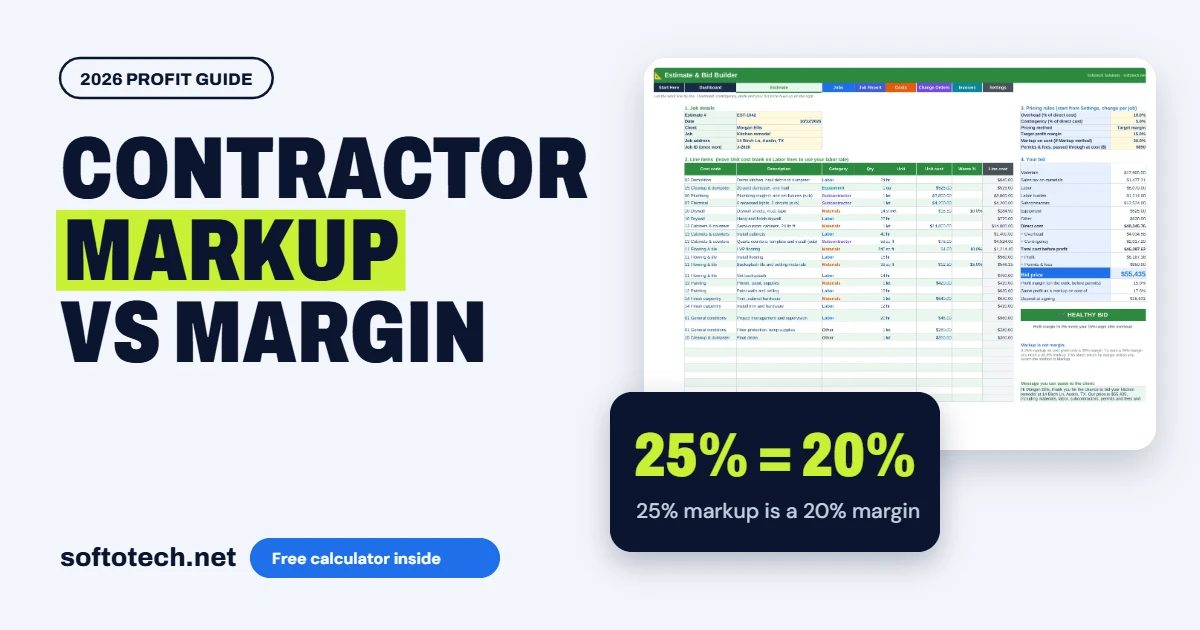
Markup is the profit as a percentage of your cost. Margin is the profit as a percentage of the selling price. A 25% markup equals a 20% margin.
What is the 10 and 10 rule?
It is an old rule of thumb of adding 10% for overhead and 10% for profit. Added as a markup, it gives only about a 17% margin, which is below the overhead many small contractors actually carry. Use your real overhead instead.
How do I calculate the price from a target margin?
Divide the job cost by one minus the target margin. For a $40,000 job and a 25% margin: $40,000 ÷ 0.75 = $53,333.
What net profit do contractors make?
Buildern puts the average at about 5% to 11%, with residential contractors around 6% to 9%, commercial 5% to 8% and specialty trades 10% to 14%.
Related guides
Sources
Tahir Abbas
Founder of Softotech Solutions. Tahir builds Excel and Google Sheets tools for small service businesses, including the free calculators on this site. Price ranges in this guide come from the sources listed above and are checked when the guide is updated.