



The 50/30/20 rule is a simple way to check your budget. Here is how to set it up, with a worked example.
Updated November 2026
The 50/30/20 rule in one minute
The 50/30/20 rule splits your after-tax income into three buckets: 50 percent for needs, 30 percent for wants and 20 percent for saving and extra debt payments. It is popular because it is simple, and it gives you a quick test of whether your spending is balanced. Try your income in our 50/30/20 budget calculator.
Step 1: Start with take-home pay
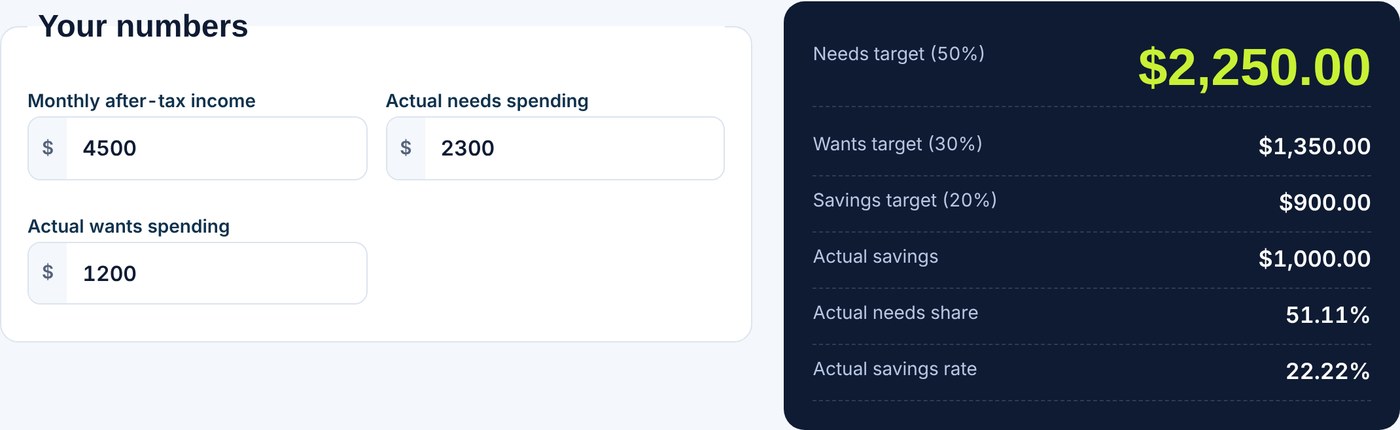
Use the money that reaches your account after taxes and payroll deductions. If you are paid biweekly, multiply a paycheck by 26 and divide by 12 to get a monthly figure. Say that comes to $4,500 a month.
Step 2: Work out the targets
| Bucket | Share | Monthly target |
|---|---|---|
| Needs | 50% | $2,250.00 |
| Wants | 30% | $1,350.00 |
| Savings and debt | 20% | $900.00 |
In Excel with income in B1 use =B1*0.5, =B1*0.3 and =B1*0.2.
Step 3: Sort your spending
Needs are costs you must pay to live and work: housing, utilities, groceries, transport, insurance and minimum debt payments. Wants are choices: dining out, streaming, travel, hobbies. Savings include your emergency fund, retirement contributions and any debt payment above the minimum.
Step 4: Compare with actual spending
Suppose needs are $2,300 and wants are $1,200. Needs are 2,300 / 4,500 = 51.1 percent of income, a little over target. Savings are what is left: $4,500 – $2,300 – $1,200 = $1,000, which is 22.2 percent, above the 20 percent goal. The budget works. In Excel the savings rate is =(B1-B2-B3)/B1.
When the rule does not fit
- In an expensive city needs may be 60 percent or more. Try 60/20/20 or cut wants first.
- If you carry high-interest debt, shift part of the wants into debt payments.
- If income is irregular, base the targets on your lowest typical month.
Build the safety net first with the emergency fund calculator, and see how retirement saving fits with the 401k contribution calculator. For a business budget use the small business budget template.
These are illustrations to help you plan, not financial advice.
Frequently asked questions
What is the 50/30/20 budget rule?
Spend 50 percent of after-tax income on needs, 30 percent on wants and put 20 percent toward savings and debt repayment.
Is 50/30/20 based on gross or net income?
Net income, the amount you take home after taxes.
Where do debt payments go?
Minimum payments are needs. Extra payments count as savings.
What if my rent is more than 50 percent?
Adjust the split, for example 60/20/20, and trim wants first.