


Future value shows what savings will grow to. Here is the formula, a worked example and the Excel version.
Updated November 2026
What future value tells you
Future value answers one question: what will money be worth later if it earns interest? It lets you compare saving plans, test a goal and see how much of a final balance comes from your deposits versus growth. Use our future value calculator to run your own numbers, or follow the steps below.
The formula
PV is the starting balance, PMT is the deposit each period, i is the rate per period and N is the number of periods. For monthly compounding, i is the annual rate divided by 12 and N is years times 12.
Worked example
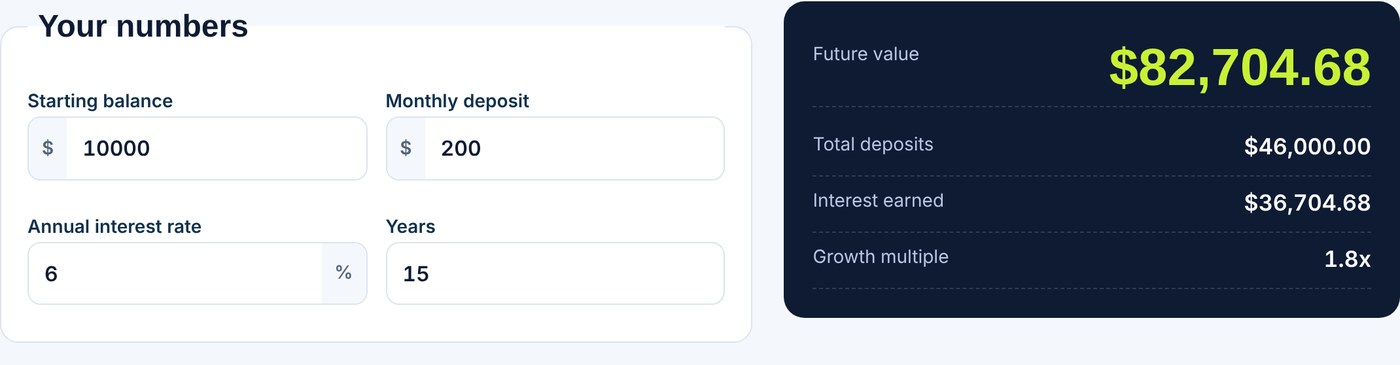
Start with $10,000, add $200 at the end of each month and earn 6 percent a year for 15 years. Then i = 0.005 and N = 180. The starting balance grows to $24,540.94. The deposits grow to $58,163.74. Together the future value is $82,704.68. You deposited $46,000.00 in total ($10,000 plus 180 x $200), so interest earned is $36,704.68. Growth is a bit over a third of the final balance.
The Excel formula
Excel does this with the FV function. For the example enter =FV(0.06/12,15*12,-200,-10000), which returns $82,704.68. The payment and the present value are negative because they are money you pay out. For deposits at the start of each month add a final argument of 1: =FV(0.06/12,180,-200,-10000,1).
What moves the result most
- Time. Doubling the years does far more than doubling the deposit, because interest compounds on interest.
- Rate. A small difference in return adds up over 15 years. Test 4, 6 and 8 percent.
- Deposits. Regular deposits matter most early, when they have the longest to grow.
To see the effect of one lump sum with no deposits, use the compound interest calculator. For a fixed number of equal payments, see the annuity calculator. The Rule of 72 calculator gives a quick doubling-time estimate.
Limits
Real returns are not steady, and taxes, fees and inflation reduce what you keep. To see the effect of inflation, divide the future value by (1 + inflation)^years. At 2.5 percent for 15 years that factor is about 1.45, so $82,704.68 would buy roughly what $57,104.73 buys today.
These are illustrations to help you plan, not financial advice.
Frequently asked questions
What is the future value formula?
FV = PV x (1 + i)^N + PMT x ((1 + i)^N – 1) / i, using the rate and number of periods.
How do I calculate future value in Excel?
Use =FV(rate, periods, -payment, -present value). For the example it is =FV(0.06/12,180,-200,-10000).
Does the calculator include inflation?
No. Divide the result by (1 + inflation)^years to estimate buying power.
Is monthly or yearly compounding better?
More frequent compounding earns slightly more at the same stated rate.