


Percent error tells you how far a measured or estimated value is from the true value, expressed as a percentage of that true value. Teachers use it in science labs, engineers use it to check instruments and analysts use it to judge forecasts. The formula is short, but small details such as which number goes in the denominator, and whether to keep the sign, trip people up all the time. This guide gives the formula, walks through several worked examples with the arithmetic shown, explains when to use absolute or signed error, and shows how to do it in Excel.
Updated November 2026
In this guide
- What percent error means
- The percent error formula
- Step-by-step method
- Worked example 1: a lab measurement
- Worked example 2: a business forecast
- Worked example 3: when the true value is small
- A table of examples
- Percent error in Excel and Google Sheets
- Absolute error, relative error and percent error
- Accuracy vs precision
- How much percent error is acceptable?
- Percent error vs percent difference vs percent change
- Common mistakes and practice problems
What percent error means
Percent error compares what you got with what you should have got. The “should have got” number is called the true value, accepted value or theoretical value. The “what you got” number is the measured, experimental or estimated value. Because the difference is divided by the true value, the result tells you the size of the error relative to the thing you were measuring. An error of 2 grams matters a great deal when you weigh 10 grams and almost nothing when you weigh 2,000 grams, and percent error captures that difference.
For a quick check, use our percent error calculator. The sections below show how to do it yourself so you can verify the result.
The percent error formula
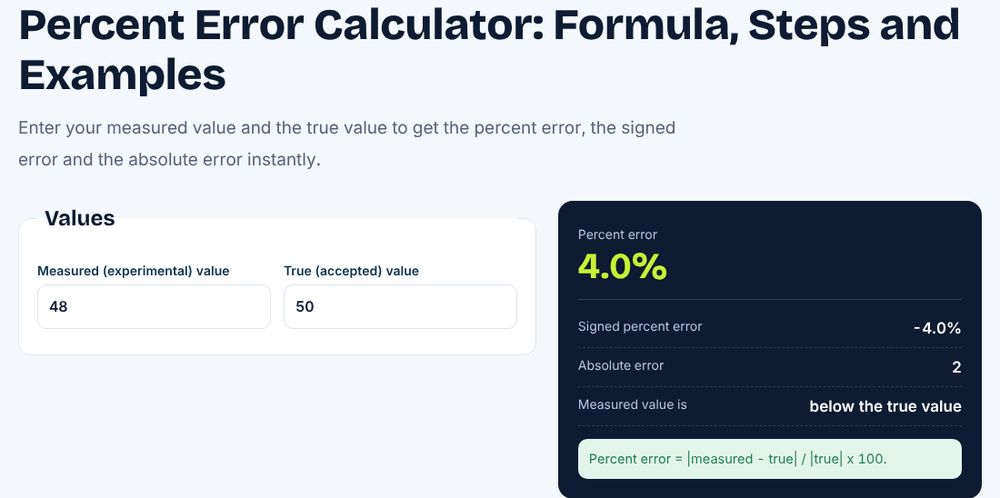
The standard formula is: percent error equals the absolute value of (measured value minus true value), divided by the true value, multiplied by 100.
In words, subtract, take the absolute value, divide by the true value and multiply by 100. The absolute value removes the sign, so the answer is always zero or positive. Some textbooks and software keep the sign instead, which tells you whether you overestimated or underestimated. If you keep the sign, the answer is positive when the measured value is too high and negative when it is too low.
Step-by-step method
- Identify the true value and the measured value.
- Subtract the true value from the measured value.
- Take the absolute value of the difference if you want a positive answer.
- Divide by the true value, not by the measured value.
- Multiply by 100 and add the percent sign.
Dividing by the wrong number is the most common slip. The true value is always the reference, even when your measurement is the one you are more interested in.
Worked example 1: a lab measurement
A student measures the boiling point of water as 98.6 degrees Celsius. The accepted value at sea level is 100 degrees. The difference is 98.6 minus 100, which is minus 1.4. The absolute value is 1.4. Dividing by 100 gives 0.014, and multiplying by 100 gives 1.4 percent. The signed error is minus 1.4 percent, showing the measurement was a little low.
A second measurement of 101.2 gives a difference of 1.2, so the error is 1.2 divided by 100, which is 1.2 percent. The second measurement is slightly more accurate even though it is on the other side of the true value.
Worked example 2: a business forecast
A shop forecast sales of 12,500 dollars for a month and actual sales were 11,800 dollars. Here the actual figure is the true value. The difference is 12,500 minus 11,800, which is 700. Dividing by 11,800 gives 0.0593, so the percent error is 5.93 percent. The forecast was about 5.9 percent too high. Had the shop used the forecast as the denominator, it would have reported 5.6 percent, which understates the error. Always use the true or actual value.
Worked example 3: when the true value is small
Percent error can look huge when the true value is small. If the true value is 0.50 and you measured 0.62, the difference is 0.12, and 0.12 divided by 0.50 is 0.24, which is 24 percent. The same absolute difference of 0.12 on a true value of 50 gives just 0.24 percent. That is why scientists often report both absolute error and percent error. If the true value is zero, percent error is undefined, since you cannot divide by zero, and you should report the absolute error instead.
A table of examples
The table below shows several measurements against their accepted values.
| True value | Measured | Difference | Percent error |
|---|---|---|---|
| 50 | 48 | -2 | 4.0% |
| 200 | 210 | 10 | 5.0% |
| 9.81 | 9.65 | -0.16 | 1.63% |
| 1,000 | 1,012 | 12 | 1.2% |
| 0.75 | 0.70 | -0.05 | 6.67% |
Check a row: for 9.81 and 9.65 the difference is minus 0.16, dividing by 9.81 gives 0.01631 and multiplying by 100 gives 1.63 percent.
Percent error in Excel and Google Sheets
Put the true value in A2 and the measured value in B2. The formula for absolute percent error is =ABS(B2-A2)/A2*100. To show the signed error use =(B2-A2)/A2*100. If you want the result displayed as a percentage, use =ABS(B2-A2)/A2 and format the cell as Percentage. To avoid a divide-by-zero error when A2 might be empty, wrap the formula: =IF(A2=0,"n/a",ABS(B2-A2)/A2). See Microsoft’s page on the IF function for details, and our IF statements guide for more examples.
Absolute error, relative error and percent error
Three related terms appear in lab reports. Absolute error is the plain difference between the measured and true value, in the same units as the measurement, for example 1.4 degrees. Relative error divides that difference by the true value, which gives a decimal such as 0.014. Percent error is the relative error multiplied by 100, so 0.014 becomes 1.4 percent. Reporting all three is common in science classes because each answers a slightly different question: how big is the miss, how big is it compared with the target and how can I compare it with other experiments.
Suppose two students measure the length of a table whose true length is 150 centimeters. Student A gets 148 and student B gets 151.5. A has an absolute error of 2 centimeters and B has 1.5 centimeters. A’s percent error is 2 divided by 150, which is 1.33 percent, and B’s is 1.5 divided by 150, which is 1.00 percent. B is more accurate, and the percent figures make the comparison easy to read.
Accuracy vs precision
Percent error measures accuracy, which is how close results are to the true value. It does not measure precision, which is how close repeated measurements are to each other. A scale that always reads 2 grams too high is very precise but not accurate. If you take five readings of a 100 gram standard and get 102.0, 102.1, 101.9, 102.0 and 102.1, every reading is within 0.1 of the others, yet each has a percent error near 2 percent. To judge precision, use the spread of your readings, for example the standard deviation, and to judge accuracy use percent error against the true value.
How much percent error is acceptable?
There is no universal limit. A school chemistry lab may accept 5 to 10 percent, a machinist may need under 0.1 percent and a quick business forecast may be fine at 10 percent. Check your instructions or industry standard. As a rule, aim to explain the largest sources of error, such as instrument resolution, reading mistakes, rounding or environmental conditions, and say how you would reduce them. A short explanation of why the error occurred is often worth as much as the number.
Percent error vs percent difference vs percent change
Three similar ideas are easy to mix up. Percent error compares a measurement to a known true value. Percent change compares an old value to a new value over time and divides by the old value. Percent difference compares two values when neither is the reference, and divides by their average. Use percent error only when you truly have a correct or accepted value to compare against.
Common mistakes and practice problems
Typical mistakes include dividing by the measured value, forgetting to multiply by 100, forgetting the absolute value when the instructions ask for it and rounding too early. Try these: (1) true 25, measured 23.5. The difference is 1.5 and 1.5 divided by 25 is 6.0 percent. (2) true 80, measured 84. The difference is 4 and 4 divided by 80 is 5.0 percent. (3) true 1.20, measured 1.188. The difference is 0.012 and 0.012 divided by 1.20 is 1.0 percent. Check each with the calculator.
Frequently asked questions
What is the percent error formula?
Percent error equals the absolute value of (measured minus true) divided by true, times 100.
Can percent error be negative?
Yes if you keep the sign, which shows underestimation. Many classes use the absolute value so it is never negative.
Is a small percent error good?
Generally yes, a smaller percent error means the measurement is closer to the true value, but what is acceptable depends on the field.
What if the true value is zero?
Percent error is undefined. Report the absolute error instead.
How is percent error different from percent change?
Percent error compares to a true value, percent change compares a new value with an older one.
Related guides and free tools
- How to Calculate Standard Error in Excel
- Percent error calculator
- Standard deviation calculator
- Rate of change calculator
- How to calculate standard deviation
- All free calculators and templates
Sources: IF function, Microsoft Support