


Mileage reimbursement is miles times a rate. Here is how to use the IRS rates, with an example and Excel formulas.
Updated November 2026
The IRS standard mileage rate
The IRS publishes standard mileage rates each year. Businesses can use them to reimburse employees, and self-employed people can use them to deduct business driving instead of tracking actual vehicle costs. The current figures are on the IRS standard mileage rates page. For 2026, that page lists a business rate of 72.5 cents per mile for 1 January to 30 June and 76 cents for 1 July to 31 December. Medical rate is 23.5 cents from 1 July and the charitable rate is 14 cents. Check the page for updates before you file. Our mileage reimbursement calculator has these rates preset.
The formula
Worked example
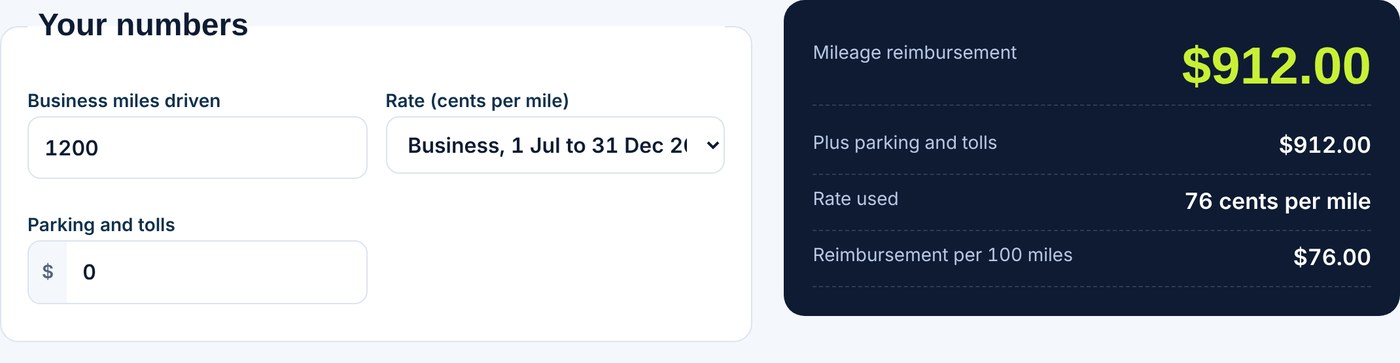
An employee drives 1,200 business miles from July to December 2026. At 76 cents a mile the reimbursement is 1,200 x 0.76 = $912.00. If the same person drove 800 miles in the first half at 72.5 cents, that trip is worth 800 x 0.725 = $580.00. Parking fees and tolls for business trips are added separately.
Excel formulas
Put miles in column B and the rate in cents in cell E1. Per trip: =B2*$E$1/100. Monthly total: =SUM(C2:C32). If the rate changes mid-year, store the rate on each row so each trip uses the rate in force on its date. See also our mileage calculator.
What counts as business miles
- Trips between workplaces, to clients and to temporary job sites.
- Commuting between home and a regular workplace generally does not count.
- Keep a log with the date, starting and ending points, miles and business purpose.
Employees vs self-employed
An employer may reimburse using the standard rate under an accountable plan. A self-employed person can claim the same rate as a deduction on a Schedule C instead of actual costs, if the rules are met. Rules on which method you can use and how to document it are in IRS publications such as Publication 463. Ask a tax professional about your situation, and plan estimated taxes with the quarterly estimated tax calculator.
These are illustrations to help you plan, not financial advice.
Frequently asked questions
What is the IRS mileage rate for 2026?
Per the IRS page, business use is 72.5 cents per mile from 1 January to 30 June and 76 cents from 1 July to 31 December 2026.
How do I calculate mileage reimbursement?
Multiply business miles by the rate. 1,200 miles at 76 cents is $912.
Can I add parking and tolls?
Yes, business parking fees and tolls can be added in addition to the mileage rate.
What records do I need?
A log with date, miles and business purpose for each trip.