



Every appliance label lists watts, but your bill is in dollars. The link between them is the kilowatt-hour, and the arithmetic takes about a minute once you know your rate. This guide shows the formula, a worked example, and how to avoid the usual mistakes.
Updated November 2026
The formula
A kilowatt-hour (kWh) is 1,000 watts used for one hour. The U.S. Energy Information Administration reports electricity in kilowatthours, as on its units and calculators page. To find the cost of running an appliance:
kWh per day = watts x hours per day / 1,000
Cost per day = kWh per day x rate per kWh
Multiply the daily cost by 30 for a month, or by 365 for a year.
Step 1: Find the wattage
Check the nameplate, the plug or the manual. If you only see amps and volts, multiply them. A device rated 10 amps at 120 volts is 1,200 watts. A power meter that plugs in between the wall and the device gives a measured figure and is the most reliable option for items that cycle on and off.
Step 2: Estimate real running hours
Use the time the appliance actually draws power. A space heater might run 4 hours a day. A refrigerator is plugged in all day, but the compressor only runs part of the time, so the label rating overstates its average draw. A device used 30 minutes a day is entered as 0.5 hours.
Step 3: Get your rate
Your rate is on your electric bill. Divide the energy charge by the kWh used, or divide the total bill by the kWh if you want delivery charges and fees included. Rates differ by utility, state and season, and some plans charge more at peak hours. The examples below use 16 cents per kWh as an illustration only. It is not a national average.
Worked example: a space heater
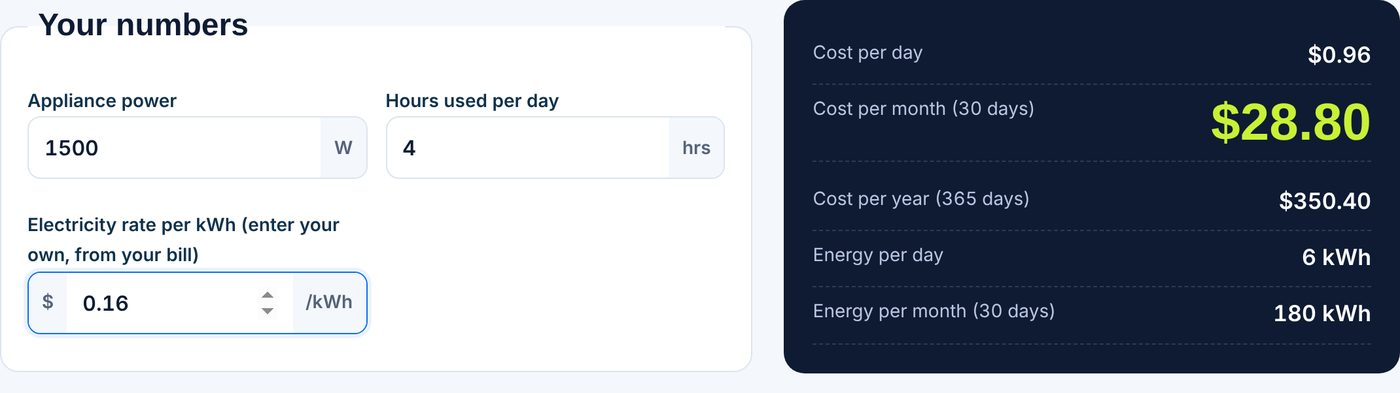
A 1,500 watt heater runs 4 hours a day at $0.16 per kWh.
- Energy per day: 1,500 x 4 / 1,000 = 6.0 kWh
- Cost per day: 6.0 x 0.16 = $0.96
- Cost per 30 day month: $28.80
- Cost per year, if used every day: $350.40
Used only through a 90 day cold season, the same heater costs $86.40.
Worked example: comparing two light bulbs
Take a 60 watt incandescent bulb and a 9 watt LED bulb, each on for 5 hours a day at the same $0.16 rate.
- 60 watt bulb: 0.30 kWh per day, $17.52 per year
- 9 watt LED: 0.045 kWh per day, $2.63 per year
The difference is $14.89 per year for one bulb. Comparing wattage and hours this way is the simplest check on whether a more efficient model will pay back its price.
Do it in Excel
Put watts in A2, hours per day in B2 and your rate in C2. Then:
Daily kWh: =A2*B2/1000
Daily cost: =A2*B2/1000*C2
Monthly cost: =A2*B2/1000*C2*30
Yearly cost: =A2*B2/1000*C2*365
Copy the row down for each appliance and total the column to see where your power goes.
Why the estimate may not match your bill
Motors, thermostats and variable speed settings mean many appliances draw less than their label wattage for much of the time. Standby power adds a little more. Bills also include fixed charges and taxes that do not change with usage. For context on where home electricity goes, the EIA explains electricity use in homes, with air conditioning, space heating and water heating among the largest shares.
Use the calculator
Our electricity cost calculator does the math for any wattage, hours and rate, and shows the daily, monthly and yearly cost. If you are sizing heating or cooling, try the BTU calculator and the HVAC sizing calculator. For circuit loads, see the wire size calculator.
Standby power and always-on devices
Some devices draw a small amount of power even when they look off: televisions, game consoles, chargers, cable boxes and anything with a clock or a remote sensor. Each one is only a few watts, but they run 24 hours a day. A 5 watt device left plugged in all day uses 0.12 kWh per day, which is 43.8 kWh over a year. At the example rate that is a few dollars per device, and it adds up across a household. Use a plug-in meter to find the real figure, and put a power strip with a switch on groups of devices you rarely use.
For appliances with a thermostat, such as a space heater, an oven or a water heater, the rated wattage is what the heating element draws while it is on. The hours to enter are the hours the element is actually heating, which is less than the time the device is switched on.
Frequently asked questions
How do I calculate the cost of running an appliance?
Multiply watts by hours of use, divide by 1,000 to get kWh, then multiply by your rate per kWh.
Where do I find my electricity rate?
It is on your electric bill. Divide the energy charge by the kWh used, or use the total bill divided by kWh for an all-in rate.
How many watts is an appliance that says 10 amps?
Multiply amps by volts. At 120 volts, 10 amps is 1,200 watts.
Why is my real cost different from the estimate?
Appliances often run below their rated power, standby use adds energy, and bills include fixed fees and taxes.