



Long wire runs lose voltage. This guide shows the formula, a worked example and the Excel version.
Updated November 2026
Why voltage drop matters
Every wire has resistance, so some voltage is lost before power reaches the load. Too much drop makes motors run hot, lights dim and equipment misbehave. The drop grows with current and length and shrinks with thicker wire. Use the voltage drop calculator to check a run, or follow the steps here.
The formula
K is the resistivity constant, about 12.9 for copper and 21.2 for aluminum. I is the current in amps, L is the one-way length in feet and CM is the wire’s cross-section in circular mils. For three-phase circuits replace the 2 with 1.732.
Circular mils for common sizes
| AWG | Circular mils |
|---|---|
| 14 | 4,110 |
| 12 | 6,530 |
| 10 | 10,380 |
| 8 | 16,510 |
| 6 | 26,240 |
| 4 | 41,740 |
Worked example
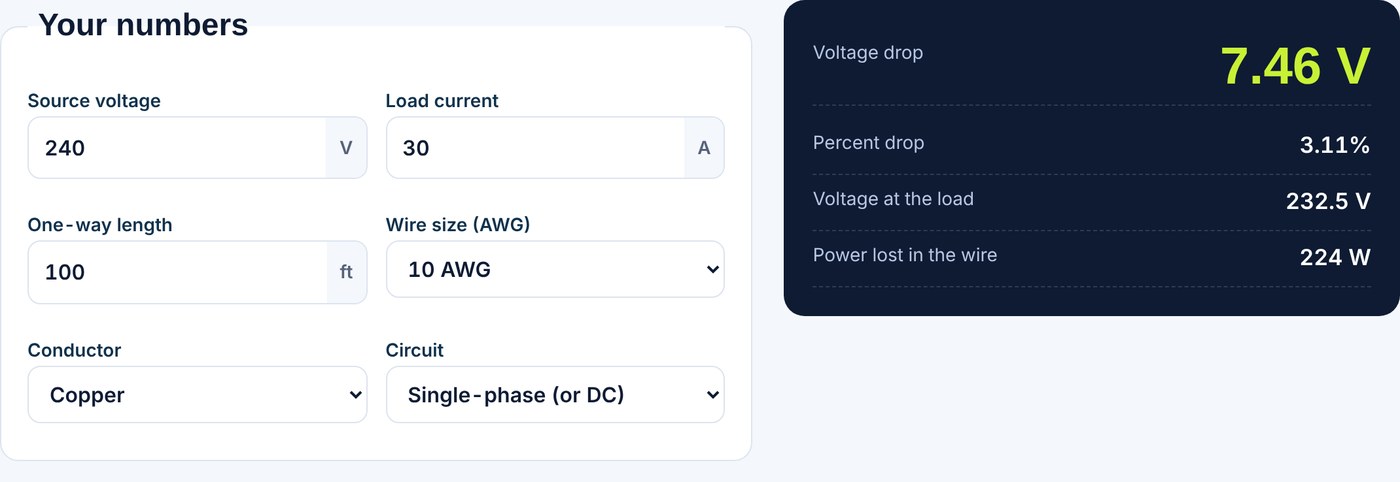
A 30 amp, 240 volt load sits 100 feet from the panel on 10 AWG copper. Voltage drop = 2 x 12.9 x 30 x 100 / 10,380 = 7.46 volts. As a share of the supply, 7.46 / 240 = 3.11 percent, so the load sees about 232.5 volts. Power lost in the wire is about 7.46 x 30 = 224 watts. Moving to 8 AWG (16,510 CM) cuts the drop to 2 x 12.9 x 30 x 100 / 16,510 = 4.69 volts, or 1.95 percent.
Excel formula
With current in B1, length in B2, circular mils in B3 and voltage in B4: =2*12.9*B1*B2/B3 for the drop and =2*12.9*B1*B2/B3/B4 for the fraction. Format the second cell as a percentage.
How to reduce voltage drop
- Use a larger conductor (a lower AWG number).
- Shorten the run or move the source closer.
- Raise the system voltage for the same power, since current falls.
- Copper drops less than aluminum at the same size.
Rules and safety
A drop of about 3 percent or less on a branch circuit is a commonly cited design goal, but code requirements and equipment specifications decide what is required. Wire must also be large enough to carry its current safely. Work on electrical systems should be done or checked by a licensed electrician. For energy cost see the electricity cost calculator.
Frequently asked questions
How do I calculate voltage drop?
Voltage drop = 2 x K x I x L / CM for single-phase. K is 12.9 for copper and 21.2 for aluminum.
What is an acceptable voltage drop?
About 3 percent or less on a branch circuit is a commonly cited goal. Follow code and equipment requirements.
Is L one-way or round trip?
Use the one-way length. The factor of 2 covers the return conductor.
How can I cut voltage drop?
Use thicker wire, shorten the run or raise the voltage.