


Updated October 2026 · 6 minute read
Handyman work is a lot of small jobs, and small jobs are easy to underprice. A ceiling fan “should take an hour” until the box is loose, the wiring is old and the store run takes forty minutes. This guide gives you 2026 hourly rates and flat prices for common jobs, then shows how to build a rate and a price list that pays for the job you actually do.
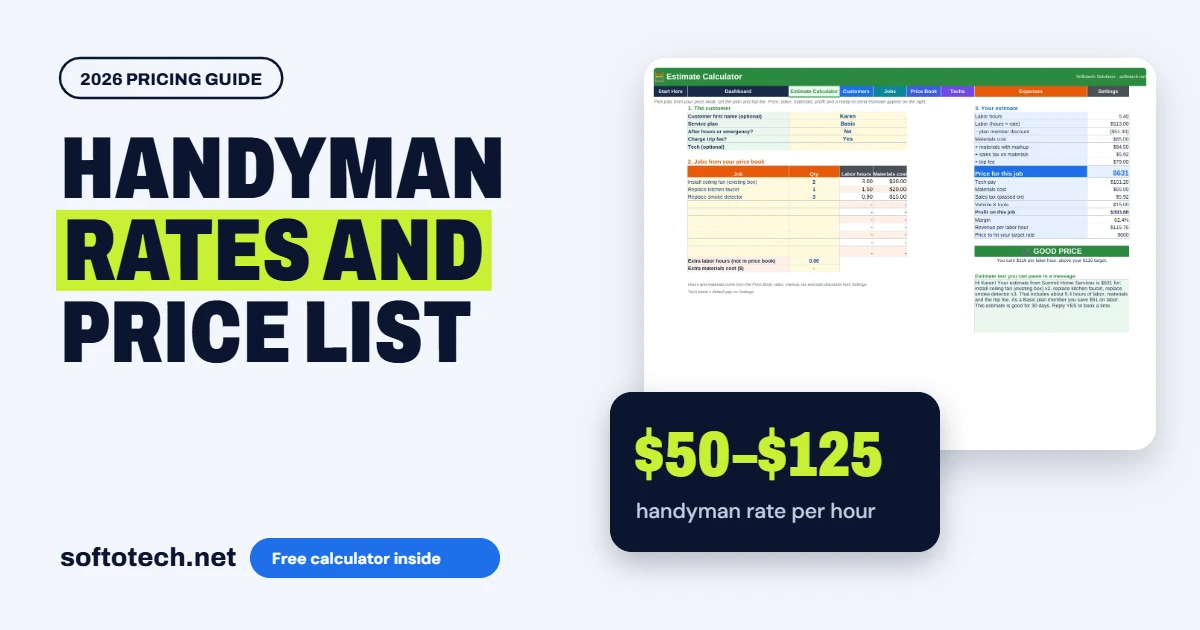
- Handymen typically charge $50 to $125 per hour; self-employed handymen about $50–$80, franchises $75–$125.
- Specialised work (light electrical, minor plumbing, smart home) runs $75–$150 per hour.
- Most set a minimum service charge and a trip fee of about $30–$80.
- Materials are usually marked up 20% to 50%.
Handyman hourly rates in 2026
| Type of handyman | Typical hourly rate |
|---|---|
| All handymen, overall range | $50–$125 |
| Self-employed / independent | $50–$80 |
| Franchise or company | $75–$125 |
| Specialised (light electrical, minor plumbing, smart home) | $75–$150 |
Source: Housecall Pro, “How to Price Handyman Jobs” (updated September 2026).
Hourly rates in major cities
| City | Typical hourly rate |
|---|---|
| New York, NY | $60–$125 |
| Los Angeles, CA | $60–$120 |
| San Francisco, CA | $60–$110 |
| Philadelphia, PA | $55–$90 |
| Dallas and Houston, TX | $40–$100 |
| Phoenix, AZ | $35–$90 |
| Austin, Minneapolis, Nashville | $50–$85 |
| Denver, CO | $50–$80 |
| Atlanta, GA | $45–$80 |
| Chicago, IL | $40–$75 |
Source: HomeGuide city data, as published by Housecall Pro (2026).
Flat-rate price list for common jobs
Customers like knowing the price before you start. A flat-rate list for your most common jobs makes quoting fast and rewards you for getting faster.
| Job | Typical price | Usual pricing |
|---|---|---|
| Small drywall repair | $150–$350 | Flat |
| Door hardware repair | $125–$250 | Flat |
| TV mounting | $150–$300 | Flat |
| Light fixture replacement | $150–$350 | Flat |
| Smart thermostat install | $150–$300 | Flat |
| Ceiling fan installation | $200–$450 | Flat |
| Faucet replacement | $200–$500 | Flat + materials |
| Furniture assembly | $100–$300 | Hourly or flat |
| Minor plumbing repair | $200–$600+ | Hourly or flat |
| Minor electrical repair | $200–$600+ | Hourly or flat |
| Fence repair | $250–$750+ | Hourly or flat |
| Deck repair | $300–$1,500+ | Hourly or project |
Source: Housecall Pro, “How to Price Handyman Jobs” (2026).
Check your state’s rules before you take on electrical, plumbing or larger jobs. Many states limit what a handyman can do without a contractor or trade licence, often above a set job value.
Want a longer list? Our printable handyman price list covers 34 common jobs by type, with a print button so you can save it as a PDF.
Fees that keep small jobs profitable
| Fee | Typical amount | Why it exists |
|---|---|---|
| Minimum service charge | $75–$200 | Covers the visit, setup and invoicing on tiny jobs |
| Trip fee | $30–$80 | Covers drive time and fuel |
| Mileage beyond your area | Up to the IRS standard rate per mile | Long drives cost real money |
| Same-day or after-hours | $50–$150+ | Rearranging your schedule has a cost |
| Haul-away | $50–$150+ | Dump fees and the extra trip |
| Complexity surcharge | +20% to 30% | Tight access, safety risk, old materials, unclear scope |
Source: Housecall Pro, “How to Price Handyman Jobs” (2026).
How to set your hourly rate
Your rate has to cover more than your wage. Every billable hour also pays for the hours you spend driving, quoting, buying materials and doing paperwork, plus your vehicle, tools, insurance and marketing.
Hourly rate = (overhead per hour + desired wage) × 1.15 to 1.20 for profit
Housecall Pro’s example: $2,400 of monthly overhead over 120 billable hours is $20 an hour of overhead. Add a $55 wage and a 15% profit factor: ($20 + $55) × 1.15 ≈ $86 an hour. Notice the 120 billable hours. Most handymen bill far fewer hours than they work, so count honestly.
How to price a flat-rate job
Worked example: ceiling fan install
Replacing a light with a ceiling fan on an existing fan-rated box. You estimate 2 hours including setup and cleanup, your rate is $86, the mounting hardware and wire connectors cost $25 marked up 30%, and your trip fee is $45.
- Labour: 2 × $86 = $172
- Materials: $25 × 1.30 = $32.50
- Trip fee: $45
- Flat price: $249.50, so quote $250 (inside the $200–$450 market range)
If the box is not fan-rated and needs replacing, that is a different job: quote the bracket and extra time as a separate line before you start, rather than absorbing it.
Build an estimate in under a minute
Pick jobs from a flat-rate price list or enter hours and materials. The free handyman estimate calculator adds markup, trip fee and minimum, and shows the price, your costs and profit per hour.
Build your own price book
The price list above is a market check. Your own price book is what you quote from. To build it:
- List your 20 to 40 most common jobs from the last year of invoices.
- Write down your real time for each one, including setup, cleanup and the photo for the invoice.
- Multiply by your hourly rate and add typical materials with your markup.
- Round up to a clean price and note what is included (for example “one fan, existing fan-rated box, up to 10 ft ceiling”).
- Add options for common extras: second item at a reduced price, high ceilings, haul-away.
Update the book whenever a job type keeps running over. After a few months you will quote most requests in minutes, and every quote will be based on your numbers, not a guess.
Quote faster, win more jobs
- Reply the same day. Many customers book whoever answers first.
- Ask for photos and measurements before you visit. You can quote many small jobs without a trip.
- Offer good, better, best where it fits: basic repair, repair plus upgrade, full replacement.
- Put the scope in writing, including what is not included, so there are no arguments at the end.
- Follow up once after two or three days. A polite reminder wins a surprising number of jobs.
Hourly vs flat rate: which to use
- Flat rate for repeatable jobs you know well (TV mounting, fixtures, faucets). Customers like certainty, and you earn more as you get faster.
- Hourly for unclear or open-ended work (finding a leak, repairing rot, “a list of small things”). Give a range and a not-to-exceed figure.
- Project pricing for multi-day jobs such as a deck repair. Housecall Pro suggests a 30% to 50% deposit for multi-day work.
Six handyman pricing mistakes
- No minimum charge. A 20-minute job across town can lose money.
- Not charging for the store run. Build it into the materials markup or the time estimate.
- Counting every working hour as billable. Overhead per hour is based on the hours you actually bill.
- Quoting without seeing photos. Ask for photos on every request; they prevent most surprises.
- Free scope creep. “While you’re here” jobs are new jobs. Quote them.
- Never raising rates. Review your rate every year. Housecall Pro puts typical net margins for handyman businesses at 20% to 40%; if you are well below, look at your rate first.
Run jobs, estimates and the price book in one sheet
The Handyman & HVAC Service Manager has the estimate calculator and a flat-rate price book built in, plus customers, jobs, techs, service plans, expenses and profit per job. Excel and Google Sheets. Also part of the Home Service Bundle.
Questions
How much does a handyman charge per hour in 2026?
Most handymen charge $50 to $125 per hour. Independent handymen are often $50 to $80, franchises $75 to $125, and specialised work like light electrical or minor plumbing $75 to $150.
What is a normal minimum charge for a handyman?
Many handymen set a minimum service charge of about $75 to $200, depending on the market, so small jobs still cover travel, setup and invoicing.
How much should a handyman mark up materials?
A markup of 20% to 50% on materials is common. It covers buying, picking up, storing and warrantying the parts.
Should a handyman charge by the hour or by the job?
Flat rates work best for common, predictable jobs; hourly works best for unclear or open-ended work. Many handymen use both.
How do I calculate my handyman hourly rate?
Divide your monthly overhead by the hours you can bill each month, add your desired hourly wage and multiply by about 1.15 to 1.20 for profit.
Related guides
Sources
- Housecall Pro: How to Price Handyman Jobs, updated September 2026
Tahir Abbas
Founder of Softotech Solutions. Tahir builds Excel and Google Sheets tools for small service businesses, including the free calculators on this site. Price ranges in this guide come from the sources listed above and are checked when the guide is updated.
See also the full handyman price list — 34 common jobs with flat prices, in a printable sheet.