


Updated October 2026 · 6 minute read
Most cleaning businesses don’t lose money on bad clients. They lose it on prices that were guessed once and never checked. This guide gives you the 2026 going rates, then shows you how to turn your own labor cost and target hourly rate into a price you can quote with confidence.
- Most US cleaners charge $30 to $75 per cleaner per hour.
- A standard clean of a 2,000 sq ft home usually costs $120 to $280. A deep clean costs 50% to 100% more.
- Weekly and biweekly clients usually get 10% to 15% off each visit.
- Set your price from hours × your target rate per labor hour, not from a competitor’s flyer.
House cleaning prices in 2026
National averages are a useful sanity check, not a price list. Your city, your pay rates and how fast your team works matter more. Here is where the market sits this year.
Price by home size (bedrooms)
| Home | Standard clean | Deep clean |
|---|---|---|
| Studio | $60–$90 | $75–$130 |
| 1 bedroom | $75–$110 | $90–$150 |
| 2 bedrooms | $100–$150 | $120–$200 |
| 3 bedrooms | $130–$200 | $150–$300 |
| 4 bedrooms | $150–$210 | $200–$420 |
| Each extra room | $25–$35 | $25–$45 |
Source: Housecall Pro 2026 pricing guide, which aggregates Angi, HomeAdvisor, HomeGuide and Thumbtack data.
Price by square footage
| Home size | Standard clean | Deep clean |
|---|---|---|
| Up to 1,000 sq ft | $100–$200 | $120–$250 |
| 2,000 sq ft | $120–$280 | $240–$500 |
| 3,000 sq ft | $300–$600 | $360–$750 |
Per square foot, that works out to roughly $0.06 to $0.14 for a standard clean, $0.12 to $0.25 for a deep clean and $0.15 to $0.35 for move-out cleaning.
Hourly rates
Hourly pricing usually sits between $30 and $75 per cleaner. A two-person team working two hours bills about $120 to $300 for the visit. Hourly pricing is easy to explain, but it punishes you for getting faster. Most growing businesses move to flat prices once they know their own cleaning times.
How to work out your own price
Every good cleaning price comes from three numbers you already know, or can find out in a week:
- How long the job takes. Time your team on a few homes of each size. Write down labor hours (two cleaners for two hours is four labor hours).
- What an hour of labor costs you. Pay rate plus payroll taxes. Cleaner pay averages about $21 an hour in 2026.
- What you need each labor hour to bring in. This is your target rate. It has to cover labor, supplies, travel, insurance, software, ads and your profit.
Profit = price − (labor hours × pay) − supplies − travel cost
Worked example
A 3 bedroom, 2 bathroom, 1,800 sq ft home in average condition takes your team 3 labor hours for a standard clean. You pay cleaners $20 an hour and want every labor hour to bring in $55.
- Price: 3 × $55 = $165 (inside the $130–$200 market range for 3 bedrooms)
- Labor: 3 × $20 = $60
- Supplies at about 8% of the price: $13
- Profit before overhead: $165 − $60 − $13 = $92
If the same home is badly overdue, the clean might take 4.5 labor hours. At the same target rate the price is about $248. That is why deep cleans cost 50% to 100% more: the work takes that much longer.
Get this number in 30 seconds
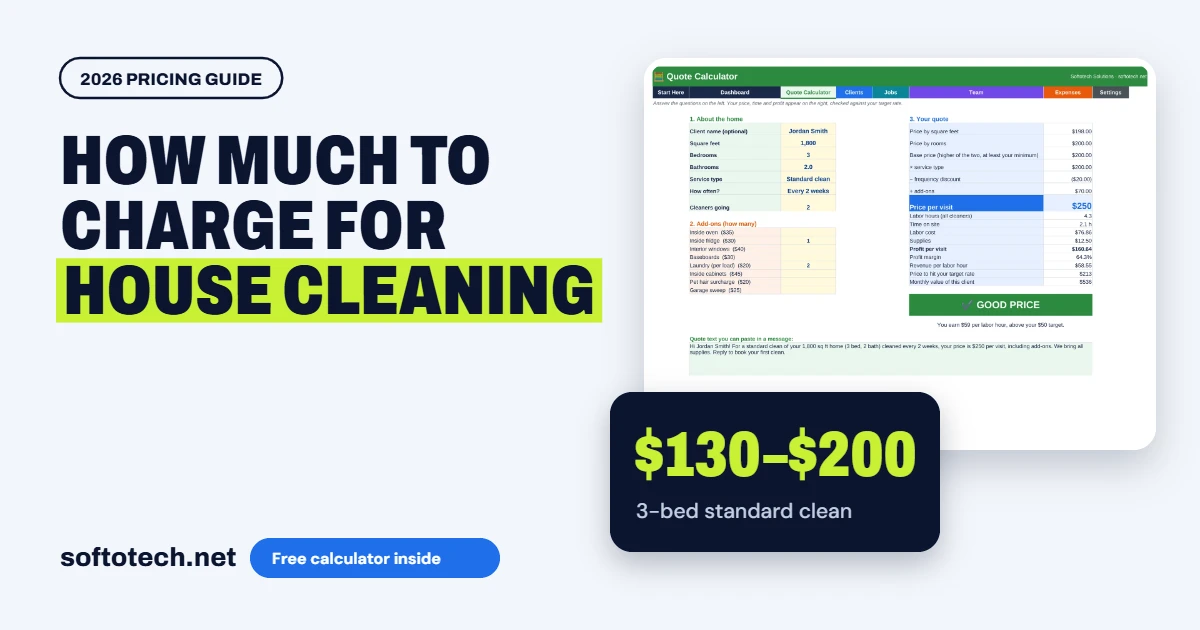
Enter square feet, bedrooms, bathrooms, condition and frequency. The free calculator shows the price, your profit and whether it beats your target rate.
Recurring discounts that still make money
Recurring clients are the backbone of a cleaning business because the home stays cleaner and your schedule fills itself. A common structure:
| Frequency | Typical discount | Why it works |
|---|---|---|
| Weekly | 10%–15% | Home stays clean, visits are short and predictable |
| Every 2 weeks | 10% | The most popular plan; still much faster than a first clean |
| Every 4 weeks | 0%–5% | Close to a full clean each time |
| One-time | Full price | Usually the slowest, dirtiest homes |
Price the first clean as a deep clean, then switch to the recurring price. Discounting a first visit on a neglected home is the most common way new cleaning businesses lose money.
Cleaning short-term rentals? Our Airbnb cleaning price guide has turnover prices by bedroom count, time per turnover and how to set a flat rate for hosts.
Add-on prices
| Add-on | Typical price |
|---|---|
| Inside oven | $20–$40 |
| Inside fridge | $10–$40 |
| Baseboards (whole home) | $25–$75 |
| Laundry (per load) | $15–$30 |
| Carpet cleaning | $75–$200 |
| Eco-friendly supplies | $5–$10 fee |
Source: Housecall Pro 2026 pricing guide.
Move-out and one-time deep cleans
Move-out cleans are their own category. The home is empty, but every cabinet, appliance, baseboard and window track is expected to be spotless for the landlord or the buyer. Housecall Pro’s 2026 data puts move-out cleaning at about $0.15 to $0.35 per square foot, or roughly $250 to $600 for a 2,000 sq ft home.
Quote these as flat prices after seeing photos, and list what is included: inside cabinets and drawers, inside oven and fridge, baseboards, window sills and tracks, light fixtures and switch plates. Walls, carpet shampooing and garage cleaning are usually extras. Because move-outs are often booked at short notice around a lease end date, many businesses add a rush fee for same-week bookings.
How to quote fast without a walkthrough
An in-person walkthrough for every lead costs you an hour you are not paid for. Most homes can be quoted from a short form and a few photos:
- Ask the basics: square feet, bedrooms, bathrooms, floors, pets, and when it was last professionally cleaned.
- Ask for photos of the kitchen, the main bathroom and the worst room in the house.
- Price the first clean as a deep clean, then show the recurring price that applies from the second visit.
- Put the quote in writing with what is included, the add-on prices and your cancellation policy.
- Allow for a price check after the first visit. Tell new clients the recurring price is confirmed once you have cleaned the home once.
This keeps quoting to a few minutes per lead and protects you from the home that looked fine in the description but takes twice as long in real life.
When and how to raise prices
Pay rates, fuel and supplies go up every year, so your prices should too. A simple approach most clients accept:
- Review prices once a year, at the same time each year.
- Give recurring clients 30 days’ notice in writing, with the new price and the date it starts.
- Raise new-client prices first. Your published prices can change any time; existing clients move at the annual review.
- Re-price homes that consistently run long. If a home always takes 30 minutes more than quoted, the price should reflect it.
Five pricing mistakes to avoid
- Copying a competitor’s price. Their pay rates, speed and overhead are not yours.
- Ignoring condition. A pet-heavy or overdue home can take 30% to 50% longer. Charge for it.
- No minimum price. Driving across town for a $70 job loses money. Most businesses set a minimum of $100 to $150.
- Never raising prices. Review prices every year when pay rates and fuel go up.
- Not tracking time. If you don’t know how long each home takes, every price is a guess.
Track every client and job in one spreadsheet
The Cleaning Business Manager has this quote calculator built in, plus recurring visits, labor cost, profit per job and team pay. Excel and Google Sheets.
Questions
How much should I charge to clean a 3 bedroom house?
In 2026 most cleaners charge about $130 to $200 for a standard clean of a 3 bedroom home and $150 to $300 for a deep clean. Price from your own cleaning time: labor hours multiplied by your target rate per labor hour.
Is it better to charge by the hour or a flat rate?
Flat rates are easier for clients to accept and reward your team for working efficiently. Hourly rates make sense for unusual jobs you cannot estimate, like post-construction cleanup.
How much more is a deep clean?
A deep clean usually costs 50% to 100% more than a standard clean of the same home because it takes that much longer: baseboards, inside appliances, detailed bathrooms and built-up dirt.
What is a good profit margin for a cleaning business?
Many residential cleaning businesses aim for a 15% to 30% net margin after labor, supplies and overhead. Use the free calculator to check each price against your target rate per labor hour.
Related guides
Sources
- Housecall Pro: House cleaning prices 2026, updated September 2026
Tahir Abbas
Founder of Softotech Solutions. Tahir builds Excel and Google Sheets tools for small service businesses, including the free calculators on this site. Price ranges in this guide come from the sources listed above and are checked when the guide is updated.