


Updated October 2026 · 6 minute read
If you don’t know your cost per mile, every load board rate looks either great or terrible. This guide shows what the industry spends per mile in the latest ATRI data, then walks you through working out your own number as an owner-operator, including the deadhead miles most people forget.
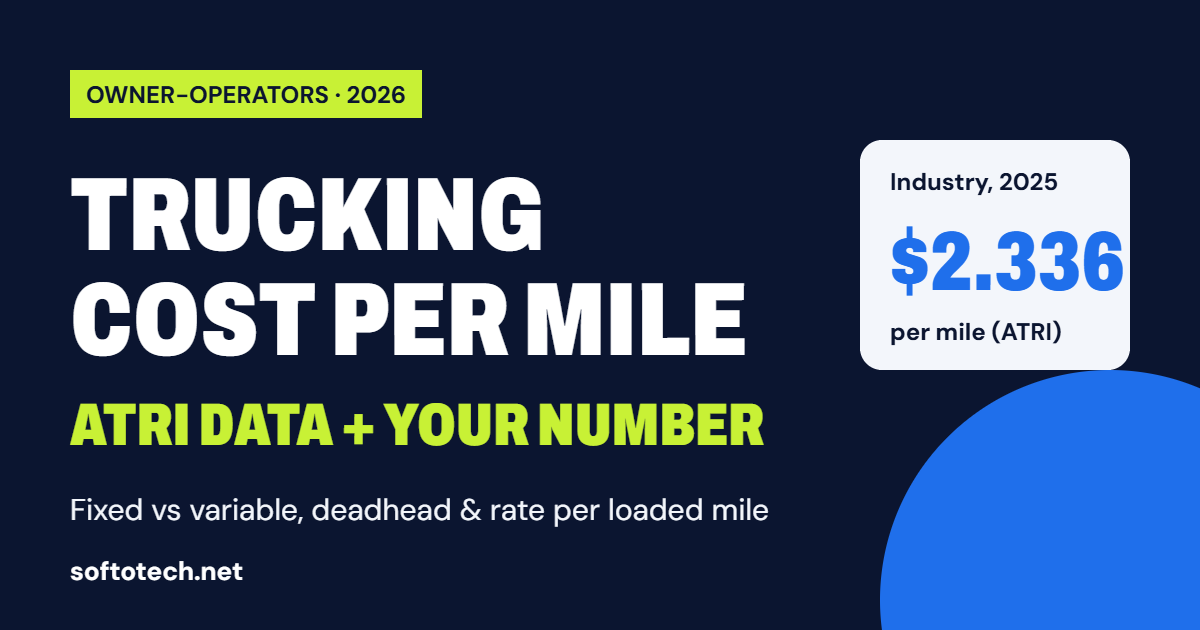
- Industry average: $2.336 per mile in 2025, a record high.1
- Without fuel: $1.854 per mile.1
- Biggest line: driver wages and benefits, about $1.03 per mile.2
- Your own number = fixed costs ÷ total miles + fuel ÷ MPG + maintenance, tires, tolls + your pay per mile.
- Rate check: divide your cost per mile by your share of loaded miles.
Industry cost per mile (ATRI)
The American Transportation Research Institute surveys fleets every year. Its 2026 report, published in July 2026 with 2025 data, gives these per-mile costs:
| Cost line | Per mile, 2025 | Change vs 2024 |
|---|---|---|
| Driver wages | $0.818 | below inflation |
| Driver benefits | $0.210 | +6.6% |
| Fuel (our calculation: total − non-fuel) | about $0.482 | below inflation |
| Repair and maintenance (excl. tires) | $0.215 | +8.6% |
| Insurance premiums | $0.106 | +3.9% |
| Tires | $0.050 | +6.4% |
| Tolls | $0.043 | +13.2% |
| Truck/trailer payments, permits and licenses (our calculation: remainder) | about $0.412 | permits −11.1% |
| Total | $2.336 | +3.4% |
| Total excluding fuel | $1.854 | +4.2% |
Sources: ATRI press release, July 15, 2026;1 line items as reported by HDT Truckinginfo2 and The Trucker.3 The fuel and remainder rows are our arithmetic from the published totals, not ATRI figures.
These are fleet averages, including company drivers on salary. As an owner-operator your mix is different: you may have a bigger truck payment and pay yourself instead of a driver, so use the table as a check, not as your number.
Fixed vs variable costs
| Fixed (per month, whether you drive or not) | Variable (go up with every mile) |
|---|---|
| Truck and trailer payment or lease | Fuel and DEF |
| Insurance | Repair and maintenance |
| Permits, plates, IFTA, UCR | Tires |
| ELD, phone, load board, software | Tolls |
| Parking, accounting, other overhead | Your pay per mile, if you pay yourself by the mile |
Fixed costs per mile fall as you run more miles. Variable costs per mile stay about the same however much you drive.
Work out your own cost per mile
Use total miles, loaded and empty, for the fixed part.
Worked example, using example assumptions for a solo owner-operator (put your own numbers in):
| Item | Example | Per mile |
|---|---|---|
| Truck payment | $2,200 / month | |
| Insurance | $1,000 / month | |
| Permits, plates, IFTA | $150 / month | |
| ELD, phone, software | $100 / month | |
| Parking | $150 / month | |
| Fixed costs ÷ 10,000 miles a month | $3,600 | $0.360 |
| Fuel: $3.70 a gallon ÷ 6.5 MPG | $0.569 | |
| Maintenance (ATRI average) | $0.215 | |
| Tires (ATRI average) | $0.050 | |
| Tolls (ATRI average) | $0.043 | |
| Cost per mile before your pay | $1.237 | |
| Your pay target | $0.800 | |
| Full cost per mile | $2.037 |
If you only ran 8,000 miles that month, the same $3,600 of fixed costs would add $0.45 a mile instead of $0.36, so your full cost rises to about $2.13. Slow months cost more per mile.
Rate per loaded mile and deadhead
Brokers pay for loaded miles, but you pay for every mile. To find the rate you need per loaded mile:
With 15% deadhead, 85% of miles are loaded: $2.037 ÷ 0.85 = about $2.40 per loaded mile.
- 10% deadhead: $2.037 ÷ 0.90 = about $2.26
- 15% deadhead: $2.037 ÷ 0.85 = about $2.40
- 20% deadhead: $2.037 ÷ 0.80 = about $2.55
Any load below your number pays less than your target, so either it pays for itself some other way (a good backhaul position, for example) or you pass on it.
Ways to lower your cost per mile
- Track MPG every fill. At $3.70 diesel, going from 6.5 to 7.0 MPG saves about 4 cents a mile.
- Cut deadhead by planning the next load before you deliver.
- Spread fixed costs over more miles in good months, and know your cost in slow ones.
- Stay on top of maintenance so a breakdown doesn’t wipe out a week of profit.
- Check insurance every renewal; premiums rose again in ATRI’s data.23
Know your cost per mile on every load
The Owner-Operator Trucking Tracker logs loads, fuel and expenses, works out your cost per mile and profit, tracks IFTA miles by state and has a load checker that tells you if a rate covers your costs. Excel and Google Sheets.
Questions
What is the average cost per mile for a truck in 2026?
ATRI’s 2026 Operational Costs of Trucking report, using 2025 data from fleets, puts the average at $2.336 per mile, a record high and 3.4% above the year before. Without fuel it was $1.854 per mile.
How do owner-operators calculate cost per mile?
Add up a month of fixed costs (truck payment, insurance, permits, ELD, parking) and divide by the miles you ran, including empty miles. Then add your variable costs per mile: fuel price divided by MPG, plus maintenance, tires and tolls. Add the pay you want per mile to get your full cost.
What is a good rate per mile for an owner-operator?
One that covers your full cost per mile, including your own pay, across all miles you drive, loaded and empty. In our example a $2.04 full cost with 15% deadhead needs about $2.40 per loaded mile just to hit the target.
How much does fuel cost per mile for a semi?
Fuel cost per mile is the diesel price divided by your MPG. At an example $3.70 a gallon and 6.5 MPG it is about $0.57 a mile. In ATRI’s 2025 fleet data, fuel worked out to about $0.48 per mile (the gap between the $2.336 total and the $1.854 excluding fuel).
Does cost per mile include deadhead miles?
It should. Your truck payment, insurance and driver pay do not stop on empty miles, so divide fixed costs by all miles. Then check that your rate per loaded mile covers the empty ones too.
Related guides
Sources
- ATRI: New ATRI Report Details Accelerating Costs and Low Profitability Despite Cuts, July 15, 2026
- HDT Truckinginfo: Trucking Fleets Faced Record Operating Costs, July 2026
- The Trucker: Trucking Is Getting More Expensive, ATRI Report Explains Why, July 2026
Tahir Abbas
Founder of Softotech Solutions. Tahir builds Excel and Google Sheets tools for small businesses, including owner-operator trackers. Industry figures come from the sources listed above; the worked example uses labelled example assumptions.