


DSCR, or debt service coverage ratio, tells a lender whether a rental property earns enough to pay its own loan. If you are searching for how to calculate DSCR for a rental property, there are two common versions, and which one applies depends on the loan.
Updated 25 October 2026. Written by Tahir Abbas, Softotech. All figures are worked examples, not quotes.
Key takeaways
- Ask the lender which formula it uses. The same house scored 1.26 and 1.07 in the two methods.
- PITIA is principal, interest, taxes, insurance and association dues, so leave none out.
- Lenders may use the lower of lease rent and appraiser market rent.
- Rate matters a lot: the same loan can pass at 6% and fail at 8%.
- Minimums vary by lender and loan. Treat 1.25 as a benchmark, not a rule.
The DSCR formula
Traditional method: DSCR = net operating income / annual debt service
A result above 1.0 means the property covers its payment. Below 1.0 it does not. Lenders set their own minimum, and 1.25 is a common benchmark, so always confirm with yours.
Example 1: the rent over PITIA method
A rental brings in $2,400 a month. The monthly costs on the loan are principal and interest $1,450, property taxes $280, insurance $130 and HOA dues $40. That makes PITIA $1,900.
To reach 1.25 exactly, the rent would need to be PITIA x 1.25 = $2,375 a month. This example passes a 1.25 minimum by a small margin.
Example 2: the net operating income method
Use the same property with annual figures. Rent is $28,800. Subtract 5% vacancy ($1,440) and operating expenses: taxes $3,360, insurance $1,560, maintenance $1,440 and management $2,304. Net operating income is $18,696. Annual principal and interest is $1,450 x 12 = $17,400.
The same house gives 1.26 under one method and 1.07 under the other. That is why you should ask which formula the lender uses before you decide whether a deal works.
Set it up in Excel
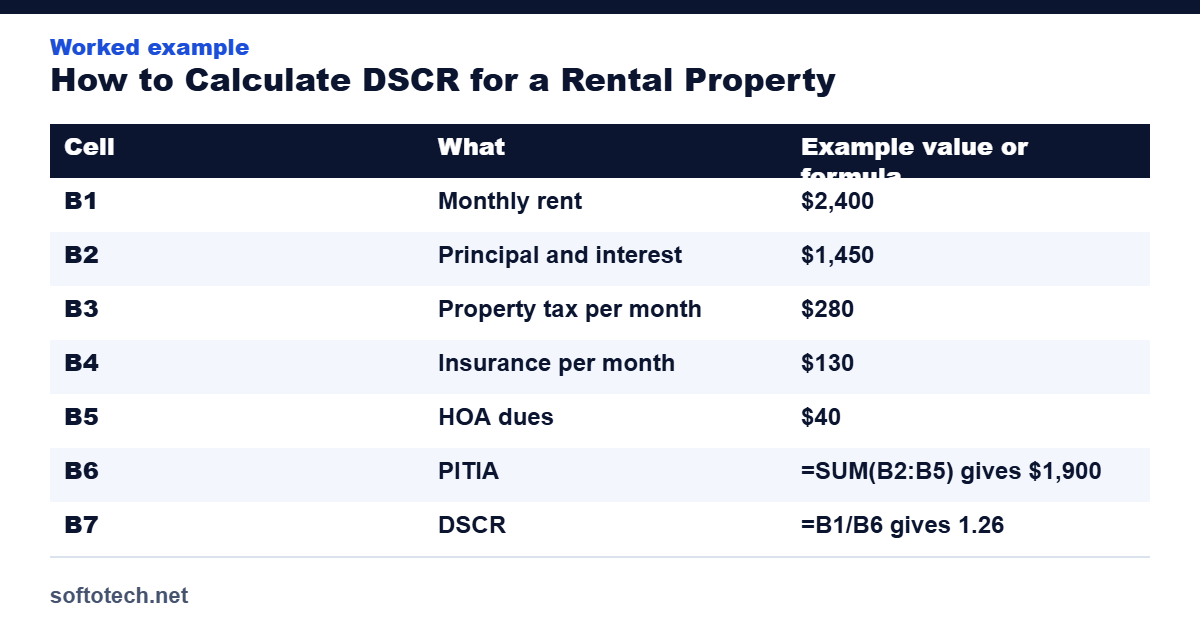
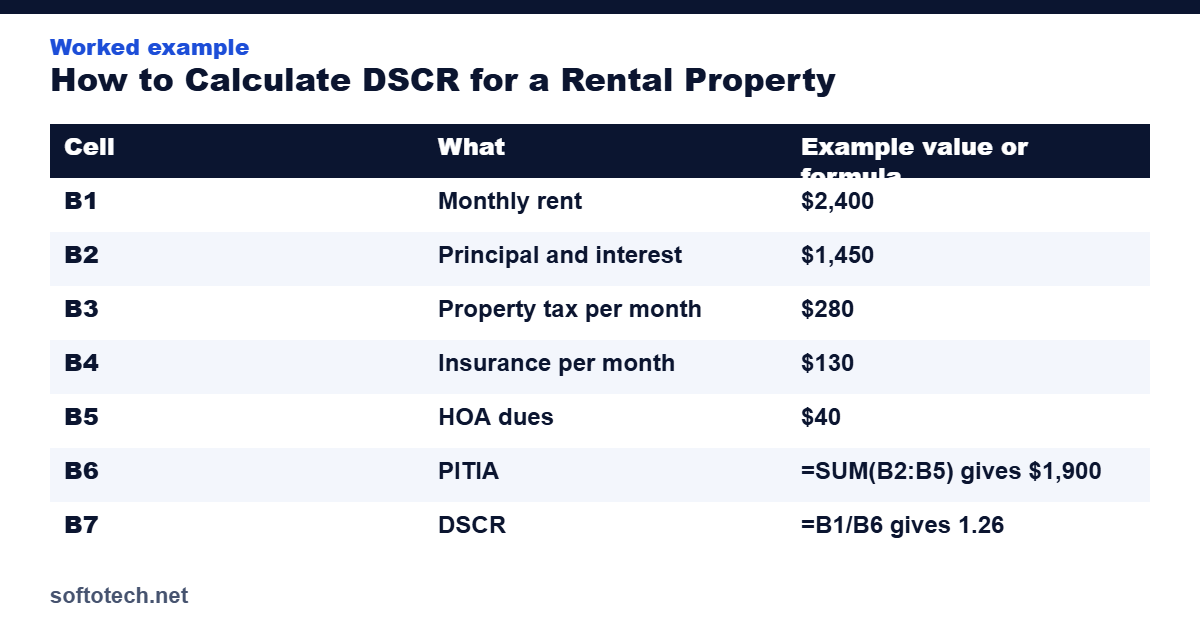
Build the rent over PITIA version with five cells. Put the numbers in column B:
| Cell | What | Example value or formula |
|---|---|---|
| B1 | Monthly rent | $2,400 |
| B2 | Principal and interest | $1,450 |
| B3 | Property tax per month | $280 |
| B4 | Insurance per month | $130 |
| B5 | HOA dues | $40 |
| B6 | PITIA | =SUM(B2:B5) gives $1,900 |
| B7 | DSCR | =B1/B6 gives 1.26 |
Format B7 as a number with two decimals. You can also set a check cell: =IF(B7>=1.25,"Meets 1.25","Below 1.25"). Change the 1.25 to the minimum your lender asks for.
What if the DSCR is below 1.0
Suppose rent is $2,000 and PITIA is $2,150. DSCR is $2,000 / $2,150 = 0.93. The rent does not cover the payment. Your options are to put more money down, find a property with better rent, or negotiate a lower price. As an example, at a 7% rate over 30 years each $1,000 of loan costs about $6.65 a month in principal and interest, so:
| Extra down payment | Payment falls by about | New PITIA | New DSCR |
|---|---|---|---|
| None | $0 | $2,150 | 0.93 |
| $20,000 | $133 | $2,017 | 0.99 |
| $40,000 | $266 | $1,884 | 1.06 |
Some lenders offer programs for ratios below 1.0, usually with a larger down payment and a higher rate. Rates and rules change, so ask for a quote before you buy.
Lease rent or market rent
Lenders often use the lower of the actual lease and the market rent from the appraisal. In Example 1 the lease is $2,400. If the appraiser says market rent is $2,250, the DSCR becomes $2,250 / $1,900 = 1.18, which misses a 1.25 minimum. Check this before you submit an application.
Related guides
See DSCR loan requirements for what lenders typically ask, DSCR for Airbnb for short-term rentals, how to calculate cap rate and cash-on-cash return. You can also run the numbers in our DSCR calculator.
Sources and a note
- IRS Publication 527, Residential Rental Property for rental income and expense categories.
- IRS: Topic no. 414, Rental income and expenses
This is general information, not financial or lending advice. The rate, payments and minimums here are examples. Ask your lender for current terms.
Check your own numbers
Use the free DSCR calculator for an instant pass or fail against your lender minimum, or the DSCR calculator Excel template to keep scenarios in a file. Short-term rental owners should read DSCR loans for Airbnb. Planning a refinance? Try the BRRRR calculator.
How does DSCR work on a second property?
Take a rental at $3,100 a month with a $300,000 loan at 7% over 30 years. Principal and interest is about $1,996 a month. Property taxes are $360 and insurance is $150. There are no HOA dues.
PITIA = $1,996 + $360 + $150 = $2,506.
DSCR = $3,100 / $2,506 = about 1.24.
That misses a 1.25 minimum by a small amount. To reach 1.25 the rent would need to be $2,506 x 1.25 = about $3,132, which is $32 a month more. Rent of $3,132 would pass; the same deal with a slightly smaller loan or a lower rate would also work.
How much does the interest rate change DSCR?
Hold everything else the same. The loan is $250,000 over 30 years, taxes and insurance are $400 a month and the rent is $2,600.
| Rate | Principal and interest | PITIA | DSCR |
|---|---|---|---|
| 6% | $1,499 | $1,899 | 1.37 |
| 7% | $1,663 | $2,063 | 1.26 |
| 8% | $1,834 | $2,234 | 1.16 |
Two points of rate moves the same house from a comfortable pass to a miss. Rates change often, so check a current quote before you sign a contract. If the deal only works at the lowest rate, it is too thin.
How big a loan can the rent support?
You can work backwards. Use Example 1: rent $2,400, with taxes, insurance and HOA of $450 a month. For a 1.25 minimum, the most PITIA you can have is $2,400 / 1.25 = $1,920. Take away $450, which leaves $1,470 for principal and interest.
At 7% over 30 years, each $1,000 of loan costs about $6.65 a month, so the maximum loan is $1,470 / $6.65 x $1,000 = about $221,000.
| Minimum DSCR | Maximum monthly P&I | Approximate maximum loan |
|---|---|---|
| 1.00 | $1,950 | $293,100 |
| 1.20 | $1,550 | $233,000 |
| 1.25 | $1,470 | $221,000 |
This shows why a lender’s minimum can matter more than your credit score for how much you can borrow on a rental. Lenders also apply loan-to-value limits, so the real maximum may be lower.
Which DSCR mistakes are easy to make?
Each row changes one cost in Example 1, where PITIA is $1,900 and DSCR is 1.26.
| Mistake | PITIA used | DSCR shown |
|---|---|---|
| HOA dues left out | $1,860 | 1.29 |
| Insurance left out | $1,770 | 1.36 |
| Correct PITIA | $1,900 | 1.26 |
Other common errors: using a quote that has no taxes or insurance, using a lease that is above market rent, and mixing the two formulas, for example dividing gross rent by annual loan payments after expenses are deducted. Write down which method you are using next to every result.
What do lenders usually ask for on a DSCR loan?
Requirements differ, but many lenders ask for the same kinds of documents. Having them ready speeds up the check.
- The lease, or an appraiser’s market rent schedule if the property is vacant.
- The property tax bill and an insurance quote.
- HOA dues, if any.
- Purchase contract or current mortgage statement.
- Proof of cash for the down payment and reserves.
Rental income and costs are also reported to the IRS, so the IRS guidance on rental income and expenses is a useful guide to what counts as an expense. Ask the lender for its written DSCR calculation method and minimum before you pay for an appraisal.
Frequently asked questions
What is a good DSCR for a rental property?
Lenders set their own minimums. A DSCR of 1.25 is a common benchmark, 1.0 means the rent only just covers the payment, and some DSCR loans accept a lower ratio with other terms. Ask your lender.
Is DSCR calculated on rent or on net operating income?
It depends on the loan. Many DSCR loans for investors divide gross monthly rent by PITIA. Conventional commercial loans usually divide net operating income by annual debt service.
What does PITIA mean?
Principal, interest, taxes, insurance and association dues: the full monthly cost of holding the loan on the property.
How can I raise my DSCR?
Raise the rent, lower the loan amount, extend the term, get a lower rate, or choose a property with lower taxes and insurance.
The examples are illustrations, not lender quotes or financial advice. Loan terms vary by lender.
What is the difference between DSCR and cap rate?
Cap rate is net operating income divided by property value and ignores the loan. DSCR compares income with the loan payment, so it tells you whether the property can carry the debt.
Does DSCR include property taxes and insurance?
In the rent over PITIA method, yes, taxes, insurance and HOA dues are in the payment. In the net operating income method, they are in operating expenses and the loan payment is only principal and interest.
Can I get a DSCR loan with a ratio below 1.0?
Some lenders offer programs for ratios below 1.0, usually with a larger down payment, a higher rate or both. Terms change, so ask for a quote before you commit to a property.
Related guides: How to calculate cap rate · How to calculate cash-on-cash return