


BRRRR stands for buy, rehab, rent, refinance, repeat. The idea is to buy a property that needs work, fix it, rent it, then refinance so that you pull most or all of your cash back out and can repeat the process. Whether it works comes down to a few numbers.
Updated 25 October 2026. Written by Tahir Abbas, Softotech. All figures are worked examples, not quotes.
Key takeaways
- Everything depends on the ARV, so use a conservative figure from recent sold comparables.
- Cash left in the deal is the number that drives the return. A lower appraisal leaves more cash trapped.
- The rent must carry the new loan, so check DSCR as well as cash flow.
- Refinance fees and seasoning rules change the plan. Ask lenders before you buy.
- If no cash is left in the deal, judge it on cash flow and DSCR, not cash-on-cash.
Step 1: Find your all-in cost
Example: purchase $100,000, rehab $30,000 and $5,000 of closing and holding costs give $135,000.
Step 2: Estimate the after-repair value (ARV)
ARV is what the property should be worth once the work is done, based on comparable recent sales nearby. Everything depends on this number, so be conservative. In this example the ARV is $170,000.
Step 3: Work out the refinance amount
Lenders vary. At 75% of $170,000, the new loan is $127,500.
Step 4: Cash left in the deal
$135,000 – $127,500 = $7,500. If the refinance covers your whole all-in cost, you have no cash left in the deal.
Step 5: Cash flow and return
- Rent: $1,600 a month is $19,200 a year.
- Operating expenses including taxes, insurance, repairs, management and vacancy: $6,900 a year, so NOI is $12,300.
- New loan payment: $127,500 at 7.25% over 30 years is about $870 a month or $10,437 a year.
- Annual cash flow: $12,300 – $10,437 = about $1,863.
- Cash-on-cash return: $1,863 / $7,500 = about 24.8%.
Notice how sensitive this is. A lower appraisal, a higher rate or a repair overrun can leave much more cash in the deal and change the return a lot.
Common BRRRR mistakes
- Using an optimistic ARV.
- Forgetting holding costs while the property is empty, such as loan interest, taxes and utilities.
- Ignoring the seasoning period some lenders require before they will refinance.
- Not checking that the rent covers the new payment. See how to calculate DSCR.
Check the rent against the new loan
A BRRRR deal only repeats if the rent can carry the refinance loan. Using the $127,500 loan from above, suppose the new loan is a 30-year mortgage at 7%. That is an example rate, so check what lenders offer today. The payment is about $848 a month, or $10,178 a year.
Now take the rent. Say it is $1,500 a month and operating costs (property tax, insurance, repairs, vacancy allowance) are $450 a month. Net operating income (NOI) is $1,050 a month, or $12,600 a year. The lender looks at the debt service coverage ratio:
DSCR = NOI / annual debt payments = $12,600 / $10,178 = about 1.24
Many lenders want a DSCR of 1.20 or more on investment loans, but this varies by lender and loan type, so ask. Cash flow after the loan payment is $1,050 – $848 = $202 a month, about $2,424 a year. On the $7,500 still left in the deal, that is a cash-on-cash return of about 32%. See our guide to cash-on-cash return and the DSCR formula.
What if the numbers move
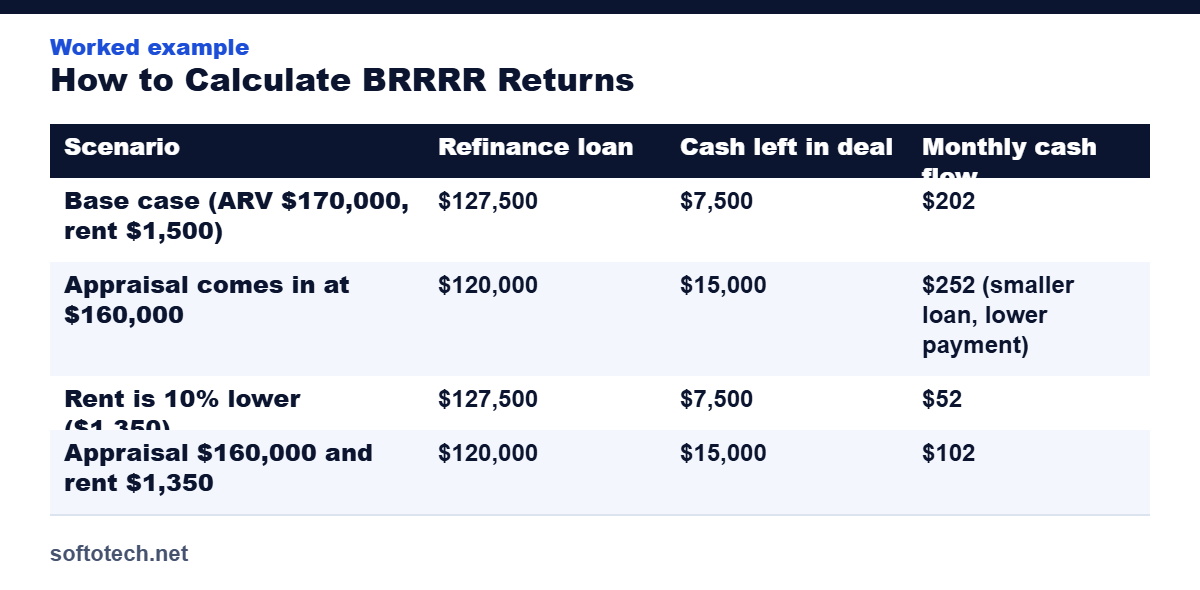
Test the deal before you buy. Small misses in value or rent change the result a lot. The table uses the same 7% rate and $450 monthly operating costs.
| Scenario | Refinance loan | Cash left in deal | Monthly cash flow |
|---|---|---|---|
| Base case (ARV $170,000, rent $1,500) | $127,500 | $7,500 | $202 |
| Appraisal comes in at $160,000 | $120,000 | $15,000 | $252 (smaller loan, lower payment) |
| Rent is 10% lower ($1,350) | $127,500 | $7,500 | $52 |
| Appraisal $160,000 and rent $1,350 | $120,000 | $15,000 | $102 |
The appraisal row shows the real risk: a $10,000 lower value at a 75% loan means $7,500 more of your cash stays in the property. The monthly cash flow looks better with the smaller loan, but you have tied up twice as much cash, so the return on your money is lower. Always rerun the calculation with your own numbers.
Timing and lender rules
- Many lenders require the property to be owned for a set period (often called seasoning) before a cash-out refinance. The length varies, so ask before you buy.
- Some lenders base the loan on the lower of the appraised value and your all-in cost during that period.
- Rehab costs are added to your cost basis, which matters for tax. See IRS Publication 551, Basis of Assets.
- Loan terms, points and fees change. Compare at least two lenders.
Sources and a note
- IRS Publication 527, Residential Rental Property for rental income and expenses.
- IRS Publication 551, Basis of Assets for how purchase and improvement costs are counted.
- Fannie Mae Selling Guide: B2-1.3-03, Cash-Out Refinance Transactions
This is general information, not financial, tax or lending advice. Check your own numbers with your lender and tax professional.
Run your numbers
Use the BRRRR calculator with your own figures. To understand the return measure, read how to calculate cash-on-cash return and how to calculate cap rate. More tools are on the free tools page.
Related guides
Free pricing tips for your business
Get short, practical tips on pricing jobs and using our free calculators. No spam, unsubscribe any time.
What does a BRRRR look like when all the cash comes back out?
Use different inputs. Purchase $90,000, rehab $25,000 and $5,000 of closing and holding costs give an all-in cost of $120,000, paid from your own cash. The ARV is $175,000. At a 75% loan-to-value limit the refinance loan is $175,000 x 75% = $131,250.
Refinancing has its own costs. Assume $3,000. Net proceeds are $131,250 – $3,000 = $128,250. That is more than the $120,000 you put in, so cash left in the deal is $0 and you have $8,250 extra.
Now check the rent. Rent is $1,700 a month and operating costs are $600 a month, so NOI is $1,100 x 12 = $13,200 a year. The loan at 7% over 30 years costs about $873 a month, or $10,479 a year. Cash flow is $13,200 – $10,479 = about $2,721 a year, or $227 a month. DSCR is $13,200 / $10,479 = about 1.26.
With no cash left in, cash-on-cash return cannot be worked out because the denominator is zero. Judge the deal on monthly cash flow and DSCR instead.
Do refinance costs change the cash left in the deal?
Yes. Step 4 above compares the loan with your all-in cost. In real life the refinance has its own fees, such as the appraisal, title work and lender charges. Add them to your cash left in the deal.
In the main example, the all-in cost is $135,000 and the loan is $127,500. If refinance costs are 2% of the loan ($2,550), cash left in becomes $135,000 + $2,550 – $127,500 = $10,050, not $7,500. Cash flow does not change, but the return on your trapped cash falls: $1,863 / $10,050 = about 18.5% instead of 24.8%. Ask for a fee estimate early and put it in your sheet.
A short BRRRR checklist before you offer
- Set the ARV from recent sold comparables, then use a lower figure for a safety margin.
- Add a repair contingency and holding costs for the whole project.
- Ask your lender about the seasoning period and the loan-to-value limit on a cash-out refinance.
- Include refinance costs in cash left in the deal.
- Check that rent covers the new payment, using the DSCR your lender uses.
- Test a lower appraisal and a lower rent, as in the table above.
If any step fails, change the offer, not the assumptions.
Frequently asked questions
What is the BRRRR method?
BRRRR means buy, rehab, rent, refinance, repeat. You buy a property that needs work, improve and rent it, refinance based on the new value, and reuse the cash for the next deal.
Can you really get all your money back in a BRRRR?
Sometimes, if the after-repair value is high enough compared with your all-in cost. It depends on the appraisal, the lender’s loan-to-value limit and your costs, so it is never guaranteed.
What is the biggest risk in a BRRRR deal?
Overestimating the after-repair value or underestimating rehab and holding costs, which leaves more cash trapped in the property.
What is the 75% rule in BRRRR?
It usually means the lender will lend up to 75% of the appraised value on a cash-out refinance, so you can only recover that share of the ARV. Limits vary by lender and loan type, so confirm yours.
How long do you have to wait to refinance a BRRRR property?
It varies. Fannie Mae’s Selling Guide, for example, generally requires six months on title before a cash-out refinance, with exceptions such as delayed financing. Investor and DSCR lenders set their own rules, so ask before you buy.
Is BRRRR better than a regular rental purchase?
Not always. BRRRR can recycle your cash but adds rehab risk, holding costs and appraisal risk. A regular purchase is simpler. Compare cash-on-cash return and cash flow for both using the same rent and costs.