



A flip can look profitable on a quick estimate and still lose money once holding and selling costs are counted. Here is how to work out the real profit before you make an offer.
Updated 25 October 2026. Written by Tahir Abbas, Softotech. All figures are worked examples, not quotes.
Key takeaways
- The 70% rule only sets a maximum offer. It is a screening step, not the profit calculation.
- Holding costs, buying costs and selling costs are what turn a good-looking flip into a thin one.
- A 10% lower sale price hurts more than a 10% rehab overrun, so test the ARV hardest.
- Compare deals on profit, return on cash and profit per month, not on profit alone.
- Profit shown here is before income taxes. Check the current IRS rules for your case.
The 70% rule for a maximum offer
ARV is the after-repair value, what the house should sell for once finished. If the ARV is $250,000 and repairs are $40,000, the maximum offer is $175,000 – $40,000 = $135,000. The 70% rule is a rule of thumb, not a law. It leaves room for costs and profit, and the right percentage can be higher or lower in your market.
Full profit calculation
- Purchase price: $135,000.
- Rehab: $40,000.
- Holding costs for 6 months at $1,200 a month, covering loan interest, taxes, insurance and utilities: $7,200.
- Closing costs when buying: $3,000.
- Selling costs at 8% of $250,000 for commissions and closing: $20,000.
- Total cost: $205,200.
- Profit: $250,000 – $205,200 = $44,800 before income taxes.
Return on cash invested
If you paid for the purchase, rehab, holding and buying costs yourself, you invested $185,200. The return is $44,800 / $185,200 = about 24.2%. If you borrowed part of it, your cash invested is smaller, but loan interest and fees raise your costs, so run the numbers both ways.
How flips go wrong
- Repairs cost more than the estimate. Add a contingency.
- The house takes longer to sell, so holding costs grow.
- The after-repair value was based on the best comparable sale rather than typical ones.
- Selling costs were left out.
Stress test the flip
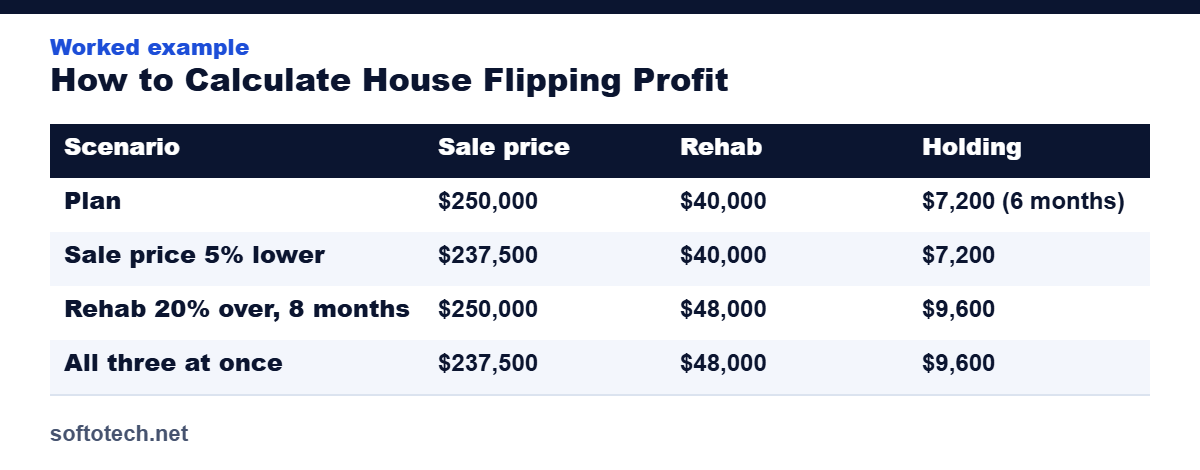
The example above makes $44,800. Real flips rarely go exactly to plan, so test three common problems before you offer. Each row changes only what is listed, using the same purchase price of $135,000 and closing costs of $3,000.
| Scenario | Sale price | Rehab | Holding | Selling (8%) | Profit |
|---|---|---|---|---|---|
| Plan | $250,000 | $40,000 | $7,200 (6 months) | $20,000 | $44,800 |
| Sale price 5% lower | $237,500 | $40,000 | $7,200 | $19,000 | $33,300 |
| Rehab 20% over, 8 months | $250,000 | $48,000 | $9,600 | $20,000 | $34,400 |
| All three at once | $237,500 | $48,000 | $9,600 | $19,000 | $22,900 |
The last row still makes money, but the profit has halved. If a deal only works when everything goes right, it is too thin. Decide a minimum profit you accept before you make an offer. For example, 10% of the ARV is $25,000 on a $250,000 house, and the stressed case above would fall short of it.
Costs people forget
- Permits and inspections, and any code fixes they require.
- Vacant-property insurance, which is often priced differently from a normal home policy.
- Utilities, lawn care and HOA fees during the whole project.
- Loan points, interest and draw fees if you use hard money or a rehab loan.
- Staging, photos and small touch-ups before listing.
- Your own time. If you manage the job full time, count what that time is worth.
Taxes on a flip
Profit from a flip is usually taxable income, and frequent flippers may be treated as dealers rather than investors, which can change how the profit is taxed. Rehab and purchase costs form your basis. See IRS Publication 544, Sales and Other Dispositions of Assets and Publication 551, Basis of Assets, and ask a tax professional about your own case.
If you plan to keep a finished house as a rental instead of selling, compare it with the BRRRR method and check the cap rate first.
Sources and a note
- IRS Publication 544, Sales and Other Dispositions of Assets
- IRS Publication 551, Basis of Assets
- IRS: Topic no. 703, Basis of assets
This is general information, not financial, tax or legal advice. The 70% rule and every figure here are examples. Use your local costs.
Run your own numbers
Use the house flipping profit calculator. If you plan to keep and rent the property instead, see how to calculate BRRRR returns. More tools are on the free tools page.
Related guides
Free pricing tips for your business
Get short, practical tips on pricing jobs and using our free calculators. No spam, unsubscribe any time.
How do you use the 70% rule on a different deal?
Take a larger house to see the rule at work. The ARV (after-repair value) is $320,000 and repairs are $55,000. The rule gives a maximum offer of $320,000 x 70% – $55,000 = $224,000 – $55,000 = $169,000.
Now run the full costs at that price. Holding costs are 5 months at $1,400, which is $7,000. Buying closing costs are $3,500. Selling costs are 8% of $320,000, which is $25,600.
| Item | Amount |
|---|---|
| Purchase | $169,000 |
| Rehab | $55,000 |
| Holding (5 months) | $7,000 |
| Buying costs | $3,500 |
| Selling costs (8%) | $25,600 |
| Total cost | $260,100 |
| Profit ($320,000 – $260,100) | $59,900 |
Cash invested before selling costs is $234,500, so the return is $59,900 / $234,500 = about 25.5%. If an owner asks more than $169,000, the profit shrinks dollar for dollar unless the repair bill or the ARV changes.
Which single change hurts flip profit the most?
Go back to the main example, which makes $44,800. Change one thing at a time to see which risk matters most. Everything else stays the same.
| Change | New profit | Drop |
|---|---|---|
| Plan as written | $44,800 | $0 |
| Sale price $10,000 lower (selling costs fall by $800) | $35,600 | $9,200 |
| Selling costs 10% instead of 8% ($5,000 more) | $39,800 | $5,000 |
| 3 extra months of holding at $1,200 | $41,200 | $3,600 |
| Rehab 10% over ($4,000 more) | $40,800 | $4,000 |
A $10,000 miss on the sale price costs the most, because almost none of it is recovered. That is why the ARV needs the most checking. The stress test above shows what happens when several problems arrive together.
How do you check an ARV before you trust it?
The ARV drives the maximum offer and the profit. A rough check uses recent sales, not asking prices.
- Use homes that sold, not homes that are listed.
- Pick sales that are close by, similar in size and condition after repairs, and recent.
- Do not anchor on the single best sale.
Say four comparable sales were $238,000, $245,000, $250,000 and $262,000. The middle value (median) is ($245,000 + $250,000) / 2 = $247,500. Using $247,500 instead of $250,000 changes the maximum offer to $247,500 x 70% – $40,000 = $133,250, about $1,750 lower than before. A small change in ARV moves the offer by 70 cents on the dollar, so be honest about which sales really match your finished house. A local agent or appraiser can help you check the comparisons.
Is total profit or profit per month the better measure?
Use all three: total profit, return on cash invested and profit per month. They answer different questions. A larger deal can make more dollars but tie up more cash for longer.
| Measure | Main example | $320,000 example |
|---|---|---|
| Profit | $44,800 | $59,900 |
| Cash invested (before selling costs) | $185,200 | $234,500 |
| Return on cash | 24.2% | 25.5% |
| Months held | 6 | 5 |
| Profit per month | about $7,467 | $11,980 |
Profit per month is profit divided by months held. It shows what your time and money earned over the project. Delays cut it quickly, which is why holding costs and the sale timeline matter as much as the rehab budget.
Frequently asked questions
What is the 70% rule in house flipping?
It says you should pay no more than 70% of the after-repair value minus the repair costs. It is a quick screening rule that leaves room for costs and profit.
How much profit should I aim for on a flip?
It depends on your risk and market. Many flippers set a minimum dollar profit and a minimum return so that a small cost overrun does not erase the gain.
Are flipping profits taxed?
Usually yes, and rules differ by country and by how often you flip. This guide shows pre-tax profit, so ask a tax professional about your situation.
Does the 70% rule include selling and holding costs?
Not directly. The rule leaves a 30% gap between the maximum offer plus repairs and the ARV, and that gap has to cover holding, buying and selling costs and your profit. Always run the full profit calculation before you offer.
How do you calculate profit per month on a flip?
Divide the total profit by the months from purchase to sale. In the guide’s example, $44,800 over 6 months is about $7,467 a month. Comparing this across deals helps you see the cost of delays.
What costs do first-time flippers miss most often?
Holding costs while the house is empty, selling costs such as commissions and closing, and a repair contingency. Permits, vacant-property insurance and loan fees are also easy to leave out of a first budget.