Updated October 2026 · 6 minute read
Data accuracy means a record matches the real world it describes: the right amount, the right person, the right date. It sounds basic, until a business runs on records that do not match anything. This guide explains why accuracy decides outcomes, where errors actually come from, and the checks that keep data right.
- Data accuracy means the record matches reality. A correct looking email that belongs to the wrong person is still inaccurate data.
- Accuracy is not completeness. A file can have every field filled and still be wrong in half of them.
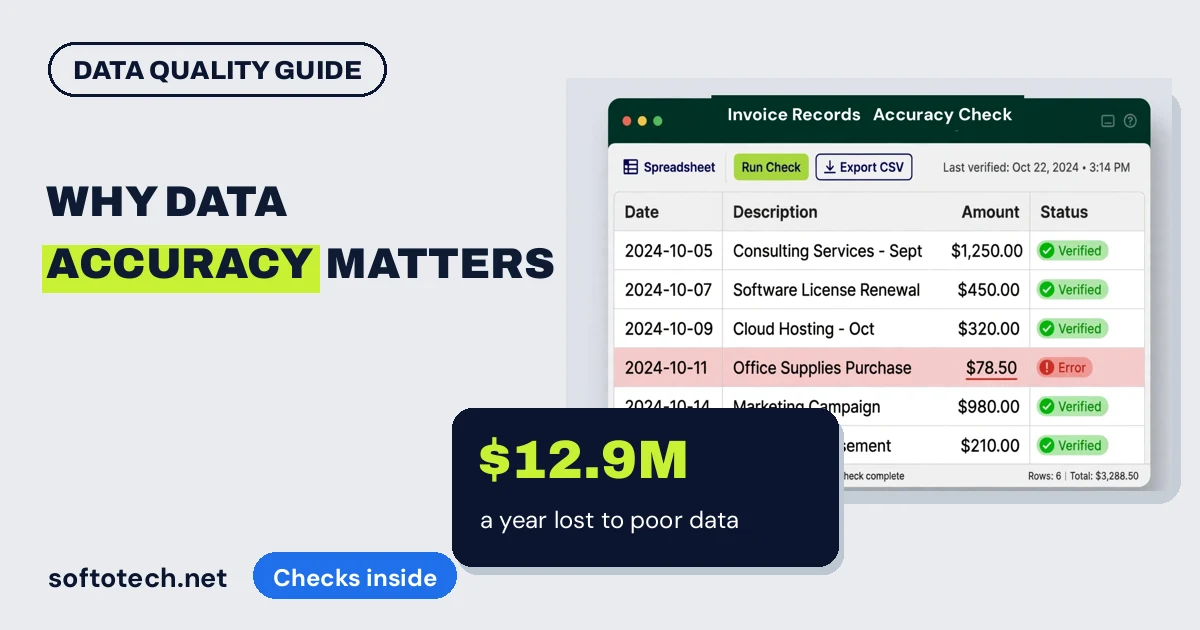
- Gartner estimates poor data quality costs organizations an average of $12.9 million a year. Small businesses pay the same tax in smaller bills: bounced campaigns, wrong invoices, decisions made on bad numbers.
- Accuracy is a process, not an event: standard formats, validation at entry, and regular checks against the source.
What is data accuracy?
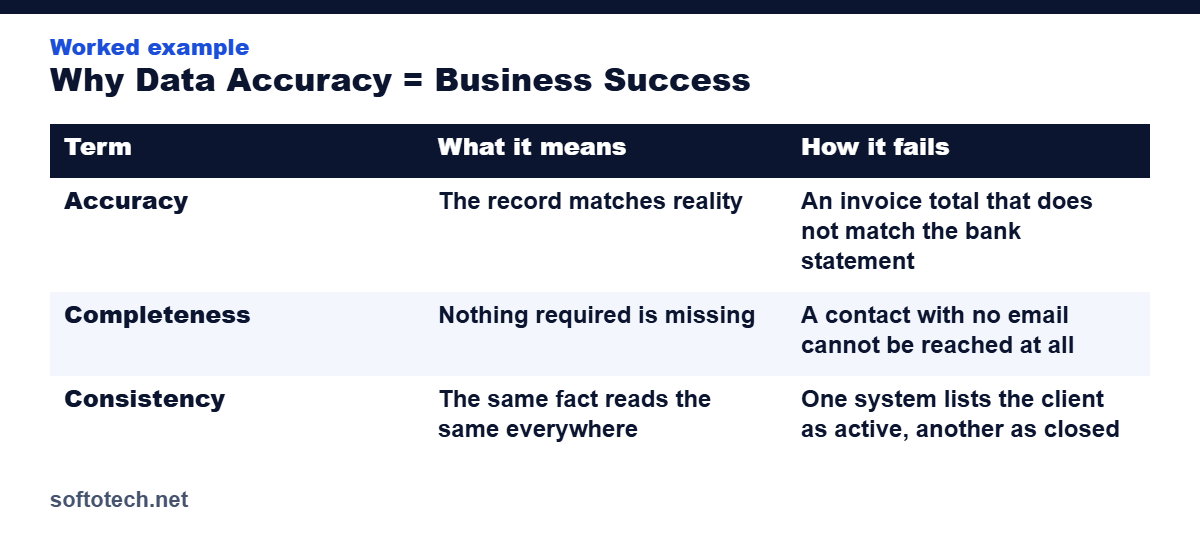
Data accuracy is the degree to which a record matches the real thing it stands for. The invoice total equals what was actually charged. The contact is the person who really holds that job today. The date is the day it really happened. Three ideas get mixed up here, and the difference matters:
| Term | What it means | How it fails |
|---|---|---|
| Accuracy | The record matches reality | An invoice total that does not match the bank statement |
| Completeness | Nothing required is missing | A contact with no email cannot be reached at all |
| Consistency | The same fact reads the same everywhere | One system lists the client as active, another as closed |
A database can be complete and consistent while being wrong in the same way everywhere. That is why accuracy is the one that decides outcomes: it is the only one of the three that is about the real world.
Why accuracy matters
- Decisions are priced on the numbers underneath them. A hiring plan, a price rise and a loan application all inherit the quality of the data they were built on.
- Money leaks quietly. Wrong invoices, duplicate payments and discounts given on stale prices rarely trigger alarms. They just accumulate.
- Trust is on the line. Clients and lenders forgive a slow reply. They remember being sent someone else’s figures.
- Automation multiplies whatever it is fed. A workflow built on accurate data saves hours. The same workflow on bad data produces confident errors at machine speed.
Where errors come from
Errors are rarely sabotage. They are process gaps, and they arrive through five familiar doors:
- Manual typing at speed. Rushed entry swaps digits, drops decimals and guesses at fields that should have been checked.
- Copy and paste between systems. Every manual move is a chance to shift a row, truncate a value or paste over the wrong cell.
- No standard format. When the same fact can be written five ways, it will be, and matching records later becomes guesswork.
- Old data that is never rechecked. People change roles and companies change details. Around 30% of business contact data goes stale within a year, even if it was perfect on day one.
- Imports without a checklist. A file loaded in a hurry imports its mistakes into every report that reads it.
What bad data looks like in real businesses
The damage seldom looks like a data problem while it is happening:
- The quote with the slipped decimal wins the job, then loses money on every hour of it.
- The sales team calls the same company twice under two spellings, and the prospect hears a business that does not know itself.
- The payroll or invoice run uses last quarter’s rates, and the correction round costs more than the original work.
- The lender pack does not tie together: projections that disagree with the statements underneath them, and a loan that stalls on questions nobody can answer.
Each one gets logged as a pricing issue, a sales issue or a finance issue. Underneath, all four are the same issue.
How to keep data accurate
- One format per field. Dates, phone numbers, names and amounts follow a written rule, with dropdowns wherever free text invites variety.
- Validate at the point of entry. Required fields, format checks and sensible ranges catch errors while the person who knows the answer is still looking at the screen.
- Reconcile important files against the source. Bank statements, invoices and payroll figures get checked against the document they came from, not against last month’s version of the file.
- Check high stakes work twice. A second pair of eyes, or a sampled recheck, on the files money moves through.
- Give every dataset an owner. Data with no owner decays on schedule. Data with an owner gets its quarterly check.
- Recheck on a schedule. Accuracy fades by itself, so the check has to be a routine, as we set out in our CRM cleanup guide.
How we handle accuracy at Softotech
Accuracy is the product in most of what we deliver. Bank statement conversions are reconciled against the statement itself, so the totals in the spreadsheet are the totals the bank printed. PDF to Excel work is checked against the source document, field by field where the figures matter. Lead lists are verified before delivery, for the reasons in our guide to how verified leads boost revenue.
That discipline sits behind a large share of our 6,000 plus projects across more than ten years, for clients who hand us the files their money and their reporting run on.
Hand us the file that has to be right
Bank statements, bulk PDFs, messy datasets. We convert and structure them, checked against the source, for a fixed quote agreed before we start.
Questions
What is data accuracy in simple words?
It means a record matches the real thing it describes: the amount is the real amount, the name is the right person, and the date is the day it actually happened.
What is the difference between accurate and complete data?
Complete means nothing required is missing. Accurate means what is there is right. A form can be filled in completely and still be wrong, which is why completeness on its own proves nothing.
How much does bad data cost a business?
Gartner estimates poor data quality costs organizations an average of $12.9 million a year. A small business pays the same tax in smaller bills: bounced campaigns, rework, wrong invoices and lost trust.
How do I improve data accuracy?
Standardize formats, validate at the point of entry, reconcile important files against their source documents, give every dataset an owner, and recheck on a schedule instead of once.
Related guides
Sources
- RecordContext: CRM data quality benchmarks, compiling Gartner and Validity research, accessed October 2026
- Validity: The State of CRM Data Health report, accessed October 2026
- Landbase: Data decay rate statistics, accessed October 2026
Tahir Abbas
Founder of Softotech Solutions. Tahir’s team converts bank statements and bulk documents and builds lead data for agencies and small businesses, with every file checked against its source. The practices in this guide are the ones his team works to.