



By the Softotech bankruptcy support team, drawing on 10+ years supporting US attorneys and almost 300 bankruptcy projects. Updated October 25, 2026.
Key takeaways
- Form 107 covers income, payments before filing, legal actions, gifts, transfers, accounts and business ties.
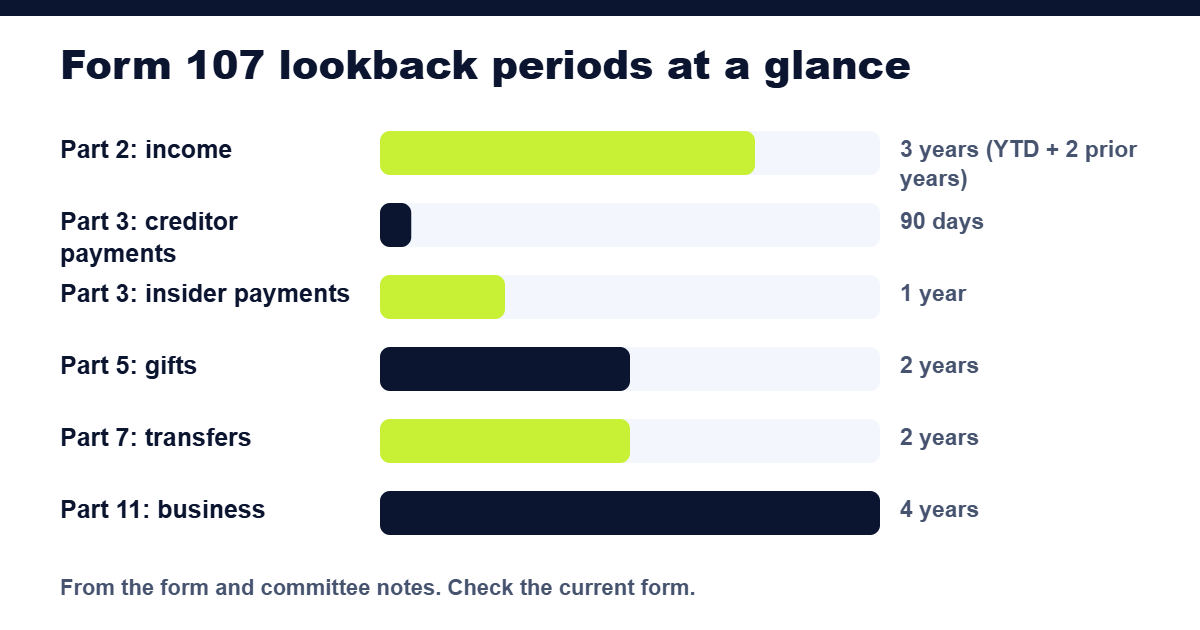
- Income is reported for the current year to date and the two prior calendar years.
- Payments to creditors are looked at over 90 days. Payments to insiders go back one year.
- Gifts and transfers reach back two years. Check the form for the gift threshold.
- Differences between W-2s and pay stubs are common. Explain them in the notes.
What is the Statement of Financial Affairs?
Official Form 107, Statement of Financial Affairs for Individuals Filing for Bankruptcy, asks the debtor to disclose financial history that the trustee and creditors may review. It is signed by the debtor under penalty of perjury, so accuracy matters more than speed. You will find the current form and instructions on the US Courts forms page.
Which parts does the form cover and how far back?
Use this table as a map. The lookback periods below come from the form and its committee notes. Always check the current form and instructions before you rely on them.
| Part | Subject | Lookback or note |
|---|---|---|
| 1 | Marital status and where the debtor lived | Prior addresses |
| 2 | Sources of income | Current year to date and the two prior calendar years |
| 3 | Certain payments before filing | 90 days for payments to creditors; 1 year for payments to insiders |
| 4 | Legal actions, repossessions and foreclosures | Mostly recent; check the form for each question |
| 5 | Gifts and contributions | 2 years; per-person and per-charity threshold on the form |
| 6 | Losses | Losses listed on the form |
| 7 | Certain payments or transfers | Transfers: 2 years |
| 8 | Financial accounts, safe deposit boxes, storage units | See form |
| 9 | Property held or controlled for someone else | No lookback stated |
| 10 | Environmental information | See form |
| 11 | Business connections | 4 years |
How do you report income in Part 2?
Part 2 asks for income from employment or a business for the current year to date and the two previous calendar years, plus income from other sources. The form asks for gross income, so use figures before deductions and check the current instructions. Self-employed debtors report gross receipts, not net profit, so collect their records early.
How do you handle payments before filing in Part 3?
Part 3 is about money that left the debtor’s hands before filing. Review the bank statements for the last 90 days for payments to creditors, and for the last year for payments to relatives or entities the debtor controls. Ask directly about repaid family loans. The form sets a threshold for creditor payments, so check it before listing small payments.
What should you ask the client about legal actions, gifts and transfers?
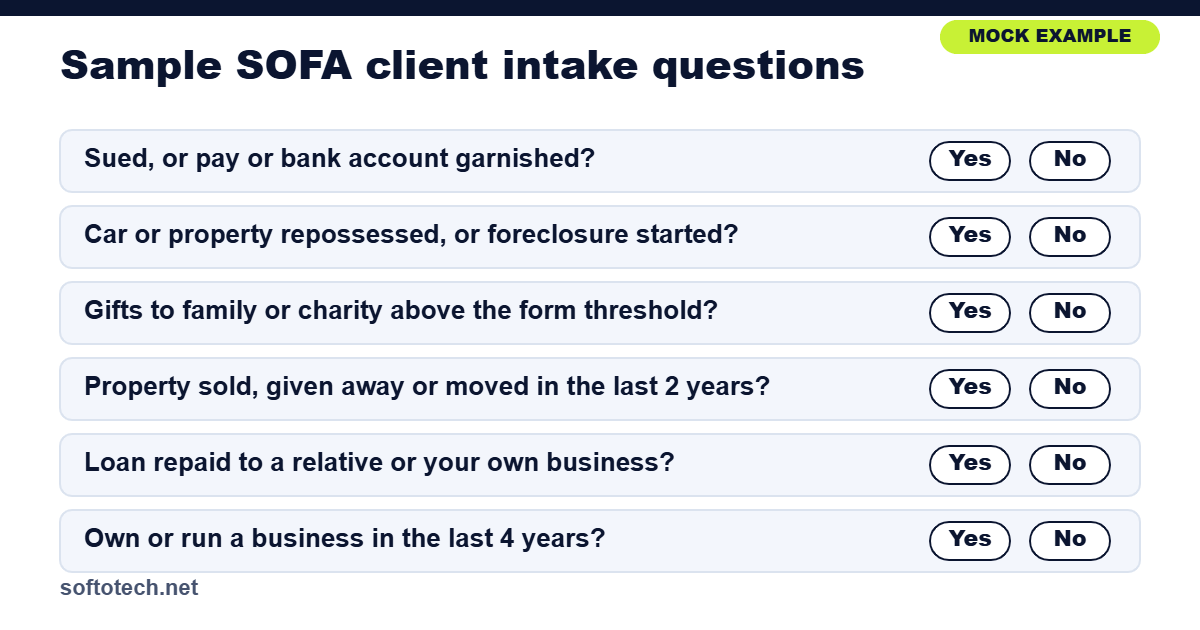
- Has anyone sued you or garnished your pay or bank account?
- Has a car or other property been repossessed, or has a lender started foreclosure?
- Have you given money or gifts to family or charity? The form has a threshold per person or charity.
- Have you sold, given away or moved any property to someone else in the last two years?
- Have you repaid a loan to a relative or to a business you control?
- Do you own or run a business, or have you in the last four years?
- Do you hold property that belongs to someone else?
How do you cross-check Form 107 against the rest of the case?
| Item on Form 107 | Check against |
|---|---|
| Part 2 income | W-2s, tax returns, year-end and year-to-date pay stubs, and Schedule I |
| Part 3 payments | Bank statements and the creditor list on Schedules D and E/F |
| Parts 5 and 7 | Bank statements, sale records and Schedule A/B |
| Part 11 business | Business records, Schedule A/B and the means test |
| Anything the client cannot document | Attorney notes, so the attorney decides what to ask next |
What are the most common Form 107 mistakes?
- Leaving income out because the client had a second job or gig work.
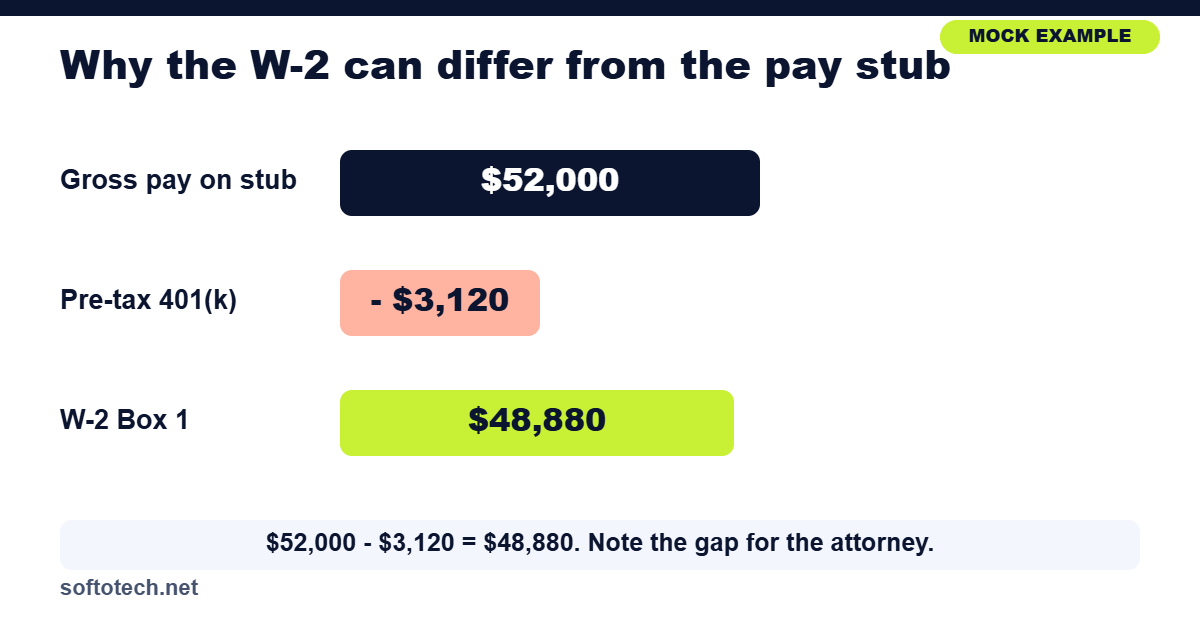
- Treating W-2 Box 1 as gross pay without checking pre-tax deductions.
- Missing a repayment to a relative inside the one-year window.
- Answering “none” to a question without asking the client.
- Forgetting a garnishment, repossession or lawsuit.
Related: Chapter 7 means test documents and petition preparer vs paralegal.
We complete the SOFA from your documents, cross-check income against W-2s and pay stubs, and flag missing information in the attorney notes.
See bankruptcy paralegal support for attorneysFrequently asked questions
What is Form 107 in bankruptcy?
It is the Statement of Financial Affairs for Individuals Filing for Bankruptcy. It asks about income, payments, transfers, legal actions, accounts and business connections.
How many years of income does the SOFA cover?
The current year to date and the two prior calendar years, as reported in Part 2.
Why does the W-2 differ from the pay stub?
A common reason is a pre-tax deduction such as a 401(k) contribution, which lowers W-2 Box 1 but not gross pay. Bonuses paid late, a second job or a missing stub are other causes.
How far back do payments to creditors go?
Payments to creditors are looked at over the 90 days before filing, and payments to insiders over one year. Check the current form for thresholds.
Where can I find the official form and instructions?
On the US Courts bankruptcy forms page, which lists Official Form 107 and the other official forms.
This article is general information for attorneys and legal staff. It is not legal advice. Forms, rules and thresholds change, so always check the current official forms and your local rules.
Related guides
- Outsource Bankruptcy Petition Preparation: A Checklist
- Chapter 7 Means Test Documents: What to Collect First
- Bankruptcy Petition Preparer vs Paralegal: What to Know