


By the Softotech bankruptcy support team, drawing on 10+ years supporting US attorneys and almost 300 bankruptcy projects. Updated October 25, 2026.
Key takeaways
- 11 U.S.C. 110 regulates non-attorney preparers who prepare filing documents for compensation.
- The definition carves out the debtor’s attorney and the attorney’s employee under direct supervision.
- Preparers must sign, give a written notice, include an identifying number and disclose fees.
- Whether an outside contractor fits the carve-out is a question for the attorney and local rules.
- Keep client contact, advice, review and signature with the attorney.
What is a bankruptcy petition preparer?
Section 110 of the Bankruptcy Code defines a bankruptcy petition preparer as a person, other than an attorney for the debtor or an employee of that attorney under the attorney’s direct supervision, who prepares a document for filing for compensation. The rules are aimed at non-attorney preparers who work for debtors directly and charge them a fee.
What does 11 U.S.C. 110 require?
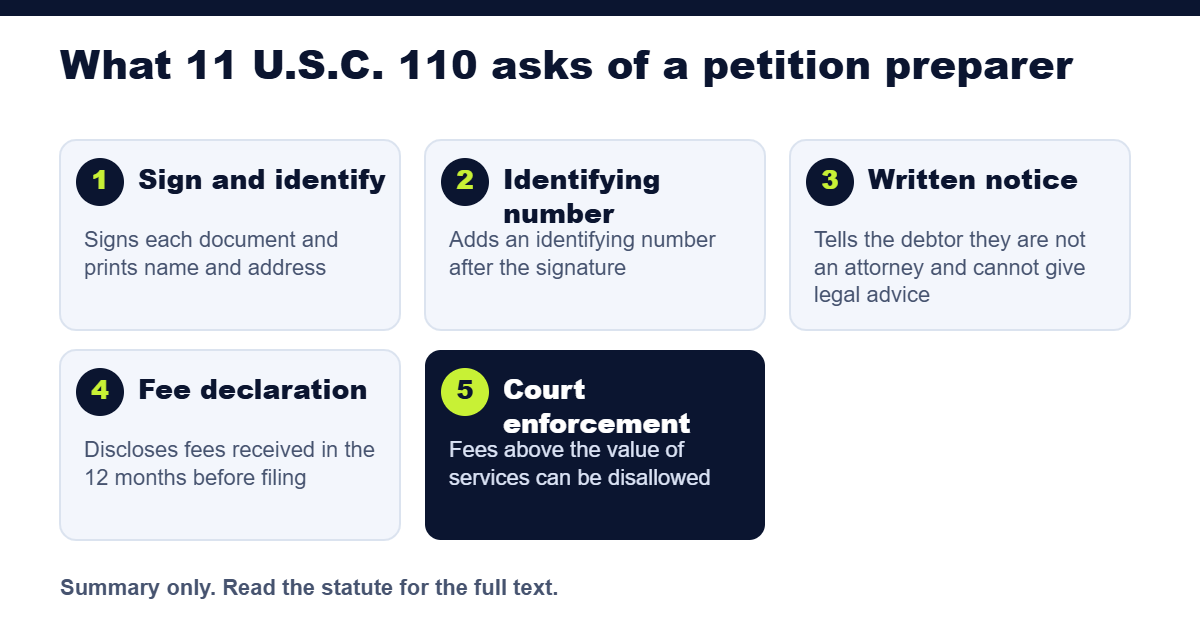
The statute puts several duties on petition preparers. In summary:
| Requirement | In plain words |
|---|---|
| Signature and address | The preparer signs each document and prints their name and address on it. |
| Identifying number | An identifying number, such as the individual’s Social Security number, goes after the signature. |
| Written notice | Before preparing documents or taking a fee, the preparer gives the debtor a written notice that the preparer is not an attorney and cannot give legal advice. |
| Fee disclosure | A declaration is filed with the petition disclosing fees received in the 12 months before filing and any unpaid fees. |
| Court enforcement | The court can disallow fees that exceed the value of the services and order them turned over to the trustee. |
Read the full text on Cornell LII before you rely on this summary.
How is a paralegal different from a petition preparer?
The difference is who the person works for and who supervises them. A paralegal who prepares documents for an attorney, under the attorney’s direct supervision, is not in the same position as a preparer who sells document preparation to debtors.
| Who prepares the documents | Treated how under section 110 |
|---|---|
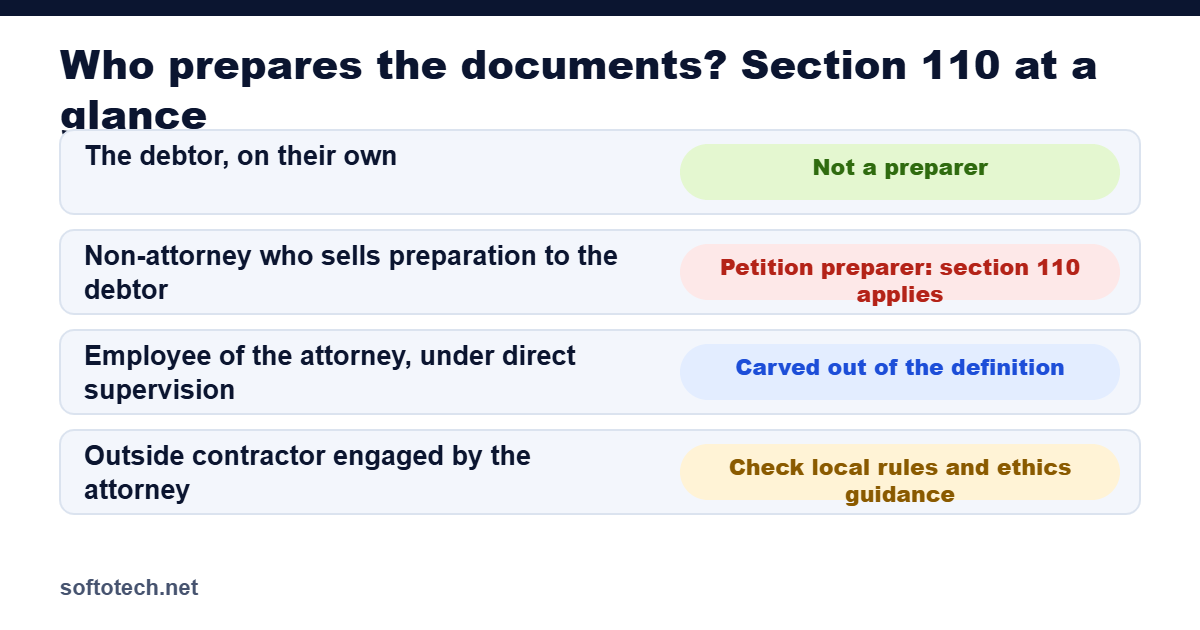
| The debtor, on their own | Not a preparer. The debtor files without help. |
| A non-attorney who sells preparation to the debtor | A bankruptcy petition preparer. Section 110 applies. |
| An employee of the debtor’s attorney, under direct supervision | Carved out of the definition. |
| An outside contractor engaged by the attorney | Depends on the arrangement and your jurisdiction. Check local rules and ethics guidance. |
Can an attorney outsource petition preparation?
Many attorneys use outside paralegals, and the statute does not say a contractor is automatically covered or excluded. The question is how the arrangement works in practice and what your jurisdiction expects. ABA Model Rule 5.3 covers an attorney’s responsibility for non-lawyer assistants, and ABA Formal Opinion 08-451 discusses outsourcing legal and support services. Many state bars have their own opinions. Read the ones that apply to you.
What are the red flags?
- The provider talks to debtors, quotes them fees or gives them advice.
- The provider signs documents as the preparer.
- Nobody on the attorney’s side reviews the work before filing.
- There is no written agreement on scope and confidentiality.
- The provider promises outcomes or tells you how to argue exemptions or strategy.
How can you structure the arrangement safely?
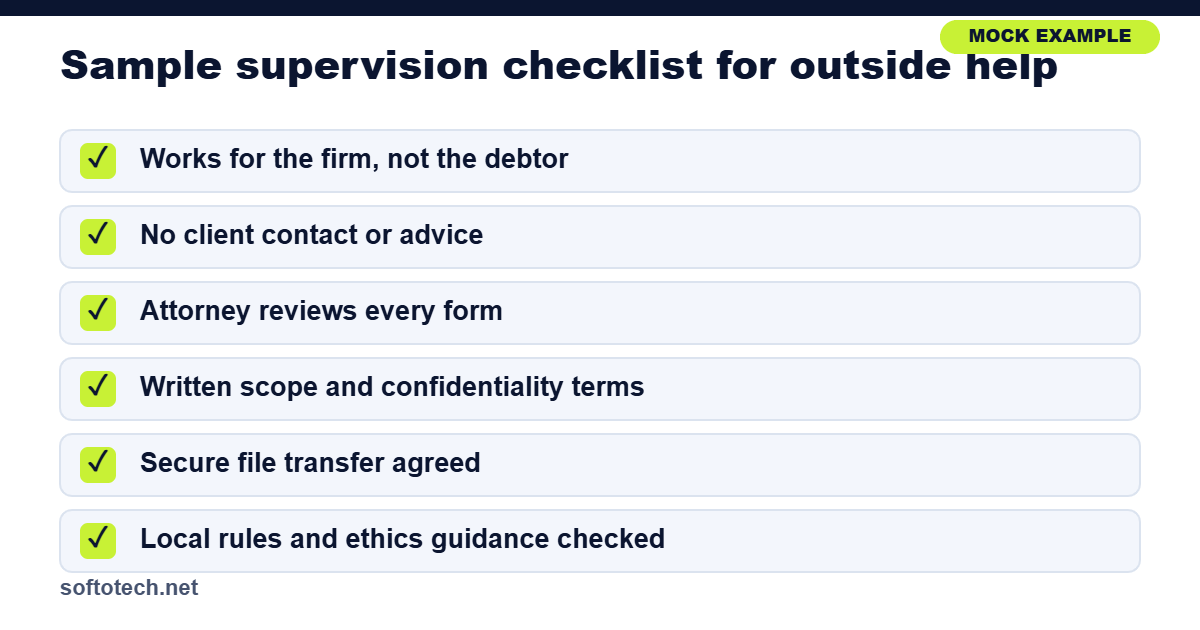
- Have the outside paralegal work for the firm, not for the debtor.
- Keep all client contact and advice with the attorney.
- Review and approve every document before it is signed or filed.
- Put scope, confidentiality and file handling in writing.
- Check your local rules, state bar guidance or ask ethics counsel.
How does Softotech work with attorneys?
We work for attorneys only. We prepare the petition package from the documents you send, give you an editable Best Case file and notes, and stop there. We do not deal with debtors and we do not give legal advice. You review, sign and file. See how to outsource petition preparation for the full workflow and our per-case pricing.
We work for attorneys only. We prepare the petition package from your documents and give you notes to review. We do not give legal advice or deal with debtors.
See bankruptcy paralegal support for attorneysFrequently asked questions
Is a paralegal the same as a bankruptcy petition preparer?
No. A petition preparer is a defined term in 11 U.S.C. 110 for people other than the debtor’s attorney or the attorney’s directly supervised employee who prepare filing documents for pay.
What does a bankruptcy petition preparer have to disclose?
They must sign and identify themselves on the documents, give the debtor a written notice that they are not an attorney, and file a declaration disclosing fees received in the 12 months before filing.
Can a lawyer outsource bankruptcy petition preparation?
Many do, but the attorney remains responsible for supervising and reviewing the work. Rules differ by jurisdiction, so check local rules and your state bar guidance.
Can a bankruptcy paralegal give legal advice?
No. Advice and strategy are for the attorney. A paralegal prepares documents from the information provided and the attorney’s instructions.
Does Softotech work with debtors directly?
No. We work for attorneys only and do not give legal advice.
This article is general information for attorneys and legal staff. It is not legal advice. Forms, rules and thresholds change, so always check the current official forms and your local rules.
Related guides
- Outsource Bankruptcy Petition Preparation: A Checklist
- Chapter 7 Means Test Documents: What to Collect First
- Statement of Financial Affairs Checklist (Form 107)