


Updated October 2026 · 6 minute read
A $100 signing sounds like easy money for an hour’s work. Then you add the drive there and back, 150 printed pages, the scanbacks, the shipping drop-off and the call to confirm the appointment, and the real hourly rate can be half what it looked like. This guide covers what loan signing agents charge in 2026, and how to tell in a minute whether an order is worth taking.
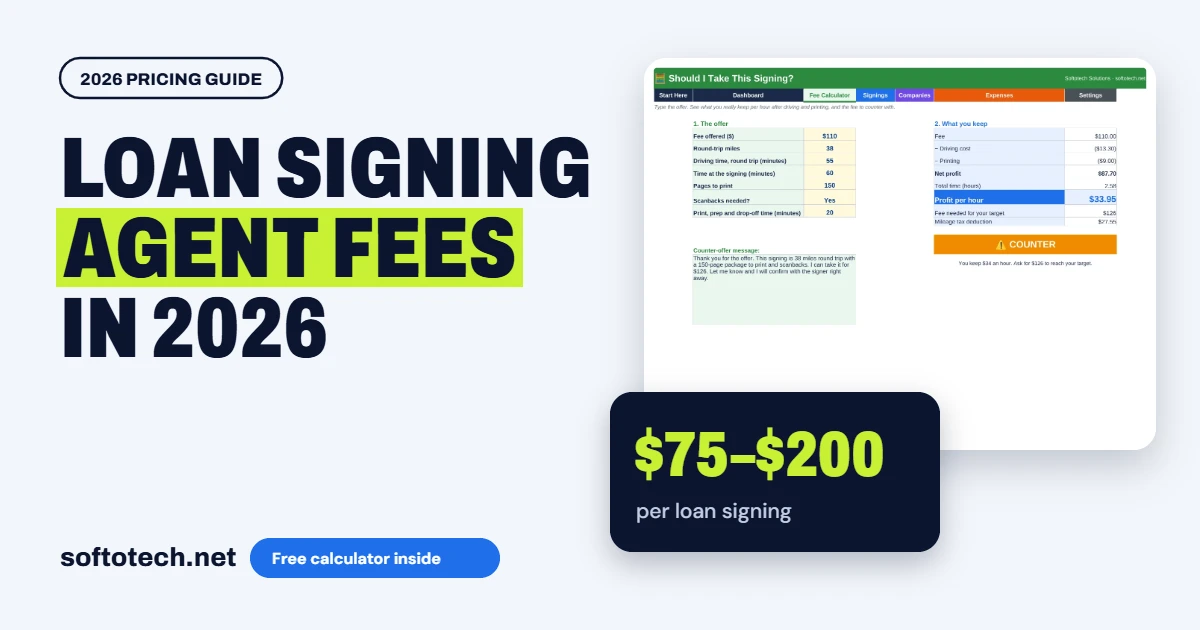
- Loan signing agents typically earn $75 to $200 per signing.
- Signing services usually pay less, often around $75 to $125; working directly for title or escrow pays more, often $150 or above.
- Most signings take about 45 minutes to an hour at the table, plus printing and travel.
- Judge every order by profit per hour after printing and mileage, not by the fee alone.
Loan signing agent fees in 2026
| Who sends the order | Typical fee per signing | Notes |
|---|---|---|
| Signing service (middleman) | $75–$125 | Steady volume; the service keeps part of what the title company pays |
| Title or escrow company (direct) | About $150+ | Higher pay; you have to market to win these clients |
| Second loan at the same signing | +$50 (service) to +$75 (direct) | Extra package, extra pages, extra time |
| Overall range | $75–$200 | Same-day, after-hours and complex packages sit at the top |
Sources: Loan Signing System pricing guide; Amazing Mobile Notary, “What Is a Loan Signing Agent?” (March 2026).
Most of that fee is not for the notarisations themselves. States cap what a notary can charge for each notarial act, and the cap is usually small. The signing fee pays for your time, travel, printing and knowledge of the loan documents. Check your own state’s rules on notary fees and travel fees before you set a price list.
Want the fee for a specific package? Our loan signing agent fee schedule by loan type compares refinance, purchase, seller, HELOC and reverse mortgage fees from five real schedules.
What affects the fee
- Package type and size. A refinance, purchase, HELOC, seller package or reverse mortgage each has a different number of pages and signers. Bigger packages take longer to print and to sign.
- Distance and traffic. A 10-minute drive and a 50-minute drive are not the same job.
- Timing. Same-day, evening and weekend signings are harder to fill and usually pay more.
- Number of signers. Each extra signer adds time at the table.
- Extras. Scanbacks (scanning signed pages back to the client), witness requirements, and a second loan in the same appointment.
- Who you work for. Direct title and escrow clients pay more but expect reliability and fast communication.
Your real costs on every signing
Before you can tell whether a fee is good, you need to know what each signing costs you. The big ones:
| Cost | How to estimate it |
|---|---|
| Printing | Pages × your cost per page (toner and paper). Loan packages often run well over 100 pages, many printed twice for borrower copies. |
| Mileage | Round-trip miles × a per-mile cost. Many agents use the IRS standard mileage rate as a simple stand-in for fuel, wear and insurance. |
| Your time | Confirming, printing, driving, signing, scanning and dropping off the package. Count all of it. |
| Shipping drop-off | Usually prepaid by the client, but the trip to the drop box takes time. |
| Fixed yearly costs | Commission, E&O insurance, background check, journal, stamp, printer and software, spread across your signings. |
How to decide if an order is worth it
Profit per hour = profit ÷ total hours (prep + travel + signing + drop-off)
Worked example
Two offers for the same Thursday evening. The cost numbers are planning assumptions for this example: about 150 printed pages at 5 cents a page, a 30-mile round trip at 70 cents a mile, and 2.5 hours in total for printing, driving, signing and dropping off.
| Signing service order | Direct title order | |
|---|---|---|
| Fee | $125 | $175 |
| Printing (150 × $0.05) | −$7.50 | −$7.50 |
| Mileage (30 × $0.70) | −$21.00 | −$21.00 |
| Profit | $96.50 | $146.50 |
| Hours (all-in) | 2.5 | 2.5 |
| Profit per hour | $38.60 | $58.60 |
Same work, a $20 an hour difference. Now imagine a service offers $95 for a signing with a 50-mile round trip: after printing and $35 of mileage, profit drops to about $52 for roughly three hours of work. That is when a counter-offer, or a polite no, makes sense.
Should I take this signing? Find out in 30 seconds
Enter the fee, miles, pages and time. The free loan signing fee calculator shows your profit, profit per hour and the minimum fee you should accept for that job.
Set your own minimums
The fastest way to stop taking bad orders is to decide your numbers in advance:
- Pick a target profit per hour that makes the work worth it for you after costs.
- Work out your cost per page and per mile once, then reuse them.
- Set a minimum fee by distance band, for example under 15 miles, 15 to 30 miles and over 30 miles, with higher minimums for evenings and weekends.
- Counter with a reason. “The round trip is 50 miles and the package is 180 pages, so my fee for this one is $150.” Services counter-offer more often than many new agents expect.
Questions to ask before you accept
A quick set of questions saves you from surprises at the table:
- What type of loan is it, and how many signers?
- Roughly how many pages, and how many sets do I print?
- Are scanbacks required, and by when?
- Is the closing disclosure approved, and will the documents arrive in time to print?
- Where is the signing, and is the time fixed or flexible?
- When and how will I be paid?
The answers tell you the real size of the job. They also make you look organised, which is exactly what title and escrow companies want from the agents they hire again.
Signing service vs working direct
Most new agents start with signing services because the orders come to you. The trade-off is lower pay, since the service keeps a share of what the title company pays. Agents who earn the most usually build a mix: services fill the calendar, while direct title and escrow clients pay the best fees.
To win direct clients, keep a short, professional one-page profile (commission, E&O coverage, background check, service area, availability), visit or email local title and escrow offices, and follow up after every signing with a quick confirmation. Reliability is what gets you the next order.
Track the business, not just the fees
At the end of the year the useful questions are: which clients paid the best per hour, which ones paid late, how many miles you drove, and what your printing really cost. Those answers tell you who to say yes to next year, and the mileage log is something you will want at tax time. Talk to a tax professional about which costs you can deduct in your situation.
Run your signing business from one sheet
The Notary & Loan Signing Agent Tracker has the “should I take this signing?” fee calculator built in, plus signings, companies, mileage, expenses, unpaid invoices and profit per client. Excel and Google Sheets.
Questions
How much do loan signing agents make per signing?
Most loan signing agents earn about $75 to $200 per signing. Signing services often pay around $75 to $125, while title and escrow companies hiring an agent directly often pay $150 or more.
How long does a loan signing take?
The appointment itself usually takes 45 minutes to an hour. Add printing, travel, scanbacks and dropping off the package to get your real time per signing.
Should I charge extra for printing?
Many agents build printing into one flat fee rather than charging it separately. Either way, know your cost per page so the fee covers it.
Is it better to work for signing services or title companies?
Title and escrow companies usually pay more per signing, but you have to find and keep those clients. Many agents use signing services to stay busy while building direct clients.
How do I know if a low offer is worth it?
Subtract printing and mileage from the fee and divide by your total hours. If the profit per hour is below your minimum, counter-offer or decline.
Related guides
Sources
- Loan Signing System: How Much to Charge as a Notary Loan Signing Agent
- Amazing Mobile Notary: What Is a Loan Signing Agent? Complete Guide (2026), March 2026
Tahir Abbas
Founder of Softotech Solutions. Tahir builds Excel and Google Sheets tools for small service businesses, including the free calculators on this site. Price ranges in this guide come from the sources listed above and are checked when the guide is updated.