


Updated October 2026 · 6 minute read
Food truck owners price two very different kinds of events. At a private catering job the client pays you a guaranteed amount. At a festival or public event you pay the organiser and hope the crowd shows up. This guide covers 2026 prices for both, and shows how to tell before you book whether an event will actually make money.
- Private food truck catering typically costs $22 to $38 per guest, with an average around $29.
- Most trucks set a catering minimum of about $800 to $1,500 for small events, and take a 25% to 50% deposit.
- Festival vendor fees range from about $50 to $150 a day at small community fairs to $1,500 to $3,000 at very large festivals, and some charge 10% to 30% of sales.
- Before you book a public event, work out the break-even number of orders.
Private catering prices in 2026
Best Food Trucks analysed 2,613 confirmed bookings from 2024 to 2026. Its booking data gives a clear picture of what customers pay:
| Measure | 2026 figure |
|---|---|
| Typical price per guest | $22–$38 |
| Average price per guest | $28.88 |
| Birthday parties (average per guest) | $38.17 |
| Wedding receptions (average per guest) | $31.12 |
| Median total booking | $1,900 |
| Average total booking | $2,584 |
| Middle half of bookings | $1,500–$2,800 |
Source: Best Food Trucks, “How Much Does It Cost to Hire a Food Truck?” (June 2026), from its own booking data.
Catering minimums by guest count
| Guests | Typical minimum |
|---|---|
| Under 75 | $800–$1,200 |
| 75–150 | $1,200–$2,000 |
| 150–300 | $2,000–$4,000 |
| 300+ | $4,000+ or several trucks |
A minimum protects you from a small party that would not cover the cost of closing your normal service for the day. A common way to write it: “$1,500 minimum for up to 60 guests, then $25 per additional guest.” The standard service window is about 1.5 to 2 hours, and longer service should cost more.
Deposits
Most trucks take 25% to 50% of the total when the event is booked, with the balance due before or on the event day. Make the deposit non-refundable inside a set number of days before the event, and say so in writing.
Want the per-guest numbers in more detail? See our food truck catering cost per person chart by event type and cuisine.
Festival and public event vendor fees
Public events flip the risk. You pay to be there, then earn whatever the crowd spends. Organisers charge in three main ways:
| Fee type | Typical range | Who it suits |
|---|---|---|
| Flat daily fee, small community fair | $50–$150 per day | New trucks testing an area |
| Flat weekend fee, mid-sized regional festival | $250–$800 | Most established trucks |
| Flat fee, mega-festival (50,000+ people) | $1,500–$3,000 | Fast, high-volume menus |
| Share of sales | 10%–30% (often 15% or 20%) | Lower upfront risk, less upside |
| Hybrid | Small flat fee (e.g. $200) + about 10% of sales | A balance of both |
Sources: Ticket Fairy, “Vendor Revenue Share vs Stall Rental” (updated April 2026); Dojo Business, food truck location fees (October 2025).
A percentage deal sounds safer because you pay less if the event is quiet. But on a big day it can cost far more than a flat fee. That is why the next step matters.
How to tell if an event will make money
Every event comes down to a few numbers: how many orders you will sell, your average ticket, your food cost and your fixed costs for the day.
Break-even orders = fixed costs ÷ (average ticket − variable cost per order)
Worked example
A one-day regional festival. The organiser charges $400 plus 10% of sales. The other numbers are planning assumptions for this example: an average ticket of $14, food and packaging at 30% of sales, 3% card fees, three staff for 10 hours at $18 an hour and $80 of fuel and propane. You expect about 300 orders.
| Line | Amount |
|---|---|
| Sales (300 × $14) | $4,200 |
| Food and packaging (30%) | −$1,260 |
| Vendor fee ($400 + 10%) | −$820 |
| Staff (3 × 10 h × $18) | −$540 |
| Fuel and propane | −$80 |
| Card fees (3%) | −$126 |
| Event profit | $1,374 |
Now the break-even point. Fixed costs are $400 + $540 + $80 = $1,020. Each order brings in $14, and 43% of it goes to food, the percentage fee and card fees, leaving about $7.98. So you need about 128 orders just to cover the day ($1,020 ÷ $7.98). If the organiser cannot tell you how many people came last year, that number is the risk you are taking.
Know your profit before you book
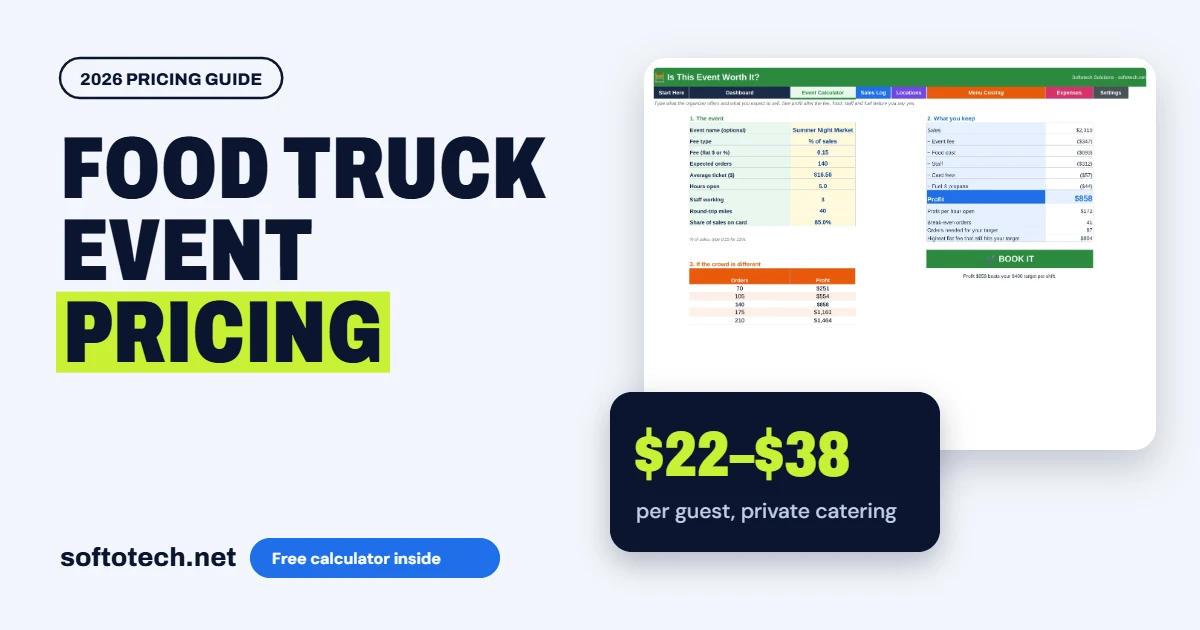
Enter the expected crowd, average ticket, food cost, vendor fee or percentage, staff and fuel. The free food truck event calculator shows sales, profit, profit per hour and your break-even number of orders.
Flat fee or percentage? Compare both
Say an organiser offers a choice: a flat $800 or 20% of sales. With the same $14 average ticket, here is what you would pay at different crowd sizes:
| Orders sold | Sales | 20% of sales | Flat fee | Cheaper option |
|---|---|---|---|---|
| 150 | $2,100 | $420 | $800 | Percentage |
| 300 | $4,200 | $840 | $800 | About even |
| 500 | $7,000 | $1,400 | $800 | Flat fee |
The crossover here is about 286 orders ($800 ÷ 20% ÷ $14). If you are confident the event will go past that, take the flat fee. If it is a first-year event with no attendance history, the percentage limits your downside.
Not sure what minimum to ask for? Our food truck minimum guarantee guide shows typical minimums for private and public events, a formula for your own number and what to put in the agreement.
Questions to ask an event organiser
- How many people attended last year, and over how many hours?
- How many food vendors will there be, and how many sell food like yours?
- Is the fee flat, a percentage, or both? When is it due?
- Is there power and water, or do you need a generator?
- What happens if the event is cancelled for weather?
- Where will your truck be placed relative to the entrance and the stage?
Event attendance alone is not enough. Ten thousand people with twenty food trucks can be worse than three thousand people with four. Divide the crowd by the number of vendors to get a rough sense of your share.
Tips that raise event profit
- Shrink the menu for big events. Five fast items sell more orders per hour than twelve slow ones.
- Price for speed. Round prices (for example $12 or $15) speed up cash and card payments.
- Add a high-margin side or drink. It raises the average ticket with little extra work.
- Prep for the break-even, stock for the forecast. Bring enough for a good day, but make sure perishable stock can be used the next day if the event is slow.
- Record every event. Orders, sales, weather and fees. After a season you will know which events to book again.
Track every event, location and sale
The Food Truck Business Tracker has the event profit calculator built in, plus events, locations, daily sales, menu costs, staff and profit per event. Excel and Google Sheets.
Questions
How much should I charge for food truck catering?
In 2026 most food truck catering costs $22 to $38 per guest, with an average around $29. Many trucks set a minimum of about $800 to $1,500 for smaller events and charge $25 or more for each guest above the minimum.
How much are festival vendor fees for food trucks?
Small community fairs often charge $50 to $150 a day, mid-sized regional festivals $250 to $800 for a weekend and very large festivals $1,500 to $3,000. Some organisers take 10% to 30% of sales instead of, or as well as, a flat fee.
How much deposit should a food truck take?
Most trucks take 25% to 50% of the total when the event is booked and collect the balance before or on the event day.
Is a percentage of sales or a flat fee better?
A percentage costs less on a quiet day and more on a busy one. Work out your expected sales and compare both; if you expect a strong event, a flat fee usually leaves you more profit.
How do I work out break-even for an event?
Add your fixed costs for the day (flat fee, staff, fuel), then divide by what each order leaves after food cost, percentage fees and card fees. The free event calculator does this for you.
Related guides
Sources
- Best Food Trucks: How Much Does It Cost to Hire a Food Truck? (2026), June 2026
- Ticket Fairy: Vendor Revenue Share vs Stall Rental, updated April 2026
- Dojo Business: Food Truck Location Fees, October 2025
Tahir Abbas
Founder of Softotech Solutions. Tahir builds Excel and Google Sheets tools for small service businesses, including the free calculators on this site. Price ranges in this guide come from the sources listed above and are checked when the guide is updated.