



Junk removal is priced by how much space the load takes up, but your price must still cover labor, the truck and disposal. Here is a way to make sure every job pays.
Updated 25 October 2026. Written by Tahir Abbas, Softotech. All figures are worked examples, not quotes.
Key takeaways
- Volume is how customers think, but cost is labor plus truck plus disposal, so quote from cost and use volume as the unit.
- One per-yard rate does not fit every job. A light 12 yard load can cost less per yard than a heavy 6 yard load.
- Small loads cost more per yard because the trip, crew and dump visit are mostly fixed. A minimum charge covers this.
- If a job runs long or needs a second dump trip, your real margin can fall by more than half.
- Check local dump fees and hazardous-waste rules before quoting, because they vary by site.
Step 1: Estimate the volume
Most companies price by cubic yards or by fractions of a truck load. Estimate the load in cubic yards. In this example the job is 6 cubic yards.
Step 2: Add up the job cost
- Labor: 2 workers for 2 hours at $20 an hour is $80.
- Truck, fuel and wear for the trip: $35.
- Dump or disposal fees: $60. These vary by site and material, so use your local rates.
Total cost is $175.
Step 3: Turn cost into a price
At a 40% margin, $175 / 0.60 = about $292. Per cubic yard that is $292 / 6 = $48.67.
Step 4: Set rules that protect your margin
- A minimum charge so tiny jobs do not lose money.
- Extra fees for heavy items, stairs, or materials that cost more to dispose of.
- A rate for multiple dump stops.
If you employ helpers, count their full cost. See labor burden. Not sure how margin differs from markup? Read this guide.
Price by truck fraction
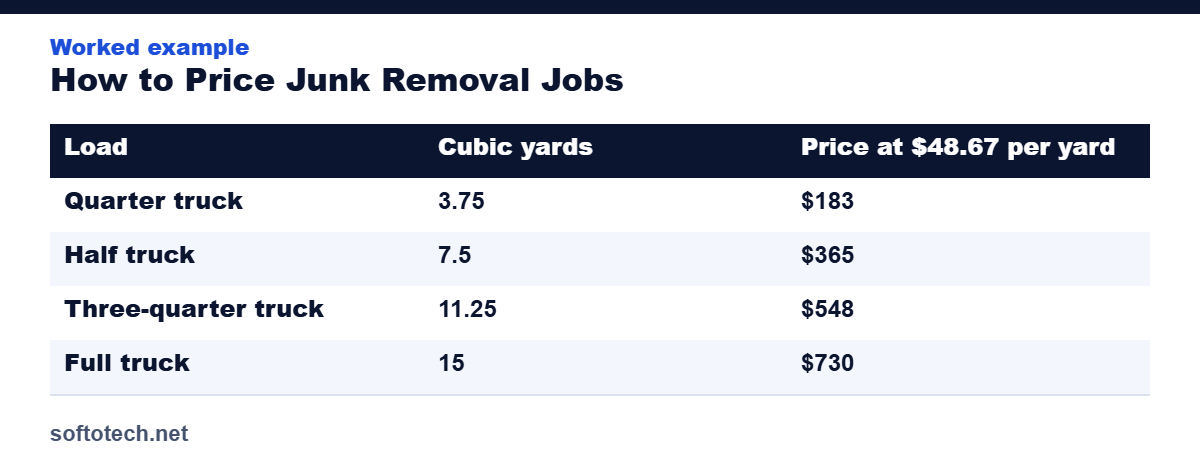
Customers think in truck loads, so a price list by fraction is easy to quote. Here is the example from above ($48.67 per cubic yard) applied to a truck that holds 15 cubic yards. The truck size is an example, so use your own.
| Load | Cubic yards | Price at $48.67 per yard |
|---|---|---|
| Quarter truck | 3.75 | $183 |
| Half truck | 7.5 | $365 |
| Three-quarter truck | 11.25 | $548 |
| Full truck | 15 | $730 |
Small loads cost more per yard because the trip, the crew and the dump visit are mostly fixed. That is why you need a minimum charge.
A heavier job and a minimum charge
Take a 10 cubic yard job with heavy material. Two workers for 3 hours at $20 an hour is $120 in labor. Truck and fuel are $45 and the dump fee is $130. Total cost is $295. At a 40% margin:
$295 / 0.60 = about $492, or $49.17 per cubic yard.
Now the smallest job you accept: 2 workers for 1 hour ($40), a $35 truck trip and $15 in dump fees. Cost is $90, and $90 / 0.60 = $150. So a minimum charge of $150 keeps even a tiny job at your target margin.
Common mistakes
- Quoting by volume when the material is heavy. Concrete, dirt and wet material cost far more to dispose of.
- Forgetting drive time and a second dump trip.
- Not counting insurance, licenses, truck payments and your own unpaid time on estimates.
- Copying a competitor price without knowing your own cost.
Disposal rules and fees differ by city and landfill, so call your local site for current rates. The EPA has general information on construction and demolition materials. To find the volume you must sell to cover all costs, see how to calculate break-even.
Sources and a note
- EPA, Sustainable Management of Construction and Demolition Materials
- EPA: Household Hazardous Waste (HHW)
Truck size, labor rates, fuel and dump fees are examples. Use your own local numbers.
Use the calculator
Enter your costs in the junk removal pricing calculator. More tools are on the free tools page.
Related guides
Free pricing tips for your business
Get short, practical tips on pricing jobs and using our free calculators. No spam, unsubscribe any time.
Why does one price per cubic yard not fit every job?
The per-yard rate from the first example ($48.67) is an output, not a fixed tariff. Two loads of different material can cost very different amounts to move. Here is a light 12 cubic yard job using the same method. Assumptions: 2 workers for 2.5 hours at $20 an hour, $40 for truck and fuel, and a $100 dump fee.
- Labor: 2 x 2.5 x $20 = $100.
- Truck and fuel: $40. Dump fee: $100.
- Total cost: $240.
- Price at a 40% margin: $240 / 0.60 = $400, or $33.33 per cubic yard.
If you had applied $48.67 a yard to this job, you would have quoted $584. That may lose the job. If you had applied $33.33 a yard to the heavy 10 yard job, you would have quoted $333 against a cost of $295, and your margin would have fallen to about 11%. Quote each job from its own cost, then check the per-yard number afterward.
What happens to your margin when a job runs long?
Estimates fail on time and trips, not on the price of gas. Take the 6 cubic yard job priced at $292 with a $175 cost, then change one input at a time.
| What goes wrong | New cost | Profit at $292 | Real margin |
|---|---|---|---|
| Nothing (as quoted) | $175 | $117 | 40% |
| Job takes 3 hours, not 2 | $215 | $77 | 26.4% |
| Second dump trip: 1 more hour of labor ($40) and $35 truck cost | $250 | $42 | 14.4% |
One extra hour cuts the margin by about a third. A second dump trip cuts it by more than half. If a second trip is likely, quote it in. The same load priced for two trips is $250 / 0.60 = about $417, or $69.44 per cubic yard. Walk the job or ask for photos first, and write the trip count into the quote.
What should you ask the customer before you quote?
A short list of questions removes most surprises. Ask them by phone or text, and ask for photos.
- What items are being removed, and how much of each? Ask for a photo of the pile.
- Is anything heavy, such as concrete, dirt, roofing, appliances or wet material?
- Where is it, and are there stairs, a long carry or limited truck access?
- Are there paints, solvents, batteries, pesticides or other hazardous items?
- Is there a deadline, or a same-day request that changes your schedule?
The last two are worth noting in writing. The EPA lists paints, cleaners, oils, batteries and pesticides as household hazardous waste. It says many communities run separate collection programs for these items, and they should not go in regular trash. Decide before you arrive whether you will take them and what your local site charges. If not, say so in the quote.
Frequently asked questions
How do junk removal companies price jobs?
Most price by the volume the load takes up in the truck, then adjust for labor, disposal fees, heavy items and travel.
What profit margin should a junk removal business aim for?
It varies with costs and volume. Work out your own break-even first, then set a margin that covers overhead and leaves profit.
Should I charge a minimum fee?
Yes. A minimum makes sure small jobs still cover the trip, labor and disposal.
How many cubic yards fit in a junk removal truck?
It depends on the truck. The guide uses 15 cubic yards as an example, so a half load is 7.5 yards. Measure your own truck bed or box and use that number for your price-by-truck-fraction table instead of a published figure.
Should I charge by the load or by the hour?
Both work if the numbers cover your cost. Load-based pricing is easier for customers to understand. Hourly pricing suits jobs with unknown access or lots of sorting. Whichever you use, calculate cost with the formula in this guide and keep a minimum charge.
Can I take hazardous items like paint or batteries?
Only if you know where to dispose of them legally and what it costs. The EPA says many communities run household hazardous waste collection programs. Check with your local solid waste agency, and list excluded items in your quote so the customer knows in advance.