

Updated October 2026 · 6 minute read
Getting through to the person who signs off on a purchase beats sending ten emails to a general inbox. This guide shows how our research team finds decision makers and their work email addresses, step by step, how to verify them, and the rules to follow before you hit send.
- 1. Name the role that buys what you sell (owner, operations manager, head of procurement).
- 2. Find the person on the company website, LinkedIn, press releases or state filings.
- 3. Find the email format from one real published address at that company.
- 4. Verify every address before you send; skip invalid and treat catch-alls with care.
- 5. Follow CAN-SPAM: it covers B2B email too.1
Pick the right role first
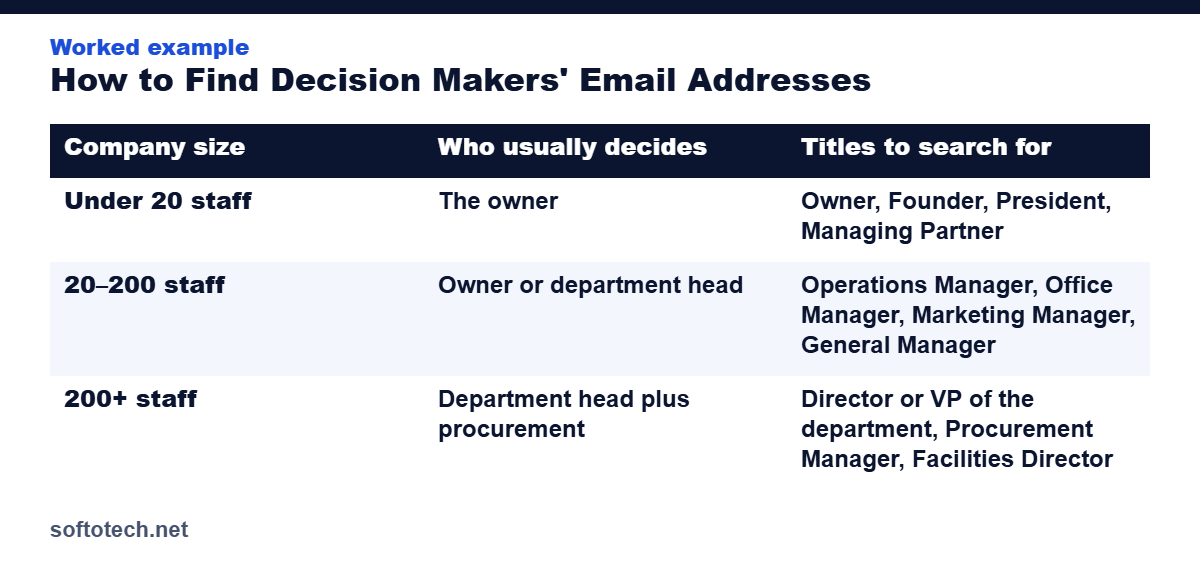
“Decision maker” depends on what you sell and the size of the company. Write down the titles before you start searching:
| Company size | Who usually decides | Titles to search for |
|---|---|---|
| Under 20 staff | The owner | Owner, Founder, President, Managing Partner |
| 20–200 staff | Owner or department head | Operations Manager, Office Manager, Marketing Manager, General Manager |
| 200+ staff | Department head plus procurement | Director or VP of the department, Procurement Manager, Facilities Director |
These are starting points from our own research projects, not rules; a quick look at the company’s team page usually tells you who runs what.
Where to find the person
- Company website: About, Team, Leadership, Contact and Press pages often list names, titles and sometimes direct emails.
- LinkedIn: search the company, filter people by title, and confirm they still work there.
- Press releases and news: announcements of new hires and promotions name the person and their role.
- Industry directories and associations: member lists often include a main contact.
- State business filings: the Secretary of State record lists officers or a registered agent for many companies, which helps with small firms.
- Events: speaker pages and sponsor lists for trade shows and webinars.
Work out the email format
Once you have a name, you need the company’s email pattern. Find one real, published address at the same domain (on the website, a PDF, a press release or a job post) and match it:
| Pattern | Example for Jane Smith at example.com |
|---|---|
| first.last | jane.smith@example.com |
| first | jane@example.com |
| first initial + last | jsmith@example.com |
| first + last initial | janes@example.com |
| firstlast | janesmith@example.com |
Apply the pattern to your decision maker, then verify it. Never assume; companies change formats, and some use different formats for older staff.
Verify before you send
- Run every address through an email verifier that checks the mail server and mailbox.
- Valid: safe to use. Invalid: remove. Catch-all: the server accepts everything, so the address is unconfirmed; send carefully or find a second source.
- Re-verify lists older than a few months before each campaign.
- Watch your bounce rate; sending to bad addresses damages your domain’s reputation and future deliverability.
The rules: CAN-SPAM
US law allows cold email to businesses, but the CAN-SPAM Act applies and “makes no exception for business-to-business email.”1 The FTC’s main requirements:
- No false or misleading header information, and no deceptive subject lines.
- Identify the message as an ad.
- Include a valid physical postal address.
- Give a clear way to opt out, and honour opt-outs within 10 business days.
- You stay responsible even if someone else sends for you.
Each email that breaks the rules can bring penalties of up to $53,088, according to the FTC.1 If you email people in the UK or EU, stricter privacy rules apply as well.
Record it in a spreadsheet
| Column | Example |
|---|---|
| Company | Example Roofing LLC |
| Website | example.com |
| Name and title | Jane Smith, Owner |
| jane@example.com | |
| Verification status and date | Valid, 2026-10-17 |
| Source | Website About page |
| Opt-out | Blank, or the date they unsubscribed |
Need a verified list of decision makers?
We research B2B contact lists to your exact targeting: industry, location, job title and company size, with every email verified and sourced, delivered in Excel or CSV.
Questions
How do I find a decision maker’s email address for free?
Start with the company website (team, leadership and press pages), then LinkedIn for the right person and title, then press releases, conference speaker pages and state business filings. Once you know one real address at the company, you can usually work out the format for others and verify it before sending.
What is the most common business email format?
There is no single rule, but first.last@example.com, first@example.com and first initial plus last name (jsmith@example.com) are formats you will see often. Confirm a company’s format from a real address you find published, then verify each guess.
Is it legal to cold email decision makers in the US?
Yes, commercial email to businesses is allowed in the US, but it must follow the CAN-SPAM Act, which makes no exception for business-to-business email. That means honest headers and subject lines, a physical address, a clear way to opt out and honouring opt-outs within 10 business days.
How do I verify an email address before sending?
Use an email verification tool that checks the domain’s mail server and whether the mailbox exists. Treat catch-all domains as unconfirmed, and never send to addresses that come back invalid; high bounce rates hurt your sender reputation.
Should I buy an email list instead?
Bought lists are often out of date and the people on them never asked to hear from you. A smaller list you researched for your exact targeting, verified and sent in line with CAN-SPAM usually performs better and is easier to defend.
Related guides
Sources
Tahir Abbas
Founder of Softotech Solutions. Tahir’s team has built researched B2B contact lists for clients in the US, UK, Germany and Canada. This guide is general information, not legal advice.