Updated October 2026 · 6 minute read
A targeted email list is not a big list. It is a list where every contact fits your offer, works at a company you can serve and has an address you have checked. Here is the six-step process our research team uses to build B2B lists, with the spreadsheet layout and the compliance basics.
- 1. Define the target: industry, location, size, job title.
- 2. List matching companies from directories, maps and association lists.
- 3. Find the decision maker at each company.
- 4. Find and verify each email.
- 5. Record source and date for every contact.
- 6. Send within the rules: CAN-SPAM covers B2B email.1
Step 1: Define the target
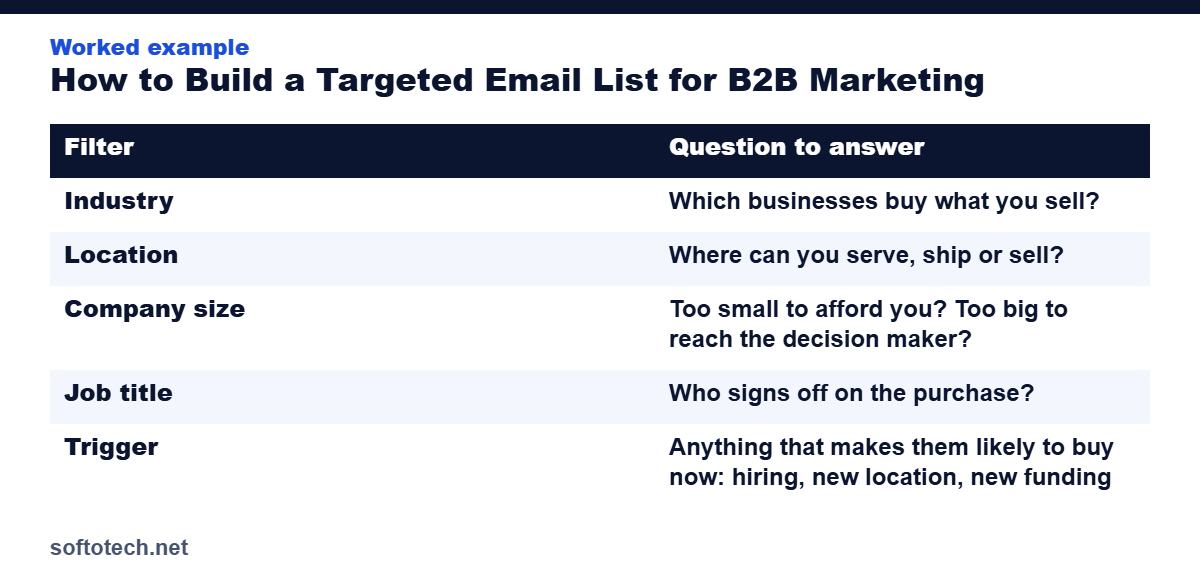
Write a one-line target before you search, for example: “Roofing contractors in Arizona and Florida, 5 to 50 staff, owner or general manager.”
| Filter | Question to answer |
|---|---|
| Industry | Which businesses buy what you sell? |
| Location | Where can you serve, ship or sell? |
| Company size | Too small to afford you? Too big to reach the decision maker? |
| Job title | Who signs off on the purchase? |
| Trigger | Anything that makes them likely to buy now: hiring, new location, new funding |
Step 2: List matching companies
- Map searches for local service businesses, with website and phone.
- Industry directories and associations for member lists.
- Licensing boards for trades that need a state licence.
- Trade show exhibitor lists for manufacturers and suppliers.
- Job boards to spot companies hiring for the role your product helps.
Remove duplicates and companies that don’t fit your size or location before you look for people. It is the cheapest place to cut.
Step 3: Find the decision maker
Check the company’s team and about pages, LinkedIn and recent press releases for the person with the right title. For small firms, state business filings often name the owner or officers. Our guide to finding decision makers’ email addresses covers this step in detail.
Step 4: Find and verify emails
- Use a published address first, from the website, a press release or a PDF.
- Otherwise, work out the company’s email pattern from one real address and apply it.
- Run every address through a verifier; drop invalid, flag catch-all.
- Use a general inbox (info@) only as a last resort, and label it.
Step 5: Record everything
| Column | Why |
|---|---|
| Company, website, industry, location, size | Segmenting and personalising |
| Contact name and job title | Reaching the right person |
| Email and phone | Outreach |
| Verification status and date | Knowing what is safe to send and when to recheck |
| Source URL | Proving where the data came from |
| Opt-out date | Never emailing someone who unsubscribed |
Step 6: Send within the rules
CAN-SPAM applies to B2B email: the FTC says the law “makes no exception for business-to-business email.”1 Use accurate sender details and subject lines, include your postal address, give a clear opt-out and honour it within 10 business days.1 Penalties can reach $53,088 per violating email.1 If any contacts are in the UK or EU, check their stricter rules first.
Start with a small batch, read the replies, and adjust your targeting before you send to the whole list.
Get a targeted list built for you
We research verified B2B contact lists to your exact industry, location, job title and company size, with a source for every contact, delivered in Excel or CSV.
Questions
How do I build a targeted email list from scratch?
Define your ideal customer first (industry, location, company size, job title), list the companies that match, find the right person at each one, find and verify their email, and record everything in a spreadsheet with the source. Then send in line with CAN-SPAM.
How many contacts do I need for a B2B email list?
It depends on how narrow your market is. A few hundred well-matched, verified contacts often beat thousands of loose ones, because replies come from relevance, not volume. Start small, measure replies, then expand.
Is it better to buy or build an email list?
Building takes longer but gives you contacts that match your offer, with known sources and fresh verification. Bought lists are often stale and untargeted, which raises bounces and spam complaints.
What fields should a B2B email list include?
At minimum: company, website, contact name, job title, email, verification status and date, source, and an opt-out column. Industry, location, company size and phone help with segmenting.
Do I need permission to email businesses in the US?
US law doesn’t require prior consent for commercial email, but CAN-SPAM rules apply to B2B email too: honest headers and subjects, a physical address, a working opt-out and honouring opt-outs within 10 business days.
Related guides
Sources
Tahir Abbas
Founder of Softotech Solutions. Tahir’s team has built researched B2B contact lists for clients in the US, UK, Germany and Canada. This guide is general information, not legal advice.