


Short-term rental income looks large until you subtract the mortgage, utilities, supplies and fees. This guide shows how to work out your real profit and the occupancy you need to break even.
Updated 25 October 2026. Written by Tahir Abbas, Softotech. All figures are worked examples, not quotes.
Key takeaways
- Profit is sensitive to occupancy: in the example, 55% occupancy leaves $3,445, against $8,683 at 65%.
- Break-even occupancy is the number to check before you buy, furnish or sign a lease.
- Management and cleaning costs can cut the example profit by half or more if the guest fee does not cover them.
- Check local permit and lodging-tax rules first. Some cities limit or ban short-term rentals.
- This guide shows pre-tax profit. Rental income tax depends on stay length and services, so check the IRS rules.
Step 1: Estimate revenue
Booked nights = 365 x occupancy rate. At 65% occupancy that is about 237 nights. At $150 a night, revenue is $35,550 a year.
Step 2: List your costs
- Mortgage or rent: $1,300 a month, or $15,600 a year.
- Property taxes and insurance: $4,200.
- Utilities and internet: $3,000.
- Supplies and consumables: $1,200.
- Maintenance and repairs: $1,800.
- Platform host fee: this example uses 3% of revenue, about $1,067. Fees change, so check the current fee for your platform.
- Cleaning: in this example the guest cleaning fee covers the cleaner, so it nets to zero. If it does not, add it as a cost.
Total costs are about $26,867.
Step 3: Profit
$35,550 – $26,867 = $8,683 a year, about $724 a month, before income tax.
Step 4: Break-even occupancy
Fixed costs here are $25,800. The denominator is $150 x 365 x 0.97 = $53,108, so break-even occupancy is about 48.6%. If your real occupancy is close to that, the property is risky.
What to check before you rely on the numbers
- Local rules: some cities limit or ban short-term rentals or require a permit.
- Seasonality: use an annual average, not your best month.
- Time cost: if you manage it yourself, your time is part of the cost.
What happens when occupancy or price drops
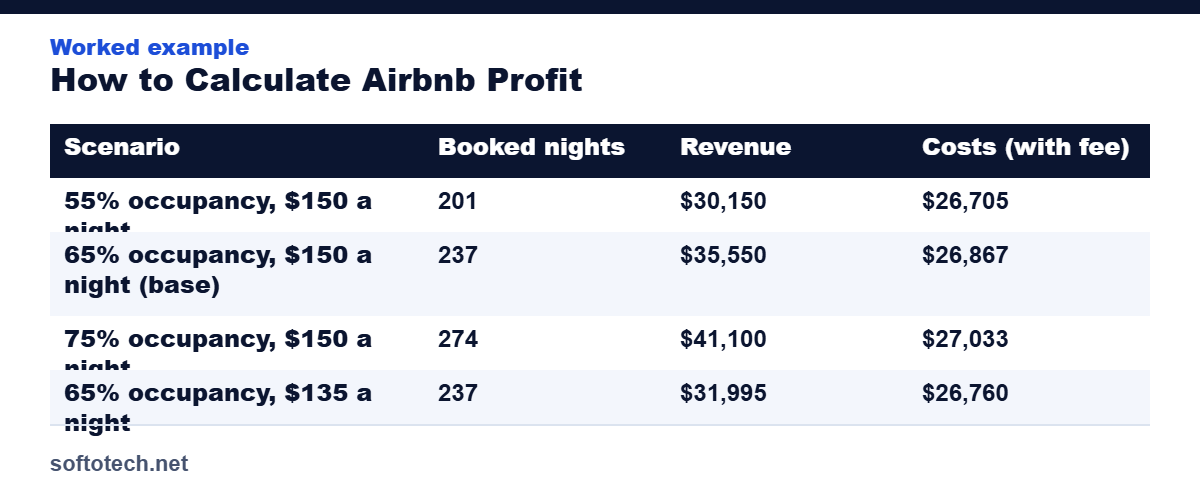
Short-term rental profit swings with the calendar. Here is the example above with different occupancy levels and one price cut. Fixed costs are the same: $25,800 a year before the 3% platform fee.
| Scenario | Booked nights | Revenue | Costs (with fee) | Profit |
|---|---|---|---|---|
| 55% occupancy, $150 a night | 201 | $30,150 | $26,705 | $3,445 |
| 65% occupancy, $150 a night (base) | 237 | $35,550 | $26,867 | $8,683 |
| 75% occupancy, $150 a night | 274 | $41,100 | $27,033 | $14,067 |
| 65% occupancy, $135 a night | 237 | $31,995 | $26,760 | $5,235 |
A drop from 65% to 55% occupancy cuts profit by more than half, and a 10% lower nightly price cuts it by about 40%. That is why it pays to know your break-even occupancy before you buy or furnish a place.
Costs people forget
- Furniture, linens and replacements. Guests break and lose things.
- Local lodging or occupancy taxes and any permit or license fees. Many cities have rules for short-term rentals, so check yours first.
- A different insurance policy, because standard home insurance often excludes paying guests.
- Deep cleans, laundry and restocking between stays when the guest fee does not cover them.
- Software for pricing, messaging or channel management.
- Vacancy in the slow season, and your own time answering guests.
Taxes and where to read more
How short-term rental income is taxed depends on how long guests stay and on the services you provide. Start with IRS Topic 414, Rental Income and Expenses and Publication 527, then ask a tax professional. If you are financing the property, see how lenders look at it in our guide to DSCR for Airbnb. If you also clean the unit yourself, see how much to charge to clean an Airbnb.
Sources and a note
This is general information, not financial, tax or legal advice. The platform fee, rates and occupancy here are examples. Check current fees on your platform.
Run your numbers
Enter your own figures in the Airbnb profit calculator. If you want to finance a short-term rental, see DSCR loans for Airbnb. More tools are on the free tools page.
Related guides
Free pricing tips for your business
Get short, practical tips on pricing jobs and using our free calculators. No spam, unsubscribe any time.
What if you pay a co-host or the cleaning fee does not cover the cleaner?
The base example assumes you manage the place yourself and the guest cleaning fee pays the cleaner. Most hosts change one of those two things at some point. Here is what each change does to the $8,683 base profit. Assumptions: average stay of 3 nights (237 nights / 3 = 79 stays), a $60 cleaner cost per stay that the guest fee does not cover, and a co-host who takes 20% of revenue.
| Scenario | Extra cost | Annual profit | Per month |
|---|---|---|---|
| Base case | $0 | $8,683 | $724 |
| Cleaner not covered by guest fee | 79 x $60 = $4,740 | $3,943 | $329 |
| Co-host at 20% of revenue | $35,550 x 0.20 = $7,110 | $1,573 | $131 |
Both are examples, not market rates. Your own stay length and cleaner price change the result. The lesson is that the base profit is only valid for the exact costs listed. Put a line for every cost into your sheet, even if it is zero.
What nightly rate do you need to break even?
You can solve for price instead of occupancy. The formula in plain words: fixed costs divided by booked nights, divided by (1 minus the fee rate).
Break-even nightly rate = fixed costs / (booked nights x (1 – fee rate)).
Using the example: $25,800 / (237 x 0.97) = about $112 a night. That is $38 below the $150 base rate, or about 25% lower. Run the same check for a slow season, a lower occupancy and a higher fixed cost. If your market only supports a rate near the break-even number, the property carries more risk than the base-case profit suggests.
You can also flip the question. At $135 a night, break-even occupancy is $25,800 / ($135 x 365 x 0.97) = about 54.0%, up from 48.6% at $150. With a 20% co-host fee added to the 3% platform fee, break-even occupancy at $150 is $25,800 / ($150 x 365 x 0.77) = about 61.2%.
What do lenders and tax preparers ask for?
If you plan to finance the property or file a return, the profit figure above is a starting point, not a final answer. Expect to be asked for:
- Twelve months of platform payout statements, or a market study if the unit is new.
- Receipts for expenses such as repairs, supplies, utilities and insurance.
- Proof of any permit, license or lodging-tax registration the city requires.
- A clear record of how many nights the unit was rented, how many you used it yourself, and what services you provided.
For tax rules, start with the IRS pages listed under Sources and talk to a tax professional. For financing, our guide to DSCR for Airbnb explains how lenders test the same income. Check the current rules before you rely on any rule of thumb.
Frequently asked questions
How do I calculate Airbnb profit?
Multiply your nightly rate by booked nights to get revenue, then subtract the mortgage or rent, taxes, insurance, utilities, supplies, repairs and platform fees.
What occupancy rate do I need to break even?
Divide your fixed costs by the revenue earned at full occupancy after fees. In this example it is about 49%, but it depends on your costs and rate.
Are Airbnb earnings taxable?
Generally yes, and rules differ by country, state and city, including local occupancy taxes. This guide shows pre-tax profit.
How do I find my Airbnb break-even occupancy?
Add up fixed costs for the year, then divide by your nightly rate x 365 x (1 minus the platform fee rate). In the example, $25,800 / ($150 x 365 x 0.97) is about 48.6%. Re-run it for a lower rate or higher costs.
Should I include my own time as a cost?
Yes, if you could earn money doing something else with those hours, or if you would pay a co-host to do it. The co-host table shows what a 20% fee does to the example. Leaving your time out makes a weak property look better than it is.
What occupancy rate is realistic for a short-term rental?
It depends on the city, season, property type and price. Do not use a national average. Look at actual booked nights for similar listings near you, use a full-year average, and test your numbers at a lower occupancy than you expect.